 Email Id :-
 Mobile: -


IRCC Certified Translation India

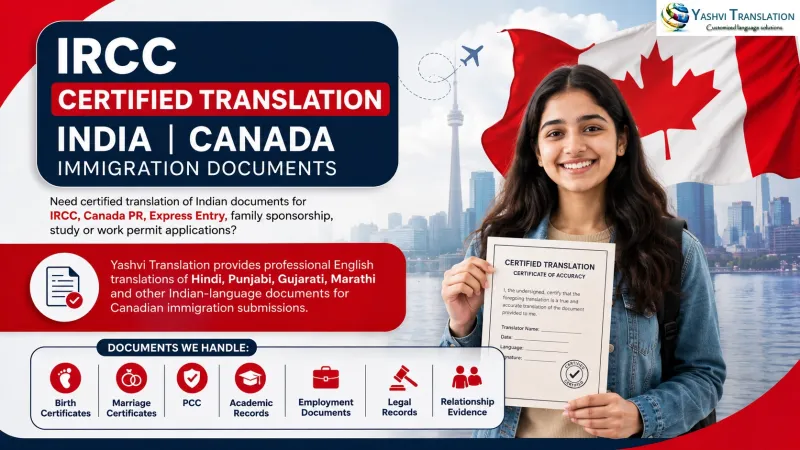
IRCC Certified Translation in India for Canada Immigration
Does IRCC accept translations from India?
For documents not in English or French, the required translation package depends on the IRCC program and the translator’s status. Some IRCC processes accept translations completed by certified translators who are members in good standing of recognized professional translation associations in Canada or abroad. Where the translator does not meet the applicable certified-translator definition, an affidavit may be required. Always follow the checklist for the specific IRCC application.
Need certified translation of Indian documents for IRCC, Canada PR, Express Entry, family sponsorship, study or work permit applications? For applicants preparing family-related documents, our IRCC dependent visa translation in India service can also be relevant.
Yashvi Translation provides professional English translations of Hindi, Punjabi, Gujarati, Marathi and other Indian-language documents for Canadian immigration submissions.
Documents we handle: Birth Certificates • Marriage Certificates • PCC • Academic Records • Employment Documents • Legal Records • Relationship Evidence
[Upload Your IRCC Documents]
[Get a Translation Quote]
What Are IRCC’s Translation Requirements?
Unless IRCC tells you otherwise, supporting documents must be in English or French. IRCC’s current general guidance says a document in another language should be submitted with:
- an English or French translation;
- an affidavit(Certificate) from the person who completed the translation endorsed by the authorized Translation agency.
- a certified photocopy of the original document.
Application-specific checklists may contain additional or differently worded instructions, so applicants should always follow the requirements for their particular immigration program.
Quick Answer: A translation should not be prepared in isolation. The correct IRCC package depends on the document, application category, translator’s status and the applicable IRCC checklist.
IRCC Certified Translation Cost in India
Pricing depends on the document and service requirements. You can also review the Yashvi Translation pricing policy before requesting a quote.

Pricing depends on:
- source language;
- document type;
- number of pages or words;
- legibility;
- formatting;
- certification or affidavit requirement; and
- turnaround time.
Send a scan of your document to receive an exact quotation.
[Get an IRCC Translation Quote]
Turnaround Time
Standard turnaround depends on the language, document type and volume.
Urgent and same-day translation may be available for selected short documents.
For time-sensitive submissions, send your complete document rather than only the first page so the delivery schedule can be assessed accurately.
How Our IRCC Certified Translation Process Works
Step 1 — Upload
Send clear scans or photographs of every relevant page.
Step 2 — Assessment
We review the language, document type, legibility, immigration purpose and required translation format.
Step 3 — Translation
The complete relevant content is professionally translated into English.
Step 4 — Quality Review
Names, dates, numbers, terminology, stamps and completeness are checked against the source.
Step 5 — Certification
The appropriate translator certification and, where requested and applicable, affidavit arrangements are prepared.
Step 6 — Delivery
Receive the completed translation electronically, with physical copies available where required. Our shipping and delivery policy explains the available physical-delivery arrangements.
[Upload Your IRCC Document]
What You Receive
Depending on the required service, your package may include:
- complete English translation;
- translator certification or declaration;
- source-document reference;
- certified PDF; and
- physical copies where requested.
The receiving authority always makes the final decision on document acceptance. Applicants comparing Canadian and U.S. immigration translation requirements can also review our USCIS certified translation page.
What We Need From You
For an accurate quote, send:
- document type;
- source language;
- all pages of the document;
- IRCC application type;
- applicable IRCC instruction/checklist, if available;
- deadline; and
- digital or hard-copy requirement.
Sample


Does IRCC Accept Translations Completed in India?
Understanding IRCC Requirements: Do You Need a Certified Translator or an Affidavit?
Yes, translations can be completed outside Canada, but applicants need to make sure the translation route complies with the instructions applicable to their application.
One of the most common reasons for IRCC application delays is “incomplete translation documentation.” Here is the critical distinction:
- Translations Done in Canada: Must be completed by a member in good standing of a provincial organization of translators (e.g., ATIO, STIBC, OTTIAQ). No affidavit is required.
- Translations Done Outside Canada (India): Since most Indian translators are not members of Canadian provincial bodies, the IRCC requires the translator to provide Affidavit of Translation. This is a document where the translator swears, before a Notary Public, that the translation is a true representation of the original.
Why this matters: A simple “company seal” from a translation agency is often not enough for Canada PR. We provide the full package: Professional Translation + Sworn Affidavit + Notary Authentication.
For an Indian applicant, the important question “Does my translation package meet the instructions for my IRCC application?”
IRCC Certified Translator vs Translator Affidavit
| Route | What to Check |
| Certified translator | Whether the translator’s certification meets the definition used by your IRCC instructions |
| Other qualified translator | Whether an affidavit and certified copy are required |
| Applicant/family translation | Should not be used where prohibited by IRCC |
IRCC’s rules restrict applicants and specified family members, representatives or consultants from acting as the translator in circumstances covered by its certified-translation guidance.
ARE YOU LOOKING FOR MORE SOCIAL PROOF
SEE OUR *5 Star CUSTOMER REVIEWS!!
What Is an IRCC Translation Affidavit?
A translator affidavit is separate from the translation.
It is a sworn statement in which the translator confirms that the translation is a true and accurate representation of the original document best of his knowledge and belief.
IRCC explains that the translator makes this declaration before a commissioner authorized to administer oaths(notary public) in the country where the translator lives.
Does IRCC Require a Notarized Translation?
Not in every situation.
A certified translation, certified copy, translator affidavit and notarization are not the same thing.
Some IRCC checklists specifically discuss notarized/certified translations or affidavits, while IRCC’s general Help Centre currently refers to a translation, translator affidavit and certified photocopy. Follow the checklist that applies to your application rather than assuming that notarization alone is sufficient.
If a separate authority asks for notarisation, see our notarized translation services in India for more information.
Documents We Translate for IRCC
Civil Documents
Birth certificates, marriage certificates, divorce records, death certificates, adoption documents and name-change records.
Police & Legal Documents
Police Clearance Certificates, FIRs, court orders, affidavits, custody records and legal documents.
Academic Documents
Marksheets, degrees, diplomas, transcripts and school or university certificates.
Employment Documents
Experience letters, employment certificates, appointment letters and supporting employment records.
Financial & Property Documents
Bank, tax, income and property-related documents where required for the immigration application.
Relationship Evidence
WhatsApp chats, text messages, emails, letters and social-media conversations submitted as proof of relationship.
For spousal sponsorship, IRCC’s document checklist specifically requires certified English or French translations of proof-of-contact documents that are not already in English or French.


IRCC Translation for Different Canadian Immigration Applications
We assist with documents intended for:
▶️ Express Entry
▶️ Canada Permanent Residence
▶️ Provincial Nominee Programs
▶️ Spousal and Family Sponsorship
▶️ Parents and Grandparents Sponsorship
▶️ Study Permits
▶️ Work Permits
▶️ Visitor Visa / Super Visa
▶️ Citizenship-related applications
For example, IRCC’s current work-permit guidance lists certified translations among supporting documents that may be required when documents are not in English or French. Applicants can also review our Canada work permit translation service for related document-translation requirements.
Always check the document checklist generated for your individual application. For broader visa-document questions, our visa translation FAQ checklist can provide additional guidance.
What Should an IRCC Translation Package Contain?
Depending on the application and translation route, the submission may include:
- Source document
A clear copy of the relevant original-language document. - Complete English or French translation
Including all relevant text, stamps, seals and endorsements. - Translator certification or declaration
Where applicable. - Translator affidavit
Where required. - Certified copy of the source document
Where required by the applicable IRCC instructions.
IRCC also states that stamps and seals not in English or French need to be translated.
My Indian Certificate Is Partly in English. Does It Still Need Translation?
Possibly.
Many Indian documents contain English in the main fields but regional-language content elsewhere.
For example, a certificate may contain:
Main details: English
Municipal stamp: Hindi
Registrar endorsement: Hindi
Reverse-side instructions: Hindi
Do not assume that a document is completely English simply because its major fields are bilingual.
We review the front, reverse, stamps, seals, handwritten entries and endorsements before determining what needs translation.

Real Indian Document Translation Examples
Gujarati Birth Certificate → English
A Gujarati birth certificate translation may include the Gujarat government or municipal authority heading, child’s name, date and place of birth, parents’ names, registration date, registration number, certificate number, issuing authority details and any Gujarati stamps, seals or handwritten endorsements appearing on the document.
Punjabi Marriage Certificate → English
A Punjabi marriage certificate translation may cover the names of both spouses, date and place of marriage, registration particulars, issuing authority, certificate number and relevant declarations. Punjabi seals, stamps, handwritten notes and endorsements are also translated or clearly identified where required.
Hindi Academic Certificate → English
A Hindi academic document translation may include the name of the school, university or board, student details, qualification or course title, subjects, marks or grades, examination year, roll or registration number, result status and any Hindi stamps, seals, notes or reverse-side instructions.
Where document samples are displayed publicly, personal and sensitive information can be anonymized while preserving the document structure and translation format for reference.
Common Applicant Scenarios
Common IRCC Translation Scenarios
Canada PR
A Canada PR applicant may have a Gujarati birth certificate where the main fields are already in English, but the municipal stamp, registrar’s endorsement or reverse-side notes remain in Gujarati. In such cases, the untranslated Gujarati content should be reviewed carefully so that relevant official information is not omitted from the translation package.
Spousal Sponsorship
For spousal or partner sponsorship applications, applicants may submit Punjabi, Hindi or mixed-language WhatsApp chats, text messages, emails or other conversations as relationship evidence. Applicants who need supporting marriage or relationship documents translated can also see our spouse visa translation service. Where the selected communication is not fully in English or French, the relevant portions may need certified translation. Sender names, dates, timestamps and the original sequence of messages should be preserved so the immigration officer can clearly understand the communication timeline.
Work Permit
A Hindi employment or experience certificate submitted with a Canadian work permit application may contain details such as the employee’s name, designation, period of employment, duties, salary, employer information and authorized signatures. Any Hindi text, stamps, seals or handwritten notes appearing on the document should be accurately translated where relevant to the application.
Express Entry / PNP
Applicants applying through Express Entry or a Provincial Nominee Program may need to submit regional-language civil, educational, employment or legal documents as part of their permanent residence application. Documents such as birth certificates, marriage records, employment evidence or supporting declarations should be reviewed against the applicable document checklist, with all relevant non-English or non-French content translated accurately before submission.
Punjabi Certified Translation for Canada
Punjabi documents are frequently submitted with Canada PR, Express Entry, family sponsorship, study permit and work permit applications. Where any part of the document is in Punjabi, the relevant content should be translated accurately into English or French in line with the applicable IRCC requirements.
Common Punjabi documents we translate include:
- birth and marriage certificates;
- educational certificates, marksheets and transcripts;
- police, court and other legal documents;
- property and revenue records;
- affidavits and supporting declarations; and
- Punjabi or mixed Punjabi-English WhatsApp chats, text messages and other relationship evidence.
Our translations carefully reproduce names, dates, registration numbers, official terminology and document details, while also covering relevant Punjabi stamps, seals, handwritten entries and endorsements.
For relationship evidence, we maintain the sender names, dates, timestamps and original sequence of messages so the translated conversation remains clear and easy to follow for the reviewing immigration officer.
Gujarati Translation for Canada PR
Gujarati documents are commonly required for Canada PR, Express Entry, family sponsorship, study permit and work permit applications. If any relevant part of the document is in Gujarati, it should be translated accurately into English or French according to the applicable IRCC requirements.
Common Gujarati documents we translate include:
- birth and marriage certificates;
- school certificates, marksheets and academic records;
- municipal and government-issued documents;
- police, court and other legal records;
- property, land and revenue documents; and
- affidavits, declarations and supporting immigration documents.
Our translations cover the complete relevant content of the document, including names, dates, registration numbers, certificate numbers, official terminology, stamps, seals, handwritten entries, endorsements and reverse-side information.
Where a document contains both Gujarati and English, we carefully identify and translate the remaining Gujarati content so that important information is not overlooked during the immigration submission. For applicants with dependent family members, our dependent visa translation service may also be relevant.
What Exactly Is Translated?
The translation covers all relevant textual content appearing on the document, including headings, printed text, names, dates, document and registration numbers, stamps, seals, handwritten entries, annotations, endorsements and reverse-side information. Non-textual elements are also identified where appropriate using clear descriptions such as [Signature], [Official Seal], [Round Stamp] or [Illegible Handwritten Entry], so that the translated document accurately reflects the content and structure of the original.
Names, Dates and Transliteration on Indian Documents
Indian documents can contain spelling variations when names are transliterated from Hindi, Punjabi, Gujarati or other Indian scripts into English. For example, a name shown as “Gurpreet Singh” in a passport may appear with a slightly different English spelling when transliterated from a regional-language document. Where passport details are provided, we check name spellings for consistency and flag significant differences rather than altering the source information without basis. The same careful review is applied to dates, initials, maiden and married names, parents’ names, document numbers and historical spelling variations so that the translation remains accurate and consistent with the original records.

Why Yashvi Translation for IRCC Documents?
Our service is designed around the practical problems found in Indian documents:
- experience with Indian civil, academic and legal records;
- Hindi, Punjabi, Gujarati and other regional languages;
- complete-document review;
- attention to stamps, seals and reverse pages;
- name, date and document-number checking;
- professional formatting;
- confidentiality;
- digital delivery; and
- hard-copy/courier options where required.
Quick IRCC Translation Decision Guide
Is the entire document already in English or French?
If yes, translation may not be necessary unless IRCC specifically requests it.
Does any relevant content appear in another language?
If yes, assess the document for translation.
Which IRCC program are you applying under?
Check the current program-specific checklist.
Does your translator meet the applicable certified-translator requirement?
If not, determine whether the translation must be accompanied by an affidavit and certified copy.
This approach helps prevent applicants from using the wrong translation package.
Common IRCC Translation Mistakes
Avoid:
- translating only the main paragraph;
- ignoring stamps or handwritten entries;
- forgetting the reverse side;
- submitting an incomplete source document;
- treating notarization and translator certification as identical;
- using an ineligible family member as translator;
- omitting an affidavit where required;
- changing names or dates to make documents match; and
- relying on generic advice instead of the current application checklist.
Certified Translation vs Certified Copy vs Affidavit vs Notarization
| Term | Meaning |
| Translation | English or French rendering of the foreign-language content |
| Certified Translation | Translation certified according to the applicable translator requirements |
| Certified Copy | Copy formally certified as a true copy of the original |
| Translator Affidavit | Sworn declaration confirming the translation’s accuracy |
| Notarization | A notarial act; it is not automatically a substitute for the other requirements |
Understanding these differences can prevent one of the most common problems in IRCC document preparation. Similar certification questions can arise in other immigration systems, including applications requiring certified translation services for UK visa applications.
IRCC Certified Translation Services Across India
Yashvi Translation provides IRCC certified translation services across India for applicants preparing documents for Canada PR, Express Entry, family sponsorship, study permits, work permits and other immigration applications. Clients in Delhi, Mumbai, Bengaluru, Hyderabad, Chennai, Kolkata, Pune, Ahmedabad, Chandigarh, Jaipur, Lucknow, Kochi and other cities can submit documents digitally for review and translation. Applicants with business-related immigration documentation can also explore our business visa translation services. We handle birth certificates, marriage certificates, PCCs, academic records, employment documents, legal records and relationship evidence in Hindi, Punjabi, Gujarati, Marathi, Bengali, Tamil, Telugu and other Indian languages. Completed translations are delivered electronically, with translator certification, affidavit arrangements and physical copies available where required by the applicable IRCC instructions.
Indian Languages We Translate for IRCC
We handle documents in:
Hindi • Punjabi • Gujarati • Marathi • Bengali • Urdu • Tamil • Telugu • Kannada • Malayalam • Odia and other Indian languages
We can also handle documents containing more than one language, such as Hindi-English, Punjabi-English or Gujarati-English records.
Hindi Translation for IRCC
We translate Hindi birth certificates, marriage records, educational certificates, municipal documents, legal records and handwritten endorsements into professional English for Canadian immigration use.
Names, dates, registration numbers and official terminology are checked carefully against the source.
Do I Need an Apostille Before IRCC Translation?
Translation certification and apostille are different processes.
An apostille authenticates the origin of certain public documents for international use, while translation converts the document’s content into the required language.
Do not obtain an apostille simply because a document needs translation. Check whether your particular Canadian immigration process requires any separate authentication.
If an apostille or authentication page forms part of a document submitted to IRCC and contains relevant content outside English or French, that content should also be assessed for translation.
Need an IRCC Certified Translation From India?
Send us:
1. Clear scans of every page
2. Source language
3. IRCC application type
4. Required delivery date
We will review the documents and advise the appropriate translation format for your requirement.
[Upload Your IRCC Documents]
[Request a Quote]
Yashvi Translation
📞 Phone: 099111 95559, 088008 41734, 07411866733
✉️ Email: info@translate-englishto.com | yashvi.tran@gmail.com | info@yashvitranslation.com
🌐 Website: www.translate-englishto.com
Office Hours: Monday–Saturday | 10:00 AM – 6:00 PM
Content Written by: Vikas Chaturvedi
Summary:
For Canadian immigration, IRCC requires literal English or French translations for any non-English documents. Because India does not have a “Canadian Certified Translator” equivalent, translations performed there must be accompanied by a Translator’s Affidavit sworn before a Notary Public. A complete IRCC-compliant package from India typically consists of the professional translation, the sworn affidavit, and a certified photocopy of the original document.
Yashvi Translation specializes in providing these services for regional languages including Hindi, Punjabi, and Gujarati. Their service covers a wide range of documents required for Express Entry, PR, and study permits, such as birth and marriage certificates, PCCs, and academic records. Crucially, they ensure that all elements of a document—including municipal stamps, seals, handwritten endorsements, and reverse-side text—are fully translated, as omitting these details is a frequent cause of application rejection.
To avoid processing delays, the translation process involves professional rendering followed by a quality review of names, dates, and registration numbers. Applicants are prohibited from translating their own documents or using family members, making professional services essential. Yashvi provides the necessary certification and notary arrangements, delivering both digital PDFs and physical copies to ensure the submission meets the specific checklist requirements of the applicant’s immigration program.
Frequently Asked Questions
Translations can be completed outside Canada, but the translator and supporting documents must meet the instructions applicable to the particular IRCC application.
Not every IRCC instruction is worded identically. Check the current guide or checklist for your application before choosing the translation route.
It is an English or French translation prepared and certified according to the translator requirements applicable to the IRCC submission.
It depends on the translator’s status and the instructions for your application. IRCC’s general Help Centre currently includes an affidavit in its requirements for foreign-language supporting documents.
IRCC does not permit applicants to act as their own translator under its certified-translation rules.
Certain family members are excluded from acting as translators under IRCC’s guidance. An independent qualified translator should be used.
Not universally. Certification, notarization, certified copies and affidavits have different functions. Follow the instructions for your specific application.
Yes. IRCC’s glossary states that stamps and seals not in English or French must also be translated.
If relevant Hindi content remains untranslated—for example, a stamp, endorsement or reverse-side note—that content should be reviewed for translation.
Relevant legible handwritten information should normally be translated rather than omitted.
IRCC generally accepts supporting documents in either English or French unless specific instructions state otherwise.
Where chats are submitted as proof of contact and are not already English or French, the IRCC spouse sponsorship checklist requires certified translations.
If required for your application and it contains content outside English or French, it should be translated according to the applicable IRCC instructions.
IRCC may request additional documentation during processing. Applicants should therefore submit complete and accurate documents from the beginning.
Not simply because a translation is required. Apostille/authentication and certified translation are separate requirements.
Turnaround depends on the language, document size and certification requirements. Short documents may qualify for urgent service.
Recent Clients Review


