 Email Id :-
 Mobile: -


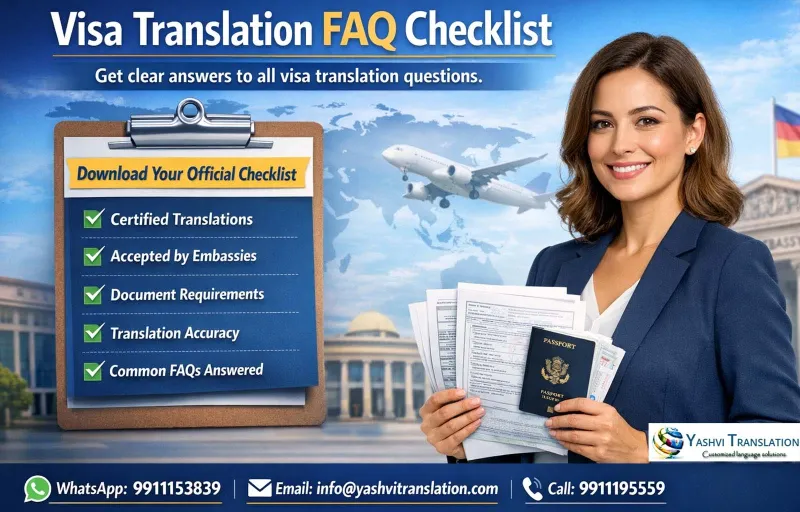
Visa Translation Faq Checklist

Introduction: Why Visa Translation Questions Matter
Visa applications—whether for Schengen, USA, Canada, UK, Australia, or Gulf countries—require documents that are accurate, complete, and translated according to strict embassy guidelines. Applicants often face uncertainty about what needs translation, who can translate, what formats are accepted, and how to avoid delays.
This comprehensive Visa Translation FAQ page answers the most common questions asked by applicants under deadlines. The content is structured to provide clear, reliable, and embassy-compliant guidance, ensuring your translation is accepted the first time.
For trusted, embassy-approved support, rely on Yashvi Translation.
Quick Summary
Visa translation must be done by a certified, sworn, or embassy-approved translator. Translated documents must be complete, accurate, include all seals, and come with a signed translator certification. Documents not in English or the embassy’s official language must be translated for visa applications.
You can also review a detailed Schengen translation service overview for embassy-specific requirements.
| Section No. | Topic | What You’ll Learn |
|---|---|---|
| 1 | Why Correct Translation Is Critical for Schengen Visa Approval | How translation errors cause delays, RFEs, and rejections |
| 2 | Quick Checklist for Schengen Visa Document Translation | A step-by-step summary to avoid common mistakes |
| 3 | Which Documents Need Translation for a Schengen Visa | List of personal, legal, academic, and financial documents |
| 4 | Step-by-Step Checklist: How to Translate Documents | Complete process from embassy rules to final submission |
| 5 | Certified vs Sworn vs Notarized Translation | Differences and embassy acceptance criteria |
| 6 | Embassy & Country-Specific Translation Rules | Germany, France, Spain, Italy, Netherlands requirements |
| 7 | Cost, Timeframe & Delivery Options | Pricing, turnaround time, express services |
| 8 | How to Choose a Trustworthy Translation Provider | Checklist to select an embassy-approved translator |
| 9 | Real Case Example: Visa Saved by Correct Translation | Practical example showing why accuracy matters |
| 10 | Frequently Asked Questions (FAQ) | Clear answers to common Schengen translation queries |
| 11 | Final Review & Submission Tips | How to package documents for embassy submission |
| 12 | Conclusion & Next Steps | How to proceed with certified translations confidently |
1. What Is a Visa Translation?
A visa translation is an official, word-for-word translation of any document required for visa processing. Embassies and consulates only accept translations from:
-
- Certified translators
- Sworn/court-authorized translators (for some countries)
- Notarized translators (if required by embassy)
- Accredited translation agencies
It must include a translator’s declaration, signature, date, and seal.
2. Which Documents Usually Need Translation for Visa Applications?

This varies by country and visa type, but commonly required documents include:
-
-
- Birth certificate
- Marriage certificate / divorce decree
- Police clearance certificate (PCC)
- Educational transcripts and diplomas
- Employment letters and salary slip
- Bank statements
- Address proof documents
- Court orders, affidavits, or legal papers
- Medical certificates
-
Rule: Any document not in English, French, German, Spanish, or the official language of the destination country must be translated.
3. Who Is Allowed to Translate Visa Documents?
The translator must meet embassy requirements. Accepted translators include:
-
-
-
- Certified translators (recognized by a translation association)
- Sworn translators (required by Germany, France, Spain, Italy, etc.)
- Notarized translators (if embassy demands notarized translations)
- Professional translation agencies with legal translation expertise
-
-
Important:
Family members, applicants themselves, and unqualified freelancers cannot translate visa documents.
4. Are Certified Translations Required for All Visa Types?
Most embassies require certified translations for:
| Visa / Application Type | Certified Translation Required | Purpose |
|---|---|---|
| Schengen Visa | Yes | Mandatory for embassy acceptance |
| Student Visa | Yes | Academic and personal document verification |
| Work Permit / Employment Visa | Yes | Employer and authority validation |
| Dependent Visa | Yes | Relationship and identity confirmation |
| Spouse / Marriage Visa | Yes | Legal proof of marital status |
| PR Applications (Canada / US / UK) | Yes | Immigration and background assessment |
| Investor / Business Visa | Yes | Financial and legal compliance |
For family-based cases, professional spouse visa translation services ensure relationship documents are accepted without objections.
5. What Is a Certified Translation?
A certified translation includes:
| Key Benefit | Explanation |
|---|---|
| Accuracy | Word-for-word, complete translation |
| Professional Responsibility | Translator declaration, signature, and seal |
| Embassy Acceptance | Meets consular and immigration standards |
Certified translations are mandatory for employment-based applications such as certified work visa translation.
6. What Is a Sworn Translation?

A sworn translation is prepared by a translator who is authorized by the court or the government of certain countries.
| Country | Official Translation Requirement | Local Term Used |
|---|---|---|
| Germany | Sworn translation required | Beeidigte Übersetzer |
| Spain | Sworn translation required | Traductor Jurado |
| France | Sworn / certified translation required | Traducteur Assermenté |
| Italy | Official / legalized translation required | — |
| Netherlands | Certified translation (sometimes sworn) | Depends on case |
7. What Is the Difference Between Certified, Sworn, and Notarized Translations?
| Type | Definition | When Required |
| Certified | Translator certifies accuracy | Most visa applications |
| Sworn | Court-authorized translator | Germany, France, Spain, Italy |
| Notarized | Translator signature is verified by a notary | If embassy demands |
| Apostille | Authentication of original document | Long-term visas, PR cases |
8. Do I Need to Apostille or Notarize the Translation?
Some embassies require notarization or apostilles on the original document, not the translation.
Common rule:
✅ Apostille: For legal documents used internationally
✅ Notarization: When embassy wants translator identity verification
✅ Sworn translation: Instead of apostille in some Schengen countries
Always check the consulate’s latest guidelines.
9. How Long Does Visa Translation Take?
Typical turnaround times:
✅ Standard: 12–24 hours
✅ Express: 3–6 hours
✅ Urgent Same-Day: 1–3 hours (depends on document clarity)
✅ Bulk legal documents: 24–48 hours
Delays occur when documents are unclear or contain handwritten sections.
10. What Languages Do Visa Translation Services Cover?

| Category | Languages Supported |
|---|---|
| European Languages | English, German, French, Spanish, Italian, Dutch |
| Middle Eastern Languages | Arabic, Turkish |
| East Asian Languages | Chinese, Japanese |
| Eastern European Languages | Russian |
| Indian Languages | Hindi, Punjabi, Gujarati, Marathi, Tamil, Telugu, Kannada, Bengali, Urdu |
Each embassy has specific language requirements.
11. Can I Use Google Translate for Visa Documents?
Absolutely not.
Machine translations are not accepted due to:
➡️ Missing legal wording
➡️ Incorrect names
➡️ Wrong date formats
➡️ Formatting issues
➡️ Incomplete translation of stamps or seals
Using Google Translate often leads to visa delays or RFEs.
12. Can I Translate the Documents Myself?
No.
All embassies reject self-translations. You must use:
➡️ Certified translators
➡️ Sworn translators
➡️ Embassy-approved professionals
13. What Happens if a Translation Has Mistakes?
Even small mistakes can cause:
➡️ Visa delays
➡️ RFI or additional document requests
➡️ Document rejection
➡️ Application resubmission
Common errors include:
➡️ Incorrect spelling of names
➡️ Wrong date formats
➡️ Missing seals/stamps
➡️ Omitted handwritten notes
➡️ Incorrect translation of relationships (father/mother/guardian)
Always proofread translations before submission.
14. Do I Need to Submit the Original Document with the Translation?
In most cases, yes.
Embassies ask for:
🟢 Original document
🟢 Certified translation copy
🟢 Additional notarized copies (if applicable)
Always bring both to the visa appointment.
15. What Format Should the Translated Document Be In?
Most embassies accept:
🟢 Certified PDF copies (email or upload)
🟢 Signed and sealed hard copies (optional but recommended)
The translation must maintain the same format, structure, and spacing as the original.
16. Is There a Difference Between Visa Translation and Immigration Translation?
Yes.
Visa translations (short-term visa) focus on:
🟢 Accuracy
🟢 Embassy acceptance
🟢 Fast turnaround
Immigration translations (PR or long-term residency) may require:
🟢 Apostilles
🟢 Notarized translations
🟢 Sworn translators
🟢 Additional legal requirements
17. How Do I Choose a Reliable Translation Provider?
Use this professional checklist:
-
-
-
-
- Specializes in visa/immigration translations
- Provides certified/sealed translations
- Offers sworn translator services (if applicable)
- Transparent pricing and turnaround times
- Secure file handling
- Proven acceptance record
- Responsive communication
- Positive reviews and credentials
-
-
-
👉 You may also follow a step-by-step translation checklist to avoid mistakes.
18. Real Case Example: Visa Delay Due to Translation Error
Applicant: Rahul, applying for Spain Student Visa
Issue: Translator failed to include a handwritten note on his birth certificate.
Result: Embassy requested retranslation → 18-day delay.
Fix: A sworn translator prepared a correct, complete translation accepted immediately.
Lesson: Missing small details can lead to long delays.
19. Final Guidance: Submit Embassy-Ready Translations the First Time
Visa translation is not simply converting words into another language. It is a legal process where accuracy and compliance determine whether your visa is approved without delays.
To avoid complications:
-
-
-
-
-
- Use certified or sworn translators only
- Follow embassy-specific requirements
- Ensure all stamps, seals, and notes are included
- Check document formatting and spellings carefully
- Never rely on machine translation
-
-
-
-
For study-related cases, professional student visa translation for university admission ensures academic documents meet embassy and university standards.
Last Updated: November 2025
Author: Certified Legal & Immigration Translation Specialist
Content Written by: Vikas Chaturvedi

Recent Clients Review


