 Email Id :-
 Mobile: -


Notarized Translation Services India

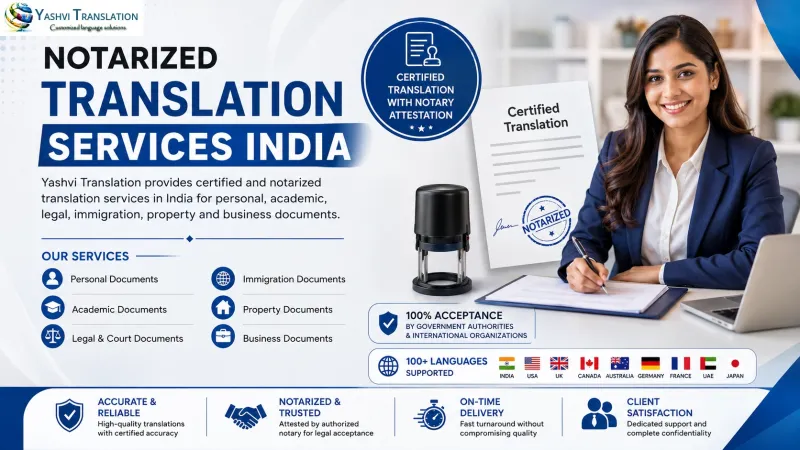
Notarized Translation Services in India
Need a document professionally translated and notarized for official use in India or abroad?
Yashvi Translation provides certified and notarized translation services in India for personal, academic, legal, immigration, property and business documents. We coordinate the translation, quality review, certification and applicable notarial process so that you receive a properly prepared document package based on your stated requirement.
Hindi • Punjabi • Gujarati • Marathi • Bengali • Tamil • Telugu • Urdu • French • German • Spanish + More
Translation → Quality Review → Certification → Notarization → Delivery
[Upload Your Document]
[Check Whether You Need Notarization]
Do You Actually Need a Notarized Translation?
Not every translated document needs to be notarized.
Whether notarization is required depends on the receiving authority, destination country, document type and purpose of submission. Some organizations ask only for a certified translation, while others may specifically request a notarized translation, translator affidavit, sworn translation, apostille or another form of authentication.
Before paying for an additional service, check the exact wording of the requirement.
| If the Authority Requests | You May Need |
| Certified translation | Professionally translated and certified document |
| Certified and notarized translation | Translation + certification + applicable notarization |
| Translator Certificate | Translation + translator declaration |
| Sworn translation | Translation by an appropriately authorized sworn translator |
| Apostilled document | Separate apostille/authentication assessment |
Important: Notarization should be added because the receiving authority requires or expects it—not simply because the document will be used abroad.
For common questions about translation requirements for visa and immigration documents, see our visa translation FAQ checklist.
What Is a Notarized Translation?
A notarized translation generally consists of a translated document accompanied by an appropriate translator declaration, certification or affidavit that undergoes the required notarial process.
Translation and notarization perform different functions.
The translator is responsible for accurately rendering the source document into the target language best of his belief . The notarial act relates to the relevant declaration, signature, oath, verification or document presented within the chosen process.
This is why notarization should not be treated as a substitute for professional translation.
What Can a Notary Do With a Translation in India?
Under India’s notarial framework, a notary may perform a range of functions that can be relevant to translated documents, including administering oaths, taking affidavits, authenticating or attesting certain instruments and, within the scope permitted by law, translating or verifying translations.
A valid notarial act is performed with the notary’s appropriate signature and official seal.
The exact procedure used for your translation should depend on what the receiving organization actually requires.
What Exactly Is Being Notarized?
This is one of the most misunderstood parts of notarized translation.
Depending on the requirement, the notarial process may relate to:
Translator Declaration
The translator a declaration confirming responsibility for the translation confirmed by the authorized official of your translation company.
Translator Affidavit
The translator makes a statement regarding competence and the accuracy of the translation as best of his belief.
Signature Verification
The notary performs the relevant act concerning the signature or execution of the declaration.
Translation Verification
Where legally and appropriately undertaken, a notary may perform functions relating to verification of a translated document.
Because different authorities use different terminology, the required format should be identified before notarization is completed.
How Much Does Notarized Translation Cost in India?
| Cost Factor | What Affects the Price |
| Language Pair | Source and target language |
| Document Size | Number of pages or words |
| Document Type | Civil, academic, legal, corporate, etc. |
| Complexity | Formatting, stamps, seals, handwritten content |
| Certification | Translation certification and notarization required |
| Delivery | Urgency, physical copies and courier requirements |
A one-page birth certificate and a twenty-page legal agreement should not be priced using the same assumptions.
For an accurate quotation, send a clear scan of the complete document.
For pricing information, see the Yashvi Translation pricing policy.
[Get a Notarized Translation Quote]
Our Notarized Translation Process

Step 1 — Upload Your Document
Send clear scans or photographs of every relevant page, including the reverse side where content appears.
Step 2 — Requirement Check
Tell us the destination country, receiving authority, intended use and deadline. If you have written instructions from the authority, send those as well.
Step 3 — Professional Translation
A translator competent in the relevant language pair prepares the translation.
Step 4 — Quality Review
We check names, dates, numbers, terminology, completeness, stamps and document references against the source.
Step 5 — Certification and Notarial Process
The appropriate translator certification, declaration or affidavit is prepared and the applicable notarial process is coordinated according to the agreed requirement.
Step 6 — Delivery
Receive the completed translation electronically, with hard copies and courier delivery available where required.
For physical copies and courier arrangements, see our shipping and delivery policy.
[Upload Your Document]
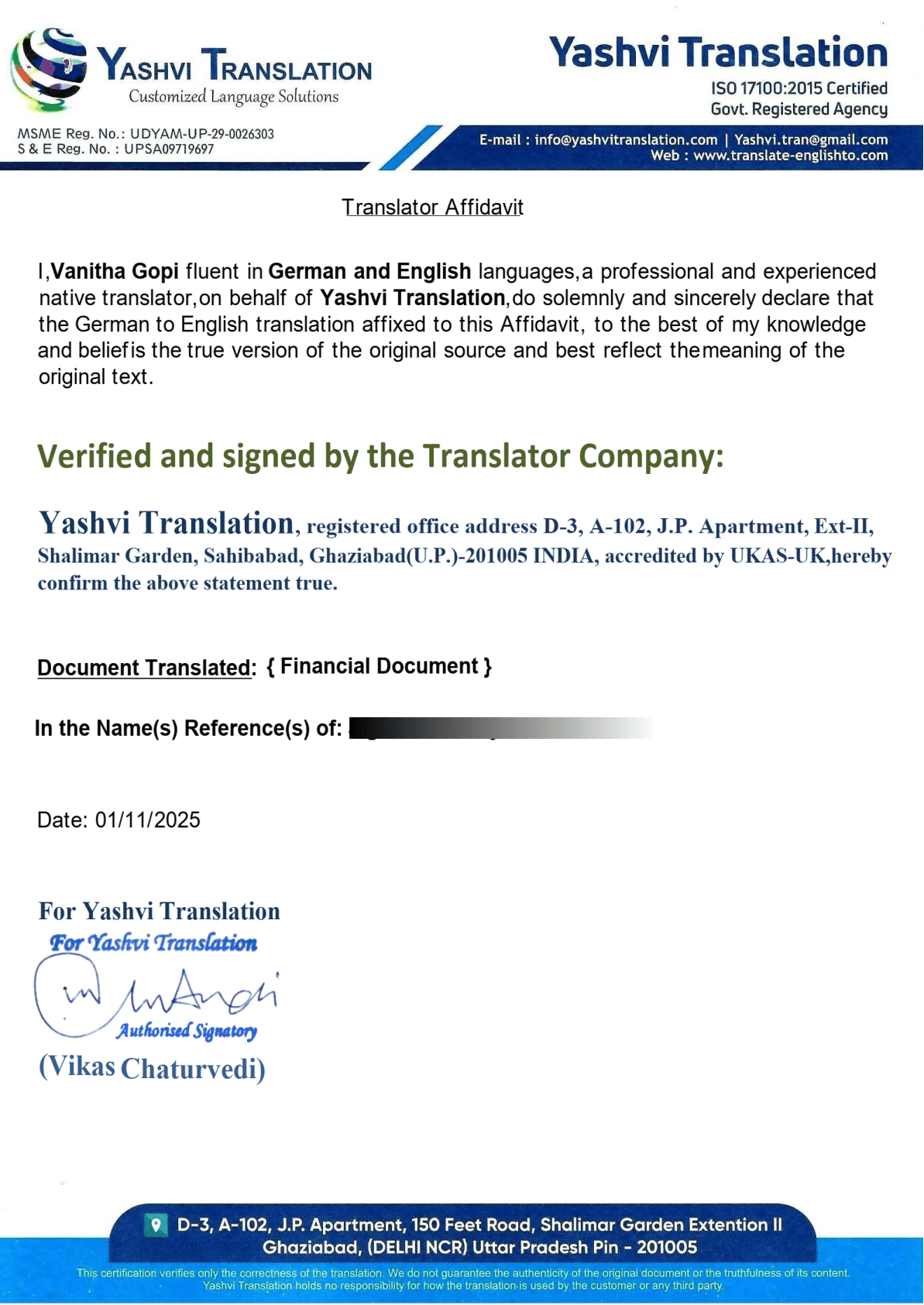
Sample



Certified vs Notarized vs Sworn vs Apostilled Translation
These services are often confused, but they are not interchangeable.
| Service | Main Purpose |
| Certified Translation | Confirms the translation’s accuracy and completeness through an appropriate translator/provider certification |
| Notarized Translation | Adds an applicable notarial act to the relevant translation certification, declaration or affidavit |
| Sworn Translation | Prepared by a translator officially authorized under the relevant country’s legal system |
| Apostille | Authenticates the origin of qualifying public documents for use between Hague Apostille Convention countries |
| Embassy Legalization | Additional diplomatic or consular authentication where applicable |
A document may require one of these services, several of them, or none beyond a standard certified translation.
One process does not automatically replace another.
ARE YOU LOOKING FOR MORE SOCIAL PROOF
SEE OUR *5 Star CUSTOMER REVIEWS!!

Documents We Provide Notarized Translation For
| Document Category | Documents We Translate | Important Considerations |
| Personal & Civil Documents | Birth certificates; marriage certificates; divorce documents; death certificates; adoption records; name-change documents; other civil-status certificates | Civil records may contain regional-language stamps, seals, handwritten entries, registration details and endorsements that also require careful translation. |
| Academic & Educational Documents | Degree certificates; diplomas; marksheets; transcripts; school certificates; migration certificates; university records; academic declarations | Requirements vary by university, credential evaluator and professional body. A receiving institution may require a certified translation, officially certified copy, sworn translation or another specified format. For example, uni-assist accepts translations from persons or institutions authorised to translate under oath or whose translations are admissible in court. |
| Legal Documents | Affidavits; declarations; powers of attorney; agreements; court orders; judgments; petitions; inheritance documents; other legal records | Legal translations require particular care with names, dates, clauses, defined terms and legal terminology. Notarization does not make an inaccurate or incomplete translation correct; translation quality must come first. |
| Property Documents | Sale deeds; conveyance deeds; title documents; land and revenue records; property agreements; inheritance records; ownership-related declarations | Property records often contain registration particulars, official stamps, seals, schedules, handwritten endorsements and complex formatting, all of which should be reviewed before translation. |
| Employment Documents | Experience certificates; appointment letters; employment agreements; service certificates; salary-related records; employer declarations | Notarization should be added where the receiving authority specifically requires or accepts it, rather than being treated as a universal requirement. USCIS, for example, generally requires a complete English translation with the translator’s certification of accuracy, completeness and competence—not a general notarization requirement. |
| Corporate & Commercial Documents | Certificates of incorporation; board resolutions; partnership documents; contracts; commercial agreements; company registrations; corporate declarations; other company records | Documents intended for use abroad may separately require apostille or attestation/legalization, depending on the destination country and document type. India’s MEA distinguishes Apostille for Hague Convention countries from normal attestation for countries where Apostille is not applicable. |
| Financial Documents | Bank records; financial statements; tax-related documents; income records; financial declarations; supporting financial evidence | The appropriate form of translation certification or notarization depends on the bank, authority, embassy, court, university or other institution requesting the records. |
Important: A notarized translation is not automatically required for every foreign-language document. The correct format depends on the receiving authority, country and purpose of submission. Before ordering notarization, check whether the authority requires a certified translation, notarized translation, sworn translation, certified copy, apostille or legalization.
Why Choose Yashvi Translation?
Yashvi Translation combines professional translation with practical document-preparation support for clients using Indian documents in India and overseas.
Our service includes:
- experience with Indian civil, academic, legal and property documents;
- support for major Indian and international languages;
- translation, certification and notarial coordination;
- careful handling of legal and official terminology;
- name, date and document-number quality checks;
- translation of relevant stamps, seals and reverse-side information;
- confidentiality;
- digital document assessment;
- hard-copy and courier options; and
- apostille or attestation coordination where separately required.
Our objective is not to add unnecessary formalities, but to prepare the translation in the format appropriate for the stated requirement.
You can learn more about our team through meet our translators and review our certification and accreditation information.


When Is a Notarized Translation Commonly Requested?
Notarized translations may be requested for official or legal procedures involving:
- affidavits and declarations;
- powers of attorney;
- court and litigation documents;
- property and inheritance records;
- overseas civil-registration matters;
- certain visa or consular submissions;
- academic or professional recognition;
- employment-related documentation;
- company and commercial documents; and
- other authority-specific applications.
The requirement is determined by the institution receiving the document, not simply by the fact that it has been translated.
Before Ordering: Check These 5 Things
Before requesting a notarized translation, identify:
- Destination Country
Where will the document be used? - Receiving Authority
Is it going to a court, embassy, university, immigration authority, employer or other institution? - Document Type
Birth certificate, degree, affidavit, court order, agreement, property record, etc. - Purpose
Immigration, education, employment, legal proceedings, overseas registration or another official use. - Exact Requirement
Check whether the instructions specifically say:
🔹certified translation;
🔹notarized translation;
🔹translator affidavit;
🔹sworn translation;
🔹legalized translation; or
🔹apostilled document.
A short requirement check at the beginning can prevent the wrong service from being ordered.

What Does a Notarized Translation Package Contain?
The final package depends on the requirement, but it may include:
✅ Source Document
▶️ A clear copy of the original-language document.
✅ Complete Translation
▶️ Translation of all relevant textual content.
✅ Translator Certification or Declaration
▶️ The applicable statement regarding the translation.
✅ Notarial Endorsement
▶️ Signature, seal and other required notarial particulars.
✅ Translator Affidavit
▶️ Where specifically required.
✅ Supporting Copies
▶️ Source-document copies or additional sets where applicable.
The purpose is to create a package in which the original document, translation and certification can be clearly connected.

When Is Notarization NOT Required?
A notarized translation is not automatically more acceptable than a certified translation.
If the authority requires only a certified translation, unnecessary notarization may add extra cost, processing time and paperwork without improving acceptance.
USCIS Example
USCIS is an important example of why applicants should verify the actual rule instead of automatically ordering notarization.
The basic USCIS requirement for a foreign-language document is a full English translation accompanied by the translator’s certification that the translation is complete and accurate and that the translator is competent to translate the foreign language into English.
There is no general USCIS rule requiring every translation to be notarized.
Therefore:
Certified translation required ≠ notarization automatically required.
Applicants should follow the specific instructions of the authority handling their case.
Notarized Birth Certificate Translation
Birth certificates are among the most commonly translated civil documents.
A complete translation may include:
🔹child’s name; 🔹date and place of birth; 🔹parents’ names; 🔹registration date; 🔹registration number; 🔹certificate number; 🔹issuing authority; 🔹official stamps and seals; 🔹handwritten endorsements; and 🔹reverse-side information.
Indian birth certificates are often bilingual. For example, the main fields may appear in English while the municipal stamp or registrar’s note remains in Hindi, Gujarati, Punjabi or another regional language.
We review the entire document, not only the main English fields.
Notarization is added where required by the receiving organization.
[Get a Birth Certificate Translation Quote]
Notarized Marriage Certificate Translation
Marriage certificate translations may be required for immigration, family registration, visa, legal or overseas administrative procedures.
The translation can include:
✅ names of both spouses; ✅ date and place of marriage; ✅ registration particulars; ✅ certificate number; ✅ issuing authority; ✅ addresses where relevant; ✅ official stamps and seals; ✅ registrar endorsements; and ✅ handwritten information.
We handle marriage certificates issued in Hindi, Punjabi, Gujarati, Marathi, Bengali, Tamil, Telugu, Urdu and other languages.
If notarization is required, the appropriate notarial process can be coordinated with the completed translation package.
Notarized Translation of Legal Documents
Legal documents require more than word-for-word replacement.
A professional legal translation should preserve the meaning and structure of the source while accurately handling:
▶️ party names; ▶️ legal designations; ▶️ clauses; ▶️ dates; ▶️ monetary figures; ▶️ property descriptions; ▶️ case or registration numbers; ▶️ signatures; ▶️ stamps; and ▶️ endorsements.
Where a declaration or affidavit accompanies the translation, the relevant notarial process can then be completed according to the stated requirement.
Accuracy comes first; notarization comes afterward.
Notarized Academic Document Translation
Students and professionals may be asked to provide translated academic documents for overseas universities, credential assessment, licensing, employment or immigration.
Common documents include:
➡️ Class X and XII certificates; ➡️ marksheets; ➡️ bachelor’s and master’s degrees; ➡️ diplomas; ➡️ transcripts; ➡️ provisional certificates; and ➡️ university-issued records.
We carefully reproduce qualification names, subjects, marks, grades, dates, registration numbers and institutional information.
Where the authority asks only for a certified translation, notarization should not be added unnecessarily.
For employment-related documents, a work visa translation service may be relevant when translated supporting records are required.
For overseas education and immigration applications, applicants may also need a student visa translation service depending on the destination country and institution.
Notarized Translation for Visa and Immigration Documents
Immigration and visa authorities around the world follow different translation rules.
Documents commonly translated include:
✔ birth and marriage certificates; ✔ police records; ✔ employment documents; ✔ academic records; ✔ affidavits; ✔ financial evidence; and ✔ relationship documents. ✔
However, a USCIS translation requirement is different from an IRCC requirement, and both differ from sworn-translation requirements in countries such as Germany or Spain.
We therefore recommend checking the destination country’s exact instructions before selecting a notarized translation.
Related guidance:
👉 USCIS Certified Translation
👉 IRCC Certified Translation
👉 German Sworn Translation
👉 Spanish Sworn Translation
Notarized Translation for Use Abroad
A notarized translation does not necessarily complete the entire international-document process.
Depending on the destination country and authority, you may separately need:
🔹apostille; 🔹MEA authentication; 🔹embassy or consular legalization; 🔹sworn translator certification; or 🔹authority-specific verification.
For example, an overseas authority may require the original public document to be apostilled, followed by translation, while another procedure may apply a different sequence.
The correct order should be confirmed before beginning multiple legalization steps.
[Check Apostille & Legalization Requirements]
Online Notarized Translation Services in India
You do not necessarily need to visit a translation office simply to begin the process.
Documents can usually be sent electronically for:
▶️ assessment;
▶️ quotation;
▶️ translation;
▶️ quality review; and
▶️ preparation of the required certification.
Where physical originals, signatures, or hard-copy notarial paperwork are needed, these can be coordinated according to the specific requirement.
This allows us to assist clients across India without requiring them to be physically located near our main office.
Urgent and Same-Day Notarized Translation
Urgent processing may be available for selected documents.
Availability depends on:
🔹language combination;
🔹document length;
🔹translator availability;
🔹complexity;
🔹certification requirement;
🔹required notarial procedure; and
🔹whether original documents are needed.
Short civil documents may sometimes be processed quickly, while lengthy legal or technical material requires adequate review time.
Send the complete document when requesting urgent service so that the actual scope can be assessed.

Common Mistakes With Notarized Translation
Avoid these common problems:
- Ordering notarization when only certification is required.
- Assuming a notarized translation is accepted everywhere.
- Confusing notarization with apostille.
- Using a standard translation where a sworn translator is specifically required.
- Translating only the front page of a document.
- Ignoring stamps, seals or handwritten entries.
- Changing official names or dates to make documents appear consistent.
- Ordering translation before reading the receiving authority’s instructions.
- Assuming all embassies and immigration authorities use the same translation rules.
- Completing apostille, translation or notarization in the wrong sequence.
A short requirement check before starting can prevent most of these problems.
Notarized Translation Near Me
If you searched for “notarized translation near me,” first determine whether you actually need to visit a local office.
For many document types, the workflow can begin remotely:
Upload Document → Requirement Assessment → Translation → Certification → Notarization → Courier
We assist clients in Delhi NCR, Mumbai, Bengaluru, Hyderabad, Chennai, Kolkata, Pune, Ahmedabad, Chandigarh, Jaipur, Indore and other Indian cities, with remote assessment and delivery options.
Where an original physical document is legally or procedurally required, we will identify that before proceeding.
Languages We Handle
We provide translation services for major Indian and international languages, including:
Hindi → English
Punjabi → English
Gujarati → English
Marathi → English
Bengali → English
Tamil → English
Telugu → English
Kannada → English
Malayalam → English
Urdu → English
We also support major international languages such as French, German, Spanish, Italian, Portuguese, Russian, Arabic, Chinese, Japanese and Korean, subject to the required certification route.
Bilingual and Partly English Documents
| Document | Example |
| Birth Certificate | English details + Hindi municipal stamp |
| Marriage Certificate | English fields + Punjabi registration endorsement |
| Marksheet | English academic details + Gujarati or Marathi seal |
| Legal Document | English text + regional-language handwritten endorsement |
Important: A partly English document may still require translation of relevant stamps, seals, annotations, handwritten entries, and reverse-side content.
What Notarization Does—and Does Not—Prove
Understanding the limitations of notarization is important. Depending on the procedure, notarization may establish or verify a signature, declaration, affidavit, oath, verification, or other notarial act performed by the notary. It does not, by itself, confirm the accuracy of the underlying translation.
Notarization Does Not Automatically Prove:
Notarization does not automatically guarantee that every authority will accept the document, eliminate the need for an apostille or legalization, satisfy a sworn-translator requirement, or make an inaccurate translation valid. Requirements can differ by country, authority and purpose of submission, so the receiving authority’s specific instructions should always be followed.
Notarized Translation Services Across India
Yashvi Translation provides professional notarized translation services across India, assisting clients in Delhi, Mumbai, Bengaluru, Hyderabad, Chennai, Kolkata, Pune, Ahmedabad, Chandigarh, Jaipur, Lucknow, Kochi and other locations nationwide. Documents can be shared online from anywhere in India for review, translation, certification and applicable notarization coordination. We handle birth certificates, marriage certificates, academic records, affidavits, legal documents, employment records, property papers and other official documents in Hindi, Punjabi, Gujarati, Marathi, Tamil, Telugu, Bengali and other Indian languages. Completed translations can be delivered digitally, with hard copies and nationwide courier delivery available where required.
Need a Document Translated and Notarized?
Send us:
1. Clear scans of all relevant pages
2. Source and target language
3. Destination country
4. Receiving authority
5. Purpose and deadline
We will review the requirement and help determine whether you need a certified translation, notarized translation, translator affidavit, sworn translation or another document-authentication route.
[Upload Your Document]
[Request a Quote]
[Check Whether Notarization Is Required]
Yashvi Translation
📞 Phone:099111 95559, 09911153839, 07411866733
✉️ Email: info@translate-englishto.com | yashvi.tran@gmail.com | info@yashvitranslation.com
🌐 Website: www.translate-englishto.com
Summary
A certified translation confirms accuracy via a translator’s statement, while a notarized translation adds a legal act (signature verification or affidavit) by a notary public. It distinguishes these from sworn translations (performed by authorized officials in specific countries) and apostilles (authentication for Hague Convention countries). Crucially, notarization validates the identity or declaration of the translator rather than the linguistic accuracy of the text itself.
Notarized translations are typically required for official legal, academic, and immigration procedures, such as birth/marriage certificates, power of attorney, and degree transcripts. However, the text warns that notarization is not always mandatory; for example, USCIS generally accepts certified translations without notarization. Users are advised to verify requirements with the receiving authority (embassy, university, or court) to avoid unnecessary costs and paperwork. Key factors include the destination country, document type, and specific submission purpose.
Yashvi Translation offers a six-step workflow: document upload, requirement assessment, translation, quality review, certification/notarization, and delivery. They support major Indian languages (Hindi, Punjabi, Gujarati, etc.) and international languages (French, German, Spanish). The final package includes the source document, the translation, a translator’s declaration, and the notary’s seal. Services are available online across India, including Delhi, Mumbai, and Bengaluru, with options for digital copies or hard-copy courier delivery.
Frequently Asked Questions
A notarized translation generally combines a professional translation with an applicable declaration, certification or affidavit that undergoes the required notarial process.
A duly authorized notary can perform notarial functions permitted under Indian law. The exact act required depends on the translation and the receiving authority’s instructions.
No. A certified translation contains an appropriate certification regarding the translation, while notarization adds a separate notarial act where required.
Only where the receiving authority requires both. If it asks only for certified translation, notarization may be unnecessary.
No. Immigration and visa authorities have different rules. Always follow the requirements of the specific country and application.
USCIS generally requires a complete English translation with the translator’s certification regarding accuracy and competence. Its basic translation rule does not impose a general notarization requirement on every translation.
It depends on where the birth certificate will be submitted. Some authorities require only certified translation, while others may request notarization or another form of authentication.
Not automatically. Check the requirements of the embassy, immigration authority, court or other organization receiving the translated certificate.
The translation and assessment can usually begin electronically. Physical signatures, originals or hard-copy notarization can then be coordinated where the procedure requires them.
Indian notarial law includes functions relating to translation and verification of translations. The appropriate practical route should nevertheless be selected according to the receiving authority’s specific requirements.
The notarial act may relate to a declaration, affidavit, signature, verification or other matter depending on the process being used. It should not automatically be interpreted as a guarantee that every word of any translation is correct.
No. Notarization and apostille are separate processes. Apostille authenticates qualifying public documents for international use under the applicable Hague Convention framework.
Potentially, but the destination authority decides whether notarization alone is sufficient or whether certified, sworn, apostilled or legalized documents are required.
Pricing depends on the language, document type, length, complexity, required certification, notarial process and turnaround time. Send the complete document for an exact quote.
Turnaround varies by document and language. Urgent service may be available for selected short documents, while complex legal or lengthy documents require additional review time.
Recent Clients Review


