 Email Id :-
 Mobile: -


UK VISA Translation Services

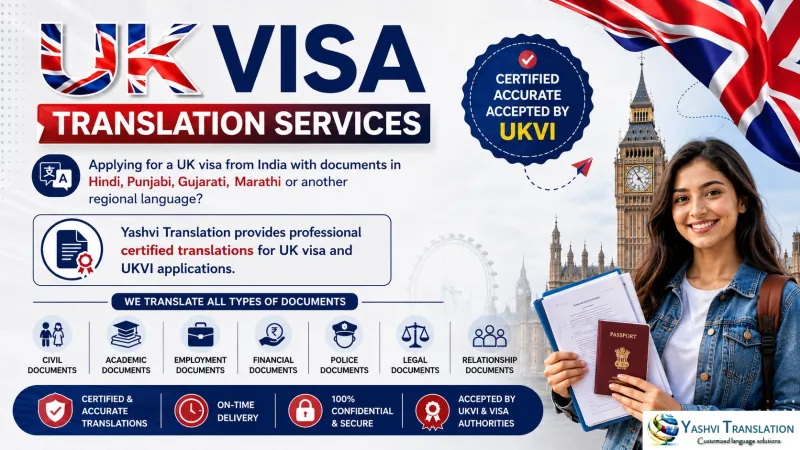
UK Visa Certified Translation in India
Applying for a UK visa from India with documents in Hindi, Punjabi, Gujarati, Marathi or another regional language?
Yashvi Translation provides professional certified translations for UK visa and UKVI applications, including civil, academic, employment, financial, police, legal and relationship documents.
We prepare translations with the information needed for independent verification, including the appropriate accuracy statement, translation date, translator or translation-company details, signature and contact information.
Hindi • Punjabi • Gujarati • Marathi • Bengali • Tamil • Telugu • Urdu + Other Languages
Spouse Visa • Skilled Worker • Student • Visitor • Family Visa • Settlement & Other UK Immigration Routes
[Upload Your UK Visa Documents]
[Get a Certified Translation Quote]
What Are the Certified Translation Requirements for a UK Visa?
Documents submitted for a UK visa that are not in English or Welsh generally need a certified translation.
Current GOV.UK guidance for visitors states that a foreign-language document must be accompanied by a full translation that can be independently verified by the Home Office. The translation must contain confirmation that it is accurate, the translation date, the translator’s full name and and contact details.
Current Home Office caseworker guidance for routes such as Skilled Worker additionally describes a fully certified translation from a professional translator or translation company that can be independently verified.
A UK Visa Certified Translation Should Include
- confirmation that it is an accurate translation of the source document;
- date of translation;
- translator’s or authorized translation-company official’s full name;
- signature;
- translator or translation company’s contact details; and
- appropriate professional or company identification/credentials where applicable.
The translation should be complete, not a summary of selected information.
For broader questions about visa-document translation requirements, you can also review our visa translation FAQ checklist.
Can a UK Visa Translation Be Completed in India?
Yes. The important issue is whether the translation meets the applicable Home Office requirements and can be independently verified—not simply whether the translator is physically located in the UK.
For applicants using Indian documents, this means a professional India-based translation provider can prepare the English translation provided the completed certification follows the applicable requirements.
This is particularly useful for documents issued by:
➡️ municipal corporations;
➡️ gram panchayats;
➡️ state education boards;
➡️ Indian universities;
➡️ marriage registrars;
➡️ police authorities;
➡️ courts;
➡️ revenue departments; and
➡️ other Indian government bodies.
What matters to UKVI is the quality, completeness, certification and verifiability of the translation—not an unsupported label such as “UKVI approved translator.”
Our UK Visa Certified Translation Process

- Upload Documents — Send clear scans/photos of all pages, including stamps and endorsements.
- Assessment — We check the language, document type, legibility and UK visa purpose.
- Translation — A competent translator prepares the English translation.
- Quality Check — Names, dates, numbers, figures, terminology and completeness are verified.
- Certification — The translation includes the required accuracy declaration, date, signature and contact details.
- Delivery — Receive the certified translation electronically, with physical copies available on request.
[Upload Your UK Visa Document]
UK Visa Certified Translation Cost in India
The cost of certified translation depends on:
🔹source language;
🔹document type;
🔹number of pages or words;
🔹legibility;
🔹handwritten content;
🔹formatting complexity;
🔹certification requirements;
🔹turnaround time; and
🔹hard-copy/courier requirements.
A short birth certificate and a lengthy legal or financial document should not be priced using the same assumptions.
Send the complete document for an exact quote.
For more information about pricing and service charges, see the Yashvi Translation pricing policy.
[Get Your UKVI Translation Quote]
What You Receive
Depending on the document and agreed service, your completed package may include:
- full English translation;
- certificate or statement of translation accuracy;
- translator or authorized company representative details;
- signature and date;
- contact information;
- company stamp/seal where applicable;
- certified PDF; and
- physical copy/courier service where requested.
The Home Office makes the final decision on evidence and the visa application itself.
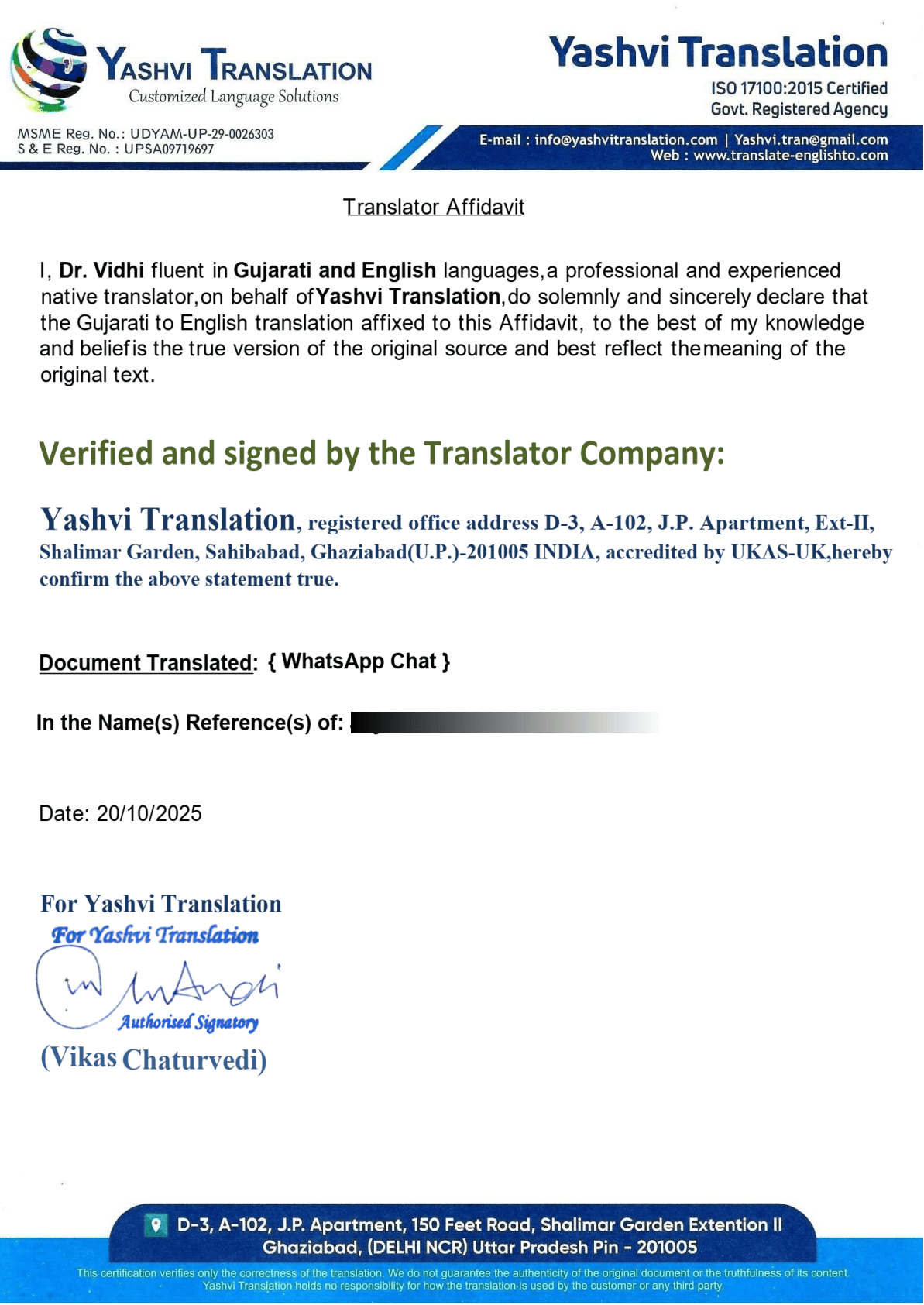
Sample


Is There Such a Thing as a “UKVI-Approved Translator”?
Applicants often search for a “UKVI approved translator in India”, but this terminology can be misleading.
Current Home Office guidance focuses on a translation prepared by a professional translator or translation company that can be independently verified and on the information that must accompany the translation.
Rather than choosing a provider simply because it advertises itself as “UKVI approved,” check whether the completed translation contains the required certification and verification information.
Does a UK Visa Certified Translation Need to Be Notarized?
Not automatically.
The standard UKVI translation requirements discussed in current GOV.UK guidance focus on a certified, accurate and independently verifiable translation; they do not create a general requirement that every UK visa translation must also be notarized.
Notarization should therefore not be added merely because the document will be submitted overseas.
For documents where notarization is specifically requested by another authority, you can review our notarized translation services in India for information about the distinction between certification and notarization.
| Requirement | What It Means |
| Certified Translation | Translation accompanied by appropriate accuracy and translator details |
| Notarized Translation | Additional notarial process where specifically required |
| Certified Copy | Certification that a copy corresponds to an original |
| Apostille | Separate authentication process for qualifying public documents |
| Sworn Translation | Translation under a country-specific sworn-translator system |
If another authority involved in your case specifically requests notarization, apostille or legalization, that should be assessed separately.
ARE YOU LOOKING FOR MORE SOCIAL PROOF
SEE OUR *5 Star CUSTOMER REVIEWS!!

Does My Indian Document Actually Need Translation?
For UK visa applications, GOV.UK states that documents not in English or Welsh must be accompanied by a certified translation. For partly English or bilingual documents, any relevant non-English content should therefore be reviewed and translated where necessary.
| Document | Example of Mixed-Language Content | Translation Review |
| Birth Certificate | English details + Hindi municipal stamp | Translate relevant Hindi content |
| Marriage Certificate | English fields + Punjabi registrar endorsement | Translate Punjabi endorsement |
| Marksheet | English academic details + Gujarati university seal | Translate relevant Gujarati text |
| Legal Document | English main text + Hindi handwritten annotation | Translate relevant Hindi annotation |
Key Point: A document should not automatically be treated as fully English merely because most of its printed content is in English. Relevant stamps, seals, endorsements, annotations and handwritten text in another language should also be checked. UK guidance requires a full translation of material submitted in a language other than English or Welsh.
What Exactly Do We Translate?
A UK visa translation should accurately represent the relevant content of the complete source document. This may include headings, printed text, names, dates, registration and certificate numbers, official designations, stamps, seals, handwritten entries, annotations, endorsements and reverse-side information.
Non-textual elements can also be appropriately identified, for example [Signature], [Official Seal], [Round Stamp] or [Illegible Handwritten Entry], allowing the translated document to correspond clearly with its source.
What Does a UKVI Certificate of Translation Include?
A professionally prepared translation should make it easy for a Home Office caseworker to identify:
What was translated
The source document and language should be clearly identifiable.
Who prepared or certified it
The translator or responsible translation-company official should be named.
Whether it is accurate
The certification should confirm the translation accurately represents the source document.
When it was completed
The translation should be dated.
How the translator/Translation agency can be contacted
Contact details should allow independent verification available online.
For example, GOV.UK’s general certification guidance asks a translator/translator Agency to confirm in writing that the translation is a true and accurate translation of the original, together with the date, translator’s full name and contact details.


Certified Translation for Different UK Visa Routes
UK Spouse and Family Visa Certified Translation
Family visa applicants may need to provide marriage, birth, divorce, financial, accommodation or relationship documents.
GOV.UK currently states that a certified translation must be provided for any family-visa document that is not in English or Welsh.
Common Indian documents include:
- Punjabi or Hindi marriage certificates;
- Gujarati birth certificates;
- divorce documents;
- family or civil records;
- financial documents; and
- supporting relationship evidence.
Applicants can also review our dedicated spouse visa translation service for additional information about documents commonly used in spouse and family visa applications.
Where foreign-language messages or other communications are selected as relationship evidence, the translation should preserve enough context for the material to remain understandable.
Why Choose Yashvi Translation for UK Visa Documents?
Our UK visa translation service is designed around the practical issues commonly found in Indian documentation:
- experience with Indian civil, academic, employment and legal documents;
- Hindi, Punjabi, Gujarati and other regional-language capability;
- UK visa-focused certification format;
- complete-document translation rather than selective summaries;
- review of stamps, seals, handwriting and reverse sides;
- passport-name and date consistency checks;
- professional quality review;
- confidential document handling;
- certified digital delivery; and
- hard-copy/courier options where required.
Our role is to prepare an accurate and appropriately certified translation—not to make unrealistic claims about guaranteeing the outcome of a visa application.
To understand more about our professional team, see meet our translators.
You can also review our certification and accreditation information.


Documents We Translate for UK Visa Applications
| Document Type | Common Information / Documents Covered | Key Translation Consideration |
| Birth Certificates | Applicant’s name, date/place of birth, parents’ details, registration date/number, certificate number, issuing authority, stamps, seals and handwritten endorsements | Indian birth certificates may contain regional-language municipal stamps, registrar notes or endorsements even when the main document is bilingual. |
| Marriage Certificates | Names of both spouses, date/place of marriage, registration details, issuing authority, certificate number, relevant addresses, stamps, seals and registrar endorsements | Punjabi, Hindi, Gujarati and other Indian marriage records should be checked on all pages for untranslated regional-language content. |
| Police & Court Documents | Police Clearance Certificates, police reports, court orders, judgments, divorce decrees, custody documents, affidavits and other legal records | Names, dates, case numbers, statutory references and official terminology should be translated accurately rather than summarized. |
| Academic Documents | Degrees, diplomas, marksheets, transcripts, school certificates, university records and academic declarations | Documents not in English or Welsh may require a fully certified translation, depending on the UK visa route and applicable Home Office requirements. |
| Employment & Financial Documents | Experience certificates, employment/appointment letters, payslips, bank statements, salary records, financial declarations and supporting business documents | Particular care should be taken with numbers, currencies, employment dates, job titles and employer details. |
Skilled Worker Visa Certified Translation
A Skilled Worker applicant may need translations of police records, qualifications, employment-related evidence, relationship documents for dependants or other supporting material.
GOV.UK confirms that where documents are not in English or Welsh, a certified translation is required.
Current caseworker guidance says translations should be produced by a professional translator or translation company, be independently verifiable and contain the required accuracy confirmation, date, name/signature and contact details.
For applicants preparing employment-related immigration documents, our work visa translation service provides another relevant resource.
UK Student Visa Certified Translation
Indian students may need translation of academic or supporting documents that are not in English or Welsh, including school records, parental documents, financial evidence or relationship documents where relevant.
Student and Child Student caseworker guidance states that a foreign-language document must have a fully certified translation from a professional translator or translation company that can be independently verified by the Home Office.
One important distinction: translating an Indian qualification into English does not itself establish its UK academic equivalence. Academic equivalency assessments are a separate matter.
For students preparing their visa documentation, see our student visa translation service.
Standard Visitor Visa Translation
For UK Standard Visitor applications, supporting evidence may include financial, employment, family, medical, business or educational documents.
Current GOV.UK visitor guidance says a document not in English or Welsh must be accompanied by a full translation that can be independently verified by the Home Office.
This makes completeness particularly important: relevant content should not be selectively omitted simply because it appears on a stamp or handwritten note.
India Young Professionals Scheme
Indian applicants under the India Young Professionals Scheme may need evidence of qualifications, financial resources and a police report or clearance certificate.
GOV.UK states that documents not in English or Welsh also require certified translation.
This can be particularly relevant where police, university or supporting records contain regional-language material.
WhatsApp and Relationship Evidence for a UK Spouse Visa
Applicants sometimes submit selected WhatsApp chats, text messages, emails or letters to support the history of a relationship.
Where the selected evidence contains Hindi, Punjabi, Urdu or another language, translation should preserve the information necessary to understand the conversation, such as:
- sender identification;
- dates;
- timestamps;
- message sequence;
- relevant message text; and
- contextual labels where necessary.
The aim is not simply to translate isolated sentences but to keep the selected evidence understandable as a coherent record.
Common UK Visa Translation Mistakes
Avoid these problems before uploading documents to your UK visa application:
- Submitting a non-English/Welsh document without certified translation.
- Using only a machine-generated or informal translation.
- Translating only selected paragraphs instead of the full relevant document.
- Leaving stamps, seals or handwritten information unexplained.
- Missing the reverse side of a certificate.
- Using inconsistent English spellings for names without review.
- Providing a translation without identifiable translator/company details.
- Omitting the date or required accuracy confirmation.
- Paying for notarization when the visa requirement only asks for certified translation.
- Assuming that translation of a qualification also proves UK academic equivalence.
Home Office caseworker guidance warns that where an acceptable translation cannot be provided or independently verified, the underlying document may not be accepted as evidence.

Names, Dates and Transliteration on Indian Documents
Transliterating names from Hindi, Punjabi, Gujarati, Bengali or other Indian scripts can produce more than one reasonable English spelling.
For example, the English spelling shown in a passport may differ slightly from the spelling produced directly from a regional-language certificate.
Where passport details are provided, we use them as an important consistency reference while remaining faithful to the source document. Significant differences can be flagged instead of silently changing information.
The same review is applied to:
- applicant and spouse names;
- parents’ names;
- maiden and married names;
- initials;
- dates of birth;
- marriage dates;
- registration numbers;
- certificate numbers; and
- historical spelling variations.
Indian Languages for UK Visa Translation
We translate documents from major Indian languages into English, including:
Hindi • Punjabi • Gujarati • Marathi • Bengali • Urdu • Tamil • Telugu • Kannada • Malayalam • Odia and other regional languages
Mixed-language documents can also be handled, including:
Hindi + English
Punjabi + English
Gujarati + English
Marathi + English
Only the presence of some English text should not be used as a reason to overlook material remaining in another language.
For applicants dealing with other international-language documents, we also provide French visa translation service and other language-specific translation support where relevant.
Hindi Certified Translation for UK Visa
Hindi documents used for UK immigration may include birth and marriage certificates, police and court records, employment certificates, academic documents and government-issued records.
The translation should cover relevant Hindi text wherever it appears, including municipal stamps, handwritten endorsements and reverse-side notes.
Punjabi Certified Translation for UK Visa
Punjabi documents are particularly common in UK spouse, family, visitor and work visa applications.
We translate Punjabi birth and marriage certificates, educational records, property or legal documents, police records, declarations and selected relationship evidence.
Care is taken with Gurmukhi-to-English transliteration, names, village and district details, registration numbers and official endorsements so that the English translation remains consistent with the source.
Gujarati Certified Translation for UK Visa
Gujarati civil, municipal, academic, legal and property documents may contain a mixture of English and Gujarati.
A Gujarati birth certificate, for example, may display the main personal data in English but retain Gujarati seals or registrar information. We assess the complete document and translate relevant content rather than treating a partly bilingual certificate as fully English.
Online UK Visa Certified Translation From India
You can usually arrange the translation without visiting a translation office.
The process can begin online:
Upload → Assessment → Quote → Translation → Certification → PDF Delivery
Applicants can send documents from Delhi NCR, Punjab, Gujarat, Maharashtra, Karnataka, Telangana, Tamil Nadu, West Bengal and other locations across India, as well as from abroad where they hold Indian-language documents.
Physical copies can be arranged separately when needed.
For information about physical document delivery and courier options, see the shipping and delivery policy.
Urgent and Same-Day UK Visa Translation
Urgent translation may be available for selected documents depending on language, length, complexity and translator availability.
Short documents such as birth or marriage certificates may be suitable for accelerated processing, while multi-page legal, financial or handwritten records need sufficient quality-review time.
If you have a biometrics appointment or document-upload deadline, provide the complete document and deadline when requesting the quotation.
Serving Major Cities Across India
Our services are available for clients in major cities and regions, including:
Delhi • Mumbai • Pune • Punjab • Bengaluru • Hyderabad • Chennai • Ahmedabad • Surat • Vadodara • Jaipur • Kolkata • Chandigarh • Lucknow • Kanpur • Nagpur • Indore • Bhopal • Kochi • Coimbatore • Patna • Bhubaneswar • Guwahati • Noida • Gurugram • Ghaziabad • Faridabad and other cities across India.
Need Certified Translation for Your UK Visa?
Send us:
- Clear scans of every relevant page
- Source language
- UK visa category
- Required delivery date
We will assess the documents and prepare the appropriate English certified translation for your stated UK visa requirement.
Yashvi Translation Details
📞 Phone: 099111 95559, 09911153839, 07411866733
✉️ Email: info@translate-englishto.com | yashvi.tran@gmail.com | info@yashvitranslation.com
🌐 Website: www.translate-englishto.com
Office Hours: Monday–Saturday | 10:00 AM – 6:00 PM
[Upload Your Documents]
[Get a UK Visa Translation Quote]
Summary:
For Indian applicants targeting a UK visa, a certified translation is a non-negotiable requirement for any document not originally in English or Welsh. To satisfy UKVI (UK Visas and Immigration) standards, the translation must be a full, accurate representation of the original, accompanied by a signed statement of accuracy, the translator’s credentials, and contact details for independent verification. This process is the primary defense against Administrative Refusal, a common issue where visa applications are delayed or rejected simply because supporting evidence like birth certificates or bank statements lacked the professional certification required by current Home Office caseworker guidance.
Navigating Indian documentation presents unique challenges, as many certificates are partially bilingual but contain regional-language stamps, seals, or handwritten notes in Hindi, Punjabi, or Gujarati that are often overlooked. A professional UK visa translation service ensures that every element—from municipal registrar endorsements to complex property deeds—is fully translated into English, maintaining consistency with passport name spellings to avoid identity discrepancies. By choosing a provider experienced with Indian civil and academic records, applicants ensure that their documentation is not just translated, but engineered to be ready for review, satisfying the Home Office’s strict requirements for completeness and linguistic clarity.
It is a critical misconception that applicants can translate their own documents or that a translation must be notarized to be valid for UKVI; in reality, the Home Office requires an independent professional translator or agency that can be reached for verification. To capture the best results for your application, focus on verifiability over misleading labels like UKVI-approved, ensuring your translation package includes the date, the translator’s identity, and a clear link between the source and the target text. By following this verified path, you solve the problem of document compliance, move through the India Young Professionals Scheme or Skilled Worker routes faster, and provide the reliable evidence necessary for a successful UK visa outcome.”
Frequently Asked Questions
Documents not in English or Welsh generally require certified translation when submitted as supporting evidence for UK visa applications.
The current Home Office requirements focus on professional, complete and independently verifiable translations rather than requiring every translator to be physically based in the UK. The translation must meet the requirements applicable to the visa route.
Current Home Office caseworker guidance refers to a professional translator or translation company whose translation can be independently verified.
For UKVI purposes, use an independent professional translator or translation company that can provide the required certification and verification details rather than relying on self-translation.
The core official requirements focus on accuracy confirmation, date, identity/signature and contact information. A translation-company stamp may be included as part of the certification format, but applicants should distinguish company presentation from the specific information UKVI requires.
There is no general requirement in the standard UKVI translation guidance that every certified translation must also be notarized. Additional notarization should be obtained when specifically required for the relevant purpose.
Relevant foreign-language information appearing in stamps, seals and endorsements should be included or appropriately represented so the translation is full and understandable.
If all relevant content is already in English or Welsh, translation may not be necessary. If Hindi, Punjabi, Gujarati or other important text remains untranslated, the document should be assessed.
If the marriage certificate or relevant content is not in English or Welsh, a certified translation is needed as part of the family-visa evidence.
If the certificate is required as evidence and contains relevant information outside English or Welsh, it should be accompanied by the appropriate certified translation.
If foreign-language bank statements are submitted as supporting evidence, relevant content should be provided in the required certified translation format.
Where a required police or criminal-record certificate is not in English or Welsh, certified translation is required. GOV.UK specifically identifies criminal-record certificates as potentially required supporting evidence for certain Skilled Worker applicants.
UK visa applications increasingly involve digital document submission, but applicants should follow the upload and evidence instructions provided for their particular application. We can provide a certified PDF, with physical copies available when required.
Not simply because translation is required. Apostille and certified translation are separate processes. Obtain an apostille only where the relevant document procedure specifically requires it.
Turnaround depends on the language, document volume and complexity. Urgent service may be available for selected short documents.
Recent Clients Review


