 Email Id :-
 Mobile: -


German Certified Translation

German Certified Translation in India for Official Use in Germany
Get your academic, personal, legal or professional documents translated by an appropriately authorised German translator.
Yashvi Translation helps applicants across India obtain German certified translations, also known as German sworn translations or beglaubigte Übersetzungen, for submission to universities, uni-assist, ZAB, recognition authorities, registry offices, courts and other German institutions.
We review your documents, confirm the intended use, coordinate with German court-sworn translators and arrange digital or paper delivery.
German Court-Sworn Translators | Pan-India Service | Digital and Paper Delivery
Upload Your Documents for a Quote
Important: Do Not Order the Wrong Translation
Golden Rule
An Indian notarised certified translation may be sufficient for APS India and certain German visa applications. However, it may not meet the requirements of uni-assist, ZAB, a German university, recognition authority, Standesamt or court.
When an institution asks for a certified German translation, sworn translation or beglaubigte Übersetzung, confirm whether it requires the stamp of a German court-authorised translator.
There is no single translation format accepted automatically by every German authority. The correct option depends on where the document is being submitted.
What Is a German Certified Translation?
In the German context, a certified translation is commonly called a beglaubigte Übersetzung.
It is prepared and certified by a translator who is officially authorised, sworn or publicly appointed to translate documents for official use. The completed translation normally carries the translator’s certification statement, signature and official stamp.
German federal states use different professional titles, but applicants do not need to understand every title. The important point is that the translator must hold the required official authorisation for the relevant language pair.
Germany’s official translator database lists translators who are authorised, appointed or sworn under the rules of the German federal states.
For documents where an officially certified or sworn translation is required, applicants can also learn more about our official sworn translation services.
Certified and Sworn Mean the Same Thing Here
On this page, the following expressions refer to the same service when a German-authorised translator is required:
- German certified translation
- German sworn translation
- Beglaubigte Übersetzung
- Court-certified German translation
- Official German document translation
- German court-sworn translator
German Certified Translation Cost
| Pricing factor | Why it matters |
| Language pair | Translator availability differs by language |
| Length and word count | Text density varies between documents |
| Certification requirement | Official translator certification affects pricing |
| Stamps and handwriting | Additional review may be required |
| Formatting complexity | Tables and mirrored layouts take additional work |
| Number of paper sets | Each certified original may carry an additional charge |
| Delivery method | Domestic or international courier costs vary |
| Urgency | Express completion depends on translator availability |
For an accurate quotation, upload every page of the document and mention the receiving authority.
For information about quotations and service charges, you can also review the Yashvi Translation pricing policy.
Request an Exact Quote!!
Our Translation Process

1. Upload the Complete Document
Send clear scans of every page, including reverse sides, stamps and attachments.
2. Tell Us Where It Will Be Submitted
Identify APS, uni-assist, ZAB, a university, visa section, Standesamt, court or recognition authority.
3. We Check the Translation Route
We help determine whether you need:
- No translation
- Notarised English translation
- Certified English translation
- German court-sworn translation
4. Receive the Quotation
The quotation confirms the document, language pair, certification type and delivery format.
5. Confirm Names and Details
We verify passport spelling, dates, registration numbers and preferred transliteration.
6. Translation and Certification
The translation is prepared and officially certified where required.
7. Quality Check and Delivery
The complete package is checked before secure digital or paper delivery.
What Your German Certified Translation Includes
Depending on the document, the translation may cover:
- Printed text
- Headings and tables
- Names and dates
- Reference numbers
- Stamps and seals
- Signatures
- Handwritten entries
- Reverse-side text
- Notarial endorsements
- Existing apostille wording
- Amendments and annotations
Where German court certification is ordered, the translation may also include:
- Translator’s certification statement
- Official signature
- Translator’s stamp or seal
- Official designation
- Language-pair details
- Date and place of certification
- Copy or reference to the source document
Sample


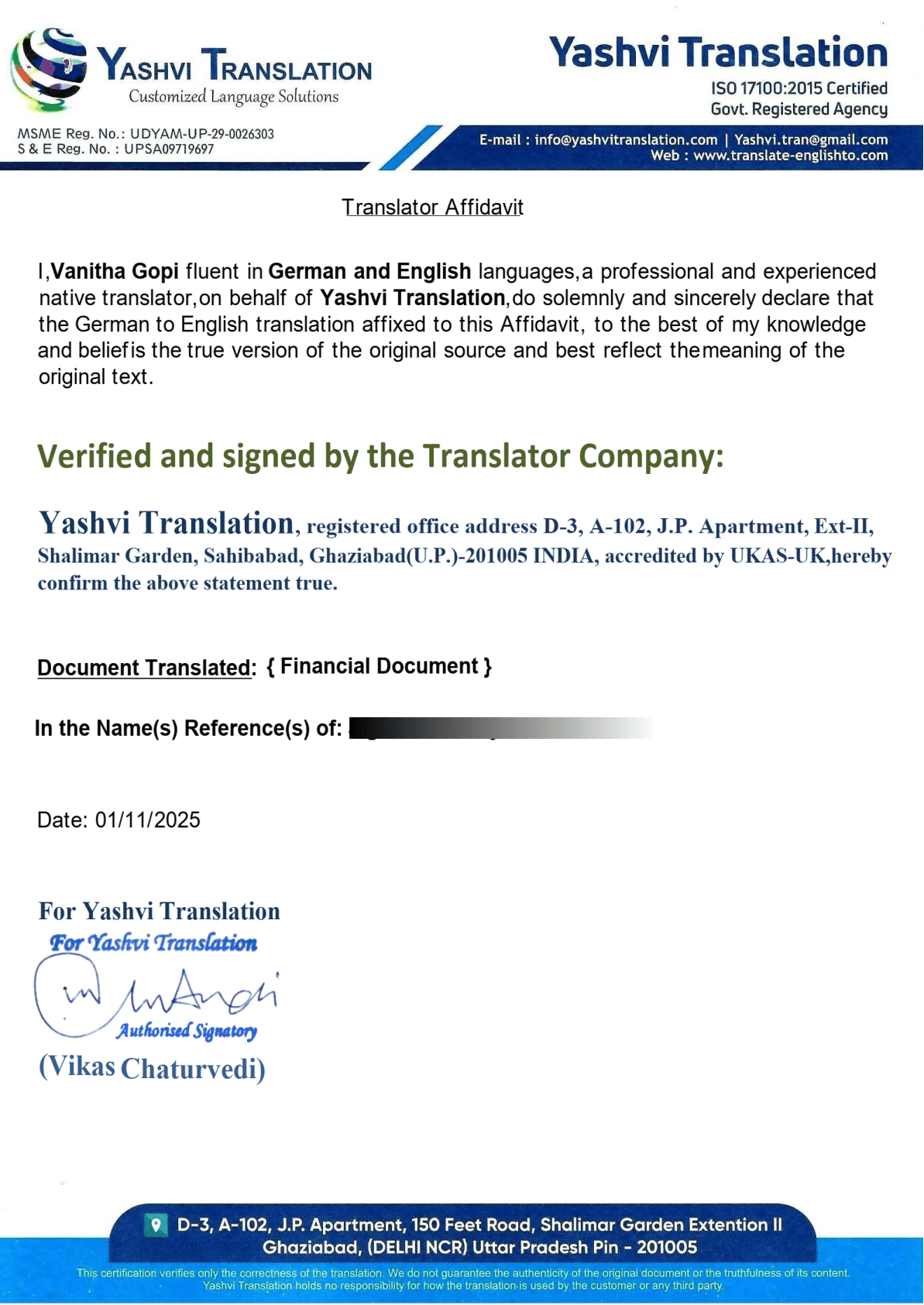
Indian Notarised Certified Translation vs German Sworn Translation
An Indian notarised translation is not automatically the same as a German sworn translation.
With an Indian notarised Certified translation, a notary normally confirms the translator’s signature or declaration. The notary does not independently verify the translator’s German court authorisation.
A German sworn translation is certified by a translator who holds official authorisation to certify translations for the relevant language pair.
Which Translation Should You Choose?
| Translation option | Where it may work | Important limitation |
| Standard agency translation | Personal, business or informational use | Usually unsuitable where official certification is requested |
| Indian notarised Certified English translation | APS India and certain German visa procedures | May not satisfy uni-assist, ZAB or an authority in Germany |
| German court-sworn translation | Universities, uni-assist, recognition, civil and legal procedures where official certification is requested | Final acceptance remains with the receiving institution |
If you are unsure which certification route is appropriate for your document, you can also review our certified translation service for official documents.
No translation provider can guarantee acceptance without checking the receiving authority’s requirements.
ARE YOU LOOKING FOR MORE SOCIAL PROOF
SEE OUR *5 Star CUSTOMER REVIEWS!!

German Translation for Students
APS India Translation Requirements
APS India (Akademische Prüfstelle) is the compulsory document verification body for Indian students who want to pursue higher education (Bachelor’s, Master’s, or PhD) in Germany
For many Indian students, APS verification is an early step in the German admission process.
Documents Already in English
Academic documents issued in English generally do not require translation or notarisation for APS India.
Bilingual certificates that already contain English and an Indian regional language also generally do not need a separate translation.
Documents in Hindi or Another Regional Language
When an academic document is issued only in Hindi, Punjabi, Marathi, Gujarati, Bengali, Tamil, Telugu or another Indian regional language, APS India requires a notarised Certified English translation.
APS India’s current guidance states that regional-language-only documents must be accompanied by notarised English translations.
Applicants preparing documents specifically for APS can also review our APS India document translation service.
Does APS Require a German Court-Sworn Translation?
Usually, no.
A notarised English translation prepared in India may be sufficient for APS when the original academic document is not in English.
However, an APS-compliant translation may not automatically satisfy the next institution handling your documents.
APS acceptance does not guarantee acceptance by uni-assist, a German university, ZAB or a professional-recognition authority.
Before ordering the translation, consider whether the same document will also be used after APS. In some cases, obtaining a German sworn translation at the beginning can avoid a second translation later.
Why Choose Yashvi Translation?
German document requirements can be confusing because APS, visa authorities, universities and recognition bodies may apply different rules.
Yashvi Translation helps you choose the correct route before translation begins.
Our service includes:
- Review of the complete document
- Confirmation of the receiving authority
- Guidance on Indian notarised versus German sworn translation
- Coordination with German court-sworn translators
- Verification of names, dates and document numbers
- Translation of stamps, seals and handwritten entries
- Digital and certified paper delivery
- Pan-India courier coordination
Where German court certification is required, the certification is issued by the individual authorised translator. Yashvi Translation manages the assessment, coordination, quality check and delivery.


Translation for Direct University Admission
German universities can set their own document rules.
One university may accept:
- Documents already issued in English
- A certified English translation
- An authorised university-issued translation
Another may request:
- A German translation
- A German court-sworn translation
- Certified copies of the original documents
- Paper originals after online submission
Applicants submitting documents through uni-assist can also review our uni-assist certified translation service.
Check both:
- The university’s international admission instructions
- The requirements of the specific course or application portal
Do not rely only on the visa checklist because university and visa requirements are separate.
Document Consistency Check
Small differences in names and dates can cause delays even when the translation itself is correct.
Before translation, check:
- Full name and order of names
- Maiden and married names
- Passport spelling
- Date and place of birth
- Parents’ names
- Registration numbers
- Degree and university names
- Transliteration of Indian names
- Document issue dates
Translation cannot correct an error in the original document. Where possible, discrepancies should be resolved before submission.

Legal, Notarial and Corporate Documents
We coordinate official German translation of:
- Powers of attorney
- Court judgments
- Affidavits and declarations
- Contracts
- Wills and inheritance documents
- Property deeds
- Incorporation certificates
- Memorandum and articles of association
- Board resolutions
- Commercial-register documents
- Financial statements
- Patent and trademark records
For broader guidance on official legal documents, see our legal translation services.
When a German lawyer, court or notary is involved, obtain the required wording and signing instructions before the source document is executed.
A translation cannot correct a power of attorney, affidavit or resolution that was signed in the wrong legal form.
For documents involving legal or immigration procedures, applicants can also review our certified translation for legal and immigration documents.

Contract and Agreement Translation
Contracts and agreements may require certified translation when they are being submitted to a German authority, court, notary, business partner or other institution.
Depending on the receiving authority, applicants may need certified translations of:
- Commercial contracts
- Employment agreements
- Business agreements
- Settlement agreements
- Purchase agreements
- Service agreements
- Partnership agreements
- Other legally binding documents
Where a German institution requires a formally translated agreement, our contract and agreement translation service may be relevant.
Certified Lease Agreement Translation
Property and rental documents may also require certified translation when submitted to German authorities, landlords, courts, notaries, banks or other institutions.
Where a lease agreement needs formal translation, applicants can review our certified lease agreement translation service.
German Translation for Visa and Immigration
German visa applications do not always require German court-sworn translations.
Many German visa procedures accept documents in German or English. When a document is in another language, the relevant checklist may permit a proper or notarised English translation.
Applicants should always verify the current requirements for their specific visa category and consular jurisdiction.
For applicants specifically preparing documents for German immigration procedures, our German visa translation service provides further information about document translation requirements.
For example, current German mission guidance for several procedures requires documents not issued in German or English to be accompanied by an English or German translation. Certain family-reunion checklists specifically request a notary-attested English translation.
Visa and Residence Routes We Support
| Visa or Residence Route | Typical Purpose |
| Opportunity Card | Job search and skilled-employment opportunities in Germany |
| EU Blue Card | Employment for highly qualified professionals |
| Skilled-Worker Visa | Employment based on recognised academic or vocational qualifications |
| Employment Visa | Work with a German employer |
| Ausbildung Visa | Vocational training in Germany |
| Student Visa | University admission and higher education |
| Research Visa | Academic, scientific, or institutional research |
| Self-Employment Visa | Freelance, professional, or business activities |
| Family Reunion Visa | Joining a spouse, parent, child, or eligible family member |
| Residence-Permit Applications | Initial applications, extensions, renewals, or changes of residence status |
German Translation for ZAB
In Germany, ZAB is the central authority responsible for assessing foreign educational qualifications. If you are a professional or student looking to work or study in Germany, you often need a ZAB Statement of Comparability (Zeugnisbewertung) to officially prove how your university degree equates to the German education system
ZAB issues services such as the Statement of Comparability for foreign university qualifications and assessments relating to foreign vocational qualifications.ZAB does not require the same translation package in every case.
Applicants should complete the ZAB Pre-Check, which generates a personalised document checklist and confirms whether translations are needed.
Important ZAB Rule
A translation does not replace the original-language document.
Applicants may need to submit:
- The document in its original language
- A translation, where requested
- Additional records listed in the Pre-Check
ZAB confirms that its assessment is based on original-language documents and that translations may be requested only as additional documents.
Documents Commonly Submitted to ZAB
🔹Degree certificate 🔹Diploma 🔹Transcript 🔹Mark sheets 🔹Diploma supplement 🔹Vocational qualification 🔹Training certificate 🔹Name-change record 🔹Supporting academic documents
Do not order a translation solely because you are applying to ZAB. Complete the current Pre-Check first.
Documents Commonly Translated for Opportunity Card Applications
| Document | Translation Relevance |
| Degree Certificates | Evidence of academic qualifications |
| Diplomas | Proof of completed higher or professional education |
| Vocational Qualifications | Evidence of technical or vocational training |
| Experience Certificates | Confirmation of professional experience |
| Birth Certificates | Personal-status and identity documentation |
| Aadhaar or Personal-Status Documents | Supporting identity or civil-status information |
| Employment Records | Evidence of work history, duties, salary, or professional background |
Important note: The current Opportunity Card checklist for applicants in India may require English translations of certain personal-status documents. Applicants may also be asked to carry the original documents when attending their visa appointment.
Translation for uni-assist
uni-assist is the centralized portal used by over 180 German public universities to process and evaluate international student applications.
uni-assist requires applicants to submit academic documents in their original language.
When the original document is not in German or English, it must normally be accompanied by a translation into German or English.
uni-assist accepts translations prepared by:
- A person or institution authorised to translate under oath(Sworn Translator)
- A translator whose work is admissible in court
- An authorised translation department of the institution that issued the document, where applicable
It does not accept an ordinary uncertified translation merely because it was produced by a translation agency.
Common Documents for uni-assist
🔹Degree certificate 🔹Provisional degree 🔹Diploma 🔹Academic transcript 🔹Semester mark sheets 🔹Consolidated mark sheet 🔹School-leaving certificate 🔹Course or subject overview 🔹Diploma supplement 🔹Name-change document
Is an Indian Notarised Translation Accepted by uni-assist?
Do not assume that notarisation alone is sufficient.
The translation must meet uni-assist’s certification standards. Applicants should also check the country-specific information and the requirements of the selected university.
A German court-sworn translation is often the clearer option where uni-assist or the university specifically asks for a court-certified or sworn translation.
ZAB vs. uni-assist Comparison
| Feature | ZAB (Central Office for Foreign Education) | uni-assist |
| Primary Target | Job seekers and working professionals. | International students applying to university. |
| What it Issues | A Statement of Comparability (Zeugnisbewertung) for employment visas. | A Preliminary Review Document (VPD) or direct application forwarding. |
| How to Apply | You apply independently on the ZAB portal. | You apply through the My assist online platform. |
| Pricing | €208 for a standard statement. | €75 for the first application; €30 for each additional course. |
| Translation Requirement | English and French are exempt. If documents are in any other language, you must upload a certified translation alongside the original language documents. | English is exempt. If documents are in any other language, you must upload a certified translation alongside the original. |
| Translation Format | Accepts high-quality digital scans of the certified translations uploaded directly to their online portal. | Many universities require you to send the physical hard copy of the certified translation to Berlin by post. |

Standesamt Requirements
A German registry office, known as a Standesamt, may ask for a German court-sworn translation.
However, requirements can differ between registry offices and German federal states.
Before translation, ask the responsible Standesamt to confirm:
- Whether German translation is required
- Whether the translator must be authorised in Germany
- Whether paper originals are required
- Whether certified copies are needed
- Whether the document will undergo authenticity verification
Do Indian Documents Need Apostille for Germany?
For Other German Authorities
Do not assume that the visa rule automatically covers every German procedure.
Courts, registry offices, universities and recognition authorities may request:
- Certified copies
- A German sworn translation
- Authority-initiated document verification
- Additional authenticity evidence
Ask the receiving institution before obtaining apostille, attestation or legalisation services.
For a detailed explanation of the correct document sequence, see our guide on apostille before sworn translation.


Do Visa Documents Need German Translation?
Not always.
Use this simple rule:
- Document in German: No translation normally required
- Document in English: Often accepted without translation
- Document in an Indian regional language: Check whether a notarised Certified English translation or German translation is requested
- Document also intended for a German authority after arrival: Consider whether a German court-sworn translation will be needed later
Always follow the checklist for the exact visa category.
German Translation for Professional Recognition
Doctors, nurses, engineers, teachers, skilled workers and other professionals may need their foreign qualifications formally recognised in Germany.
The responsible recognition authority decides:
- Which documents must be translated
- Whether German translation is required
- Whether the translator must be authorised in Germany
- Whether a translation prepared outside Germany is accepted
- Whether certified copies are also required
Germany’s official recognition portal states that German translations are frequently required and should be prepared by publicly appointed or authorised translators. It also warns that some authorities do not accept translations prepared by translators appointed abroad.

Recognition Documents We Translate
| Document Type | Typical Purpose |
| Degree and Diploma Certificates | Academic or professional qualification recognition |
| Professional Licences | Verification of eligibility to practise a regulated profession |
| Registration Certificates | Confirmation of registration with a professional body |
| Certificates of Good Standing | Evidence of current professional status and disciplinary standing |
| Employment and Experience Certificates | Verification of professional experience, roles, and responsibilities |
| Internship or Clinical Records | Evidence of supervised practical or clinical training |
| Training Curricula | Assessment of course content, subjects, and training duration |
| Mark Sheets and Transcripts | Verification of academic subjects, grades, credits, and study periods |
| Medical and Nursing Records | Recognition of healthcare education, clinical experience, or professional competence |
| Continuing Professional-Development Certificates | Evidence of additional training, skills development, and professional learning |
Important: Confirm the responsible recognition authority and its translation requirements before ordering the final translation.
Birth, Marriage and Family Document Translation
| Purpose | When a German Certified Translation May Be Required |
| Family Reunion | To prove relationships between spouses, parents, children, or other eligible family members |
| Marriage Registration | To register a foreign marriage or complete marriage formalities in Germany |
| Birth Registration | To record the birth of a child with the relevant German authority |
| Citizenship | To support nationality, naturalisation, or citizenship-related applications |
| Name Declarations | To confirm, adopt, or change a legal family name |
| Divorce Recognition | To obtain recognition of a foreign divorce judgment in Germany |
| Adoption | To support domestic or international adoption procedures |
| Custody Proceedings | To establish or verify parental rights and responsibilities |
| Inheritance Matters | To prove family relationships, marital status, or succession rights |
Common Birth, Marriage and Family Documents
| Document | Typical Use |
| Birth Certificate | Proof of birth, identity, parentage, or family relationship |
| Marriage Certificate | Proof of marital status and spousal relationship |
| Divorce Decree | Evidence that a marriage has been legally dissolved |
| Death Certificate | Proof of death for inheritance, remarriage, or civil-status procedures |
| Adoption Order | Evidence of a legally recognised adoption |
| Custody Order | Confirmation of parental custody or decision-making authority |
| Guardianship Document | Proof of legal guardianship over a child or dependent person |
| Name-Change Certificate | Evidence of an officially approved change of name |
| Single-Status Certificate | Confirmation that a person is unmarried and legally free to marry |
| Parental-Consent Document | Permission for a minor’s travel, residence, registration, or legal procedure |
Indian Languages Translated into German
We coordinate official German document translation from:
🔹English 🔹Hindi 🔹Punjabi 🔹Gujarati 🔹Marathi 🔹Bengali 🔹Tamil 🔹Telugu 🔹Kannada 🔹Malayalam 🔹Urdu 🔹Other Indian and international languages
Services include:
- English-to-German certified translation
- Hindi-to-German sworn translation
- Punjabi-to-German document translation
- Regional-language academic translation
- German-to-English certified translation
Availability of direct translation depends on the authorised translator’s language pair.
German Certified Translation Across India
Yashvi Translation assists clients throughout India.
Documents can be assessed electronically, and certified paper translations can be delivered by secure courier where required.
We support applicants in Delhi, Ghaziabad, Noida, Gurugram, Chandigarh, Jaipur, Ahmedabad, Vadodara, Mumbai, Pune, Indore, Bhopal, Kolkata, Hyderabad, Bengaluru, Chennai, Kochi and other locations.
You do not need to find a German sworn translator in your own city. The assessment and coordination process can be managed remotely.
Why Choose Yashvi Translation?
- More than 12 years of document-translation experience
- ISO 17100:2015 translation-process credentials
- German translator coordination
- Requirement-based document assessment
- Translation of stamps, seals and annotations
- Name, date and document-number checking
- Confidential document handling
- Digital and certified paper delivery
- Pan-India support
- Courier coordination where required
We do not treat every German procedure as identical. The translation route is determined by the document, language, receiving authority and intended use.
To learn more about the professionals supporting the translation process, visit Yashvi Translation.
Request German Certified Translation
Send us:
- Complete document scans
- Source language
- Purpose of translation
- Receiving authority
- Application type
- Required delivery date
- Digital or paper delivery preference
Yashvi Translation
Phone: 099111 95559 | 09911153839
Email: info@translate-englishto.com | yashvi.tran@gmail.com
Office Hours: Monday–Saturday | 10:00 AM–6:00 PM
Upload Your Documents for Assessment
Important Notice
Translation and certification requirements can differ between APS India, uni-assist, ZAB, universities, visa sections, recognition authorities, registry offices and courts.
Always follow the latest written instructions of the institution receiving your documents. Yashvi Translation can help you identify the appropriate translation route before work begins.
Frequently Asked Questions
In the German official-document context, the expressions commonly refer to a translation certified by an authorised, appointed or sworn translator.
Yes, APS India requires notarised English translations when academic documents are issued only in an Indian regional language. Documents already issued in English generally do not require translation or notarisation.
Notarisation alone does not automatically satisfy uni-assist. The translation must meet uni-assist’s standards for certified translations.
Not necessarily. Its rules focus on whether the person or institution is authorised to translate under oath or whether the translation is admissible in court. Country-specific rules may also apply.
Not in every application. Complete the ZAB Pre-Check to see whether a translation is included in your personal document checklist.
Often, no. Many German visa procedures accept documents in German or English. Follow the checklist for your exact visa category.
Usually, yes. The checklist may permit a proper or notarised English translation rather than requiring a German sworn translation.
No. German national-visa guidance states that apostille or attestation of Indian documents is not recognised and is not required for visa purposes.
Yes. Documents can be assessed online, coordinated with an appropriately authorised translator and delivered digitally or by courier.
No provider should guarantee acceptance without checking the receiving authority’s instructions. A German court-sworn translation is the strongest option where that certification is specifically required, but the receiving authority makes the final decision.
Turnaround depends on the language pair, document length, certification requirement and translator availability. The delivery schedule is confirmed after the complete document is reviewed.
Recent Clients Review


