 Email Id :-
 Mobile: -


Legal Translation Services Guide

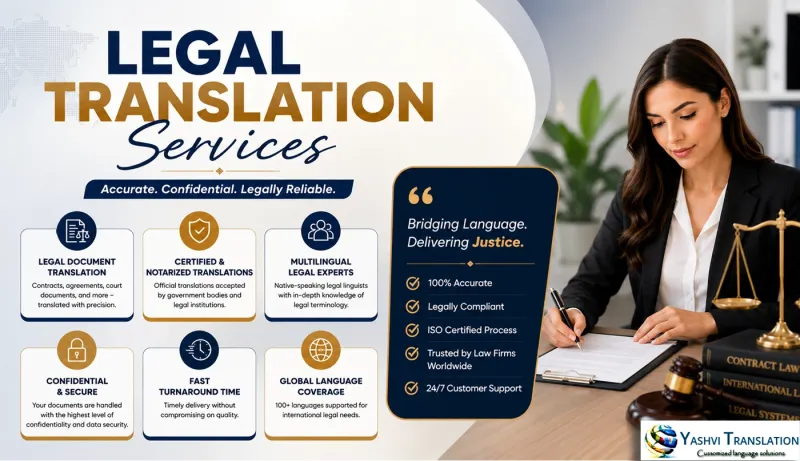
Legal Translation Services: The Comprehensive Guide to Compliance, Accuracy & Global Acceptance
Introduction: The Critical Role of Legal Translation in a Globalized Society
In an interconnected world, the boundaries of law, commerce, and migration are fluid. Whether a corporation is executing a cross-border merger, a law firm is managing international litigation, or an individual is navigating the complexities of immigration, the accuracy of legal translation is the foundation of success.
Legal translation is a high-stakes discipline where the margin for error is zero. Unlike general translation, which focuses on the “spirit” of a text, legal translation demands formal equivalence—a precise, word-for-word replication of the legal intent, rights, and obligations contained within the source document. A single mistranslated term can lead to visa rejections (RFEs), contract nullification, or judicial delays. Whether you need a certified legal translation for immigration, a sworn translation for Germany, a court document translation, or a contract translation for international business, understanding the requirements beforehand can help avoid costly delays, rejections, and compliance issues.
This comprehensive guide explains legal translation requirements, certification types, common mistakes, legal compliance standards, security requirements, pricing considerations, and best practices for ensuring international acceptance.
What is Legal Translation? (The Definition of Accuracy)
Legal translation is the specialized process of converting documents with legal standing from one language (source) to another (target) while ensuring the legal integrity of the document remains intact. It requires a deep understanding of two different legal systems and the specific juridical terminology unique to each.
Core Principles of Legal Translation:
- Linguistic Precision: Utilizing the exact terminology recognized by courts and government bodies (e.g., Affiant, Force Majeure, Petitioner).
- Technical Consistency: Ensuring that defined terms within a contract or decree remain consistent throughout the entire document to avoid ambiguity.
- Regulatory Compliance: Meeting the specific certification standards required by the receiving authority, such as USCIS (USA), IRCC (Canada), or the UK Home Office.
Key Characteristics of Legal Translation
A professional legal translation should be:
🔹Terminology accurate🔹Legally compliant🔹Contextually precise🔹Format aligned with the original document🔹Suitable for certification, notarization, or sworn validation when required🔹Accepted by courts, embassies, immigration authorities, and government agencies
Because legal language often contains jurisdiction-specific terminology, even a small translation error can significantly alter the meaning of a document.
Legal Translation vs General Translation
| Legal Translation | General Translation |
| Requires legal terminology expertise | General language knowledge |
| Used for official and regulated purposes | Used for informational purposes |
| Often requires certification | Usually no certification needed |
| Subject to authority requirements | No legal acceptance requirements |
| High compliance risk | Lower risk |
The YASHVI 8-Step Legal Translation Workflow
To maintain ISO-standard quality, we follow a rigorous process that eliminates the risks associated with machine translation.
The Professional Workflow: Ensuring ISO-Standard Quality
OUR PROFESSIONAL LEGAL TRANSLATION PROCESS
How Legal Translation Works: Step-by-Step
A transparent translation process helps ensure quality, compliance, and confidentiality.

Step 1: Document Assessment
Our specialists review:
Document type .Destination country .Authority requirements.Certification needs
Step 2: Secure Document Submission
Documents are uploaded through a secure workflow with controlled access.
Step 3: Legal Translator Assignment
Projects are assigned to:
- Certified legal translators
- Sworn translators (where required)
- Subject-matter legal linguists
Step 4: Legal Translation
The translation process focuses on:
🔹Legal terminology accuracy🔹Format preservation🔹Consistent transliteration🔹Regulatory compliance
Step 5: Independent Quality Review
A second legal linguist performs:
- Proofreading
- Terminology verification
- Formatting review
- Compliance validation
Step 6: Certification & Authentication
Depending on requirements, we provide:
- Certified translation
- Sworn translation
- Notarized translation
- Apostille coordination support
Step 7: Secure Delivery
Available delivery methods include:
| Delivery Method | Best For |
| Encrypted PDF | Fast submissions |
| Certified Hard Copy | Official requirements |
| Courier Delivery | International submissions |
| Additional Certified Copies | Multiple authority filings |
Why This Process Matters
A structured legal translation workflow helps reduce rejection risks, maintain legal accuracy, protect confidential information, and improve acceptance by immigration authorities, embassies, courts, universities, and regulatory agencies worldwide.
Sample


Why Professional Legal Translation Matters
Professional legal translation helps ensure:
🔹Compliance with authority requirements🔹Accurate legal terminology🔹Proper certification🔹International acceptance🔹Reduced rejection risk🔹Greater confidence during legal and immigration processes
Need Certified Legal Translation Services?
Whether you require legal translation for immigration, court proceedings, international business, academic recognition, or government compliance, working with qualified legal translators helps ensure accuracy, confidentiality, and acceptance by receiving authorities worldwide.
Best Practice for Legal Translation
| Recommended Approach | Benefit |
| Use Professional Legal Translators | Ensures legal accuracy and compliance |
| Maintain Consistent Names & Transliteration | Reduces identity-related issues |
| Verify Legal Terminology | Preserves the original legal meaning |
| Translate Stamps, Seals & Annotations | Improves acceptance by authorities |
| Review Date Formats Carefully | Prevents administrative discrepancies |
| Apply Multi-Level Quality Checks | Minimizes errors before submission |
Legal translations are often used for immigration, court proceedings, business contracts, academic recognition, and government compliance. Professional human translation helps avoid costly mistakes, delays, and document rejections.
SEE OUR *5 Star CUSTOMER REVIEWS!!

Certified vs. Sworn vs. Notarized Translation: A Global Comparison
Understanding the Difference Before You Submit Documents
One of the most common reasons documents are rejected by immigration authorities, embassies, and courts is the submission of the wrong type of translation.
Many applicants assume that certified, sworn, and notarized translations are interchangeable. In reality, they serve different legal purposes and are accepted by different authorities.
Certified Translation
A certified translation is accompanied by a signed declaration confirming that the translation is complete and accurate to the best of the translator’s knowledge.
A certified translation typically includes:
🔹Translator declaration🔹Certification statement🔹Translator signature🔹Date of certification🔹Agency details
✅ Commonly Required By ✅ USCIS ✅ IRCC ✅ UK Home Office ✅ Universities ✅ Professional Licensing Bodies
Best For
Immigration applications, visa submissions, academic credential evaluations, and official documentation.
Sworn Translation
A sworn translation is performed by a Sworn Translator—a professional who has been officially appointed and “sworn in” by a court of law or a government ministry. These documents carry an official seal and signature that have the same legal weight as the original.
- Standard Requirement for: Germany, France, Spain, Italy, the Netherlands, and many South American nations.
Best For
Court submissions, civil registrations, legal proceedings, and official government filings in countries that recognize sworn translators.
Notarized Translation
In this process, a Notary Public witnesses the translator signing the Certificate of Accuracy. The Notary does not verify the accuracy of the translation; they verify the identity of the person signing it.
- Standard Requirement for: Certain local government filings, specific bank requirements, and some academic credential evaluations.
Common Legal Translation Applications
- Immigration and visa applications
- Permanent residency (PR) programs
- Court proceedings and litigation support
- International business contracts
- Power of Attorney documentation
- Academic credential evaluations
- University admissions
- Government registrations and compliance filings
- Employment and work permit applications
- Civil status and family documentation
Our multilingual legal translation services are designed to help clients meet the requirements of courts, embassies, immigration authorities, universities, government departments, and international organizations worldwide.


Global Legal Translation Compliance Matrix
Which Type of Legal Translation Is Required by Different Authorities?
Different authorities have different translation acceptance standards. Understanding these requirements before submitting documents can help avoid delays, requests for additional evidence, and document rejection.
| Authority / Organization | Common Documents Required | Translation Type Typically Required | Common Purpose | Best For |
| USCIS (United States) | Birth certificates, marriage certificates, PCC, affidavits | Certified Translation | Immigration & visa processing | Green card, family sponsorship, immigration applications |
| IRCC (Canada) | Birth certificates, marriage certificates, educational documents, PCC | Certified Translation | Canada PR & immigration | PR applicants, study permits, spouse sponsorship |
| UK Home Office | Identity documents, immigration records, legal documents | Certified Translation | Immigration & settlement applications | UK visas, settlement, citizenship |
| German Authorities | Academic documents, civil records, legal documents | Sworn Translation | Student visas, work permits, civil registration | Germany visa applicants |
| French Authorities | Civil records, legal documents, academic credentials | Sworn Translation | Administrative & legal procedures | France immigration & registration |
| Spanish Authorities | Civil documents, legal records | Sworn Translation | Government and legal submissions | Spain immigration & residency |
| Italian Authorities | Civil status documents, legal paperwork | Sworn Translation | Official administrative use | Italy immigration & legal processes |
| Universities & Credential Agencies | Degrees, diplomas, transcripts | Certified Translation | Academic evaluation | WES, IQAS, ECE, university admissions |
| Courts & Arbitration Bodies | Judgments, affidavits, evidence documents | Certified / Sworn Translation | Litigation & dispute resolution | Lawyers, litigants, legal teams |
| Corporate Regulators | Contracts, compliance filings, incorporation documents | Certified Translation | Regulatory compliance | Corporates, exporters, multinational businesses |
| Embassies & Consulates | Visa support documents, civil records | Certified / Notarized Translation | Visa processing | Visa applicants and international travelers |
| Government Departments | Licenses, permits, registration certificates | Certified Translation | Administrative compliance | Individuals and businesses |
| Notary & Apostille Authorities | Legal and civil documents | Notarized Translation | International authentication | Overseas document use |
Why This Matrix Matters
Using the correct type of legal translation is critical because different authorities apply different acceptance standards. A certified translation accepted by USCIS may not satisfy a sworn translation requirement in Germany, while some embassies may additionally require notarization or apostille authentication.
Best Practice
Before translating any legal document, confirm:
🔹Receiving authority requirements 🔹Destination country regulations 🔹Certification level required 🔹Whether notarization is needed 🔹Whether apostille legalization is required
This simple verification step can significantly reduce the risk of delays, rejection, or costly re-submissions.
What Happens If Legal Translation Is Incorrect?
One of the biggest misconceptions is that legal translation is simply about converting words from one language into another. In reality, inaccurate legal translation can create serious immigration, legal, financial, and compliance consequences.
Common Legal Translation Errors & Consequences
| Translation Error | Potential Consequence |
| Incorrect spelling of names | Visa delays or rejection |
| Missing seals or annotations | Embassy refusal |
| Incorrect legal terminology | Court objections |
| Inconsistent transliteration | Identity verification issues |
| Wrong date format | Compliance problems |
| Missing certification statement | Document rejection |
| Machine-translated content | Authority refusal |
| Formatting mismatch | Processing delays |
| Court Risks | Corporate Risks |
|---|---|
| Courts may reject: 🔹 Uncertified translations 🔹Incomplete translations 🔹Improperly authenticated documents 🔹Translations lacking required declarations | For businesses, translation mistakes may result in: 🔹 Contract disputes 🔹Regulatory violations 🔹Compliance failures 🔹Financial penalties 🔹Delayed international transactions |
The Anatomy of a Certified Translation: What Must Be Included?
To be accepted by official bodies, a certified translation must contain specific “Trust Markers”:
- The Translation: A word-for-word English (or target language) version of the original.
- The Certification Statement: A formal declaration stating the translator’s competence and the translation’s accuracy.
- Contact Information: The name, address, and contact details of the translation agency or linguist.
- Date & Signature: The date the certification was issued and the hand-signed name of the authorized representative.
- Stamps & Seals: The official seal of the translation company to prevent tampering.
Why Professional Legal Translation Matters: Managing Risks
The risks associated with “automated” or “unqualified” translation in the legal sector are immense. Submitting non-compliant documents is a high-risk strategy that often results in:
- Request for Evidence (RFE): Immigration authorities like USCIS frequently issue RFEs when translations lack a proper certification statement or contain inconsistent name spellings.
- Judicial Inadmissibility: In litigation, if a translated evidence file is not certified, the court may rule it inadmissible, potentially jeopardizing the entire case.
- Contractual Disputes: In international business, a mistranslated clause regarding “Liability” or “Termination” can lead to years of expensive legal arbitration.
Security, Privacy & The “Human-Only” Guarantee
Legal documents are the most sensitive files an individual or business can share. Unlike free online tools (like Google Translate), which store your data and use it for “training,” YASHVI Translation guarantees total privacy.
- Zero-AI Policy: We do not use public AI tools that could leak your data into the “cloud.”
- AES-256 Encryption: Your files are handled through secure, encrypted portals.
- Binding NDAs: Every linguist on our team is under a strict legal Non-Disclosure Agreement.
- Chain of Custody: We track exactly who sees your document from the moment you upload it to the moment it is delivered.
Common Legal Translation Mistakes to Avoid
| Mistake | Description | Examples | Potential Consequences |
| Incorrect Name Spellings | Names must remain identical across all supporting documents and applications. Even minor spelling differences can trigger verification issues. | Passports, Birth Certificates, Marriage Certificates, Academic Records, Immigration Applications | Identity verification problems, immigration delays, additional document requests, application processing issues |
| Inconsistent Transliteration | Documents translated from non-Latin scripts require standardized transliteration to ensure consistency across records. | Hindi to English, Arabic to English, Russian to English, Chinese to English | Identity mismatches, visa delays, embassy clarification requests, document discrepancies |
| Incorrect Legal Terminology | Legal terms often have precise meanings that cannot be translated literally. Incorrect terminology may alter the legal intent of a document. | Power of Attorney, Affidavit, Decree, Injunction, Memorandum, Articles of Association | Court objections, compliance failures, contractual disputes, document rejection |
| Missing Stamps, Seals & Annotations | Official documents frequently contain stamps, seals, endorsements, registry entries, and handwritten notes that must be translated or properly referenced. | Government Stamps, Notarial Seals, Registry Entries, Official Endorsements, Marginal Notes | Authority rejection, re-submission requirements, processing delays |
| Incorrect Date Formats | Different countries use different date conventions, which can lead to misunderstandings if translated incorrectly. | India (DD/MM/YYYY), United States (MM/DD/YYYY), International Formats (YYYY/MM/DD) | Identity discrepancies, administrative errors, visa or immigration delays |
| Using Machine Translation for Legal Documents | Automated translation tools may fail to understand legal terminology, context, and jurisdiction-specific language requirements. | Contracts, Court Documents, Immigration Papers, Affidavits, Regulatory Documents | Rejection by authorities, legal inaccuracies, compliance issues, increased risk of disputes |
Quick Risk Assessment Table
| Translation Error | Risk Level | Most Common Impact |
| Incorrect Name Spellings | High | Identity verification issues |
| Inconsistent Transliteration | High | Visa and immigration delays |
| Incorrect Legal Terminology | Critical | Legal misinterpretation and document rejection |
| Missing Stamps or Seals | High | Embassy or authority rejection |
| Incorrect Date Formats | Medium | Administrative delays and discrepancies |
| Machine Translation Usage | Critical | Non-acceptance by courts, embassies, and immigration authorities |
Global Language Support & Regional Nuances
Languages Supported for Legal Translation
Professional Legal Translation in 150+ Languages
Legal translation requirements arise across immigration, litigation, international business, academic admissions, regulatory compliance, and government procedures worldwide. Our legal translation network supports more than 150 global languages, helping individuals, businesses, law firms, and institutions communicate accurately across borders.
Asian Languages
We provide professional legal translation services in major Asian languages, including Hindi, Punjabi, Bengali, Tamil, Telugu, Gujarati, Malayalam, Kannada, Marathi, Urdu, Nepali, Chinese, Japanese, and Korean. These language pairs are commonly required for immigration applications, family sponsorship cases, educational admissions, civil documentation, court proceedings, and government submissions.
European Languages
Our European language translation services cover German, French, Spanish, Italian, Dutch, Portuguese, Russian, Polish, Czech, Romanian, and Hungarian. These languages are frequently requested for EU immigration, sworn translation requirements, corporate contracts, compliance documentation, university admissions, visa applications, and international legal matters.
Middle Eastern Languages
We offer legal translation services in Arabic, Persian (Farsi), Turkish, and Hebrew for clients involved in cross-border business, employment opportunities, immigration applications, legal filings, and regulatory compliance. These languages are particularly important for international trade, work permits, family reunification cases, and government documentation.
African Languages
Our legal translation network also supports key African languages, including Swahili, Amharic, and Afrikaans. These translations are commonly used for migration applications, international business transactions, academic credential recognition, government records, and legal documentation involving African jurisdictions.
Additional Global Languages
Beyond these major language groups, we provide legal translation services in 150+ languages and dialects worldwide. Whether the requirement involves immigration, litigation, business expansion, education, intellectual property, regulatory compliance, or government procedures, our network of professional legal translators helps ensure linguistic accuracy, legal consistency, and international acceptance.
Conclusion: Securing Your Global Success through Accuracy
In the world of law and immigration, the translation is not just a document—it is a legal instrument. By choosing a professional legal translation service, you are mitigating risk, ensuring compliance, and accelerating your international objectives.
Don’t let a language barrier compromise your legal standing. Ensure your documents are accurate, certified, and globally accepted.
Ready for a Certified Legal Quote?
Yashvi Translation
SM-9, Plot No.A-105, Tushaar Apartment, 150 Feet Rd, Shalimar Garden Extension II, Shalimar Garden, Sahibabad, Ghaziabad, Uttar Pradesh 201005
[ Upload Your Documents Securely]
[ Contact a Legal Specialist]
Trusted by law firms, corporations, and immigration applicants worldwide.
FAQ – Expert Answers to Common Legal Translation Queries
Legal translation is the translation of legally binding documents while preserving their legal meaning, terminology, and jurisdiction-specific context. It requires both language expertise and an understanding of legal systems.
Legal documents commonly translated include contracts, court orders, affidavits, judgments, birth certificates, marriage certificates, divorce certificates, Power of Attorney documents, corporate agreements, and regulatory filings.
No. Legal translation refers to the translation of legal documents. Certified translation includes a signed declaration confirming the accuracy of the translation. Many legal documents also require certification.
In many cases, yes. Immigration authorities often require certified translations when supporting documents are issued in a language different from the official language of the destination country.
Acceptance requirements vary by jurisdiction. Courts may require certified, notarized, or sworn translations depending on the country and type of legal proceeding.
Yes. We translate a wide range of commercial and corporate legal documents, including service agreements, shareholder agreements, NDAs, employment contracts, and compliance documentation.
We provide legal translation services in more than 150 languages, including Hindi, English, German, French, Spanish, Arabic, Russian, Portuguese, Chinese, Japanese, Korean, and many others.
Turnaround times depend on document length, complexity, language pair, and certification requirements. Standard legal documents can often be completed within a few business days.
Yes. Legal documents often contain sensitive information. Professional legal translation providers follow strict confidentiality procedures and secure document-handling practices.
Machine translation tools may fail to interpret legal terminology, jurisdiction-specific language, and contextual meaning accurately. Professional human translators help reduce the risk of errors, disputes, and document rejection.
Yes. Depending on the destination country and authority requirements, translated documents may be notarized, certified, apostilled, or legalized for international use.
Pricing depends on the language pair, document type, complexity, word count, turnaround time, and any certification or notarization requirements.
Recent Clients Review


