 Email Id :-
 Mobile: -


Apostille Before Sworn Translation Guide

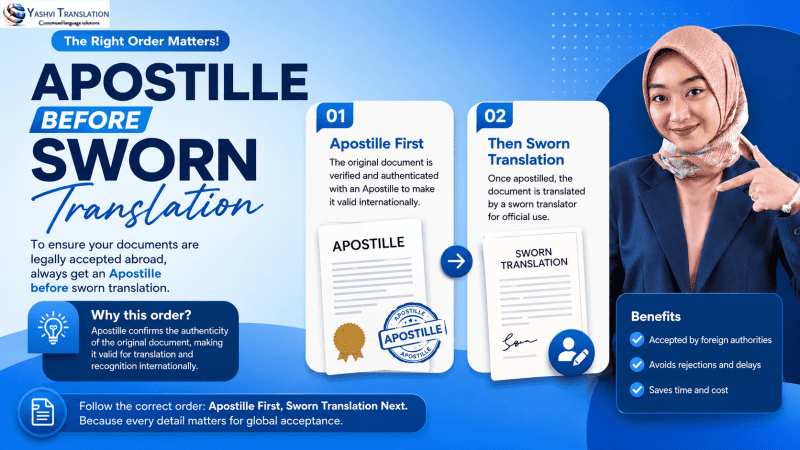
Apostille Before Sworn Translation: The Complete Order of Operations
When preparing documents for international use—whether for a student visa in Spain, residency in Italy, or a job in Germany—the sequence of legalization is critical. A common mistake is translating a document too early, leading to rejection by foreign authorities.
Should I get an Apostille before or after translation?
In almost all international legal procedures, you must obtain the Apostille first, and then perform the Sworn Translation. The Apostille is an official government seal that must be translated along with the original document. If you translate the document first, the translation will lack the Apostille’s serial numbers, seals, and signatures, leading to immediate rejection by foreign consulates or immigration authorities.
- The Golden Rule: Apostille First, Translate Second
The sequence of international document legalization is a strict legal hierarchy. A common mistake is translating a document too early, which results in an “incomplete” file in the eyes of foreign officials.
The standard workflow is:
- Issuance: Obtain the original document (e.g., Birth Certificate, Degree).
- Authentication/Apostille: The government (e.g., MEA in India) verifies the signatures.
- Sworn Translation: A professional translates the combined package (Original + Apostille).
- Submission: The document is presented to the receiving authority.
To a foreign authority, the translation is only considered “complete” if the translator has also interpreted the text, seals, and serial numbers of the Apostille itself.
Why the Order Matters: Avoiding Costly Rejections
Reversing this order is the most frequent cause of visa delays. Here is why the sequence is non-negotiable:
- The “Mirror Image” Requirement: Foreign authorities require the translation to be a 1:1 representation of the final document. If an Apostille is attached after the translation, that Apostille remains untranslated.
- Chain of Authenticity: The Apostille proves the original document is real; the Sworn Translation proves the contents are accurately interpreted. The translation acts as the final “bridge” in the legal chain.
- Cost Efficiency: If you translate first, you will likely have to pay for a second “supplementary” translation later just to include the missing Apostille information.
What Is a Sworn Translation?
A sworn translation is an officially recognized translation performed by a translator authorized by a government authority, court, ministry, or other competent institution.
Unlike a standard translation, a sworn translation typically includes:
- ✔ Official certification statement
- ✔ Translator declaration
- ✔ Signature
- ✔ Seal or stamp
- ✔ Legal recognition
Many European countries use sworn translators for official submissions involving immigration, education, residency, citizenship, and legal proceedings.
For a detailed overview of the service and country-specific requirements, see our official sworn translation services.
How the Apostille and Sworn Translation Process Works

Step 1: Confirm the receiving authority’s requirements
Before beginning the process, obtain clear instructions from the organisation receiving the documents.
Confirm:
- Whether an apostille is required
- Whether the apostille itself must be translated
- What type of translation is accepted
- Whether a specific translator qualification is required
- Whether digital copies or physical originals must be submitted
- Whether notarisation or any additional authentication is required
Where possible, obtain these instructions in writing.
Step 2: Prepare the original document
Ensure that the document is complete, legible and issued by the appropriate authority.
Check that:
- Names and dates are correct
- All pages are available
- Required signatures and seals are present
- There are no missing attachments
- The document is eligible for apostille
Corrections should normally be completed before apostille and translation.
Step 3: Obtain the apostille
Submit the original document through the applicable apostille process.
The competent authority and required preliminary authentication may differ according to:
- The type of document
- The issuing authority
- The place of issuance
- The destination country
- The applicable governmental procedure
Applicants should verify the current process before submitting their documents.
Step 4: Arrange the required translation
After the apostille has been issued, provide the translator with the complete document package.
This should include:
- Every page of the original document
- The complete apostille certificate
- Reverse-side stamps or endorsements
- Attached certificates
- Seals, signatures and handwritten notes
- Any authority-specific instructions
The translator should be informed of the destination country and the organisation receiving the translation.
Step 5: Review the completed translation
Before submission, confirm that:
- Names match the passport or identity document
- Dates and reference numbers are accurate
- All pages have been translated
- The apostille text has been included
- Seals and stamps have been represented
- The required translator declaration is present
- The translation contains the required signature or seal
- The format meets the receiving authority’s instructions
Step 6: Submit the complete document package
Submit the original document, apostille and translation in the format requested by the receiving authority.
Do not separate attached pages or remove official fasteners unless the authority expressly permits it.
The Legal Backbone: The 1961 Hague Convention
This process is governed by the 1961 Hague Convention Abolishing the Requirement of Legalisation for Foreign Public Documents.
- Member Countries: If both the issuing and destination countries are members (e.g., India and Spain), a single Apostille is sufficient.
- Non-Member Countries: If the destination country is not a member (e.g., UAE, Vietnam), you must undergo Embassy Legalization instead.
- Authority Note: The Hague Convention dictates that the Apostille certificate itself is a public document. Therefore, it falls under the same
The Indian Context: MEA Apostille Workflow
For applicants in India, the process involves specific state and central government layers before the Sworn Translation can occur:
- Notary/SDM Attestation: Preliminary verification at the local level.
- State Home Department: Authentication for personal documents.
- MEA (Ministry of External Affairs): The final Apostille stamp is placed on the back of the document.
- Sworn Translation: Once the MEA stamp is visible, the document is ready for a Sworn/Certified translation (e.g., via Yashvi Translation).
Sample

Why the Apostille Should Be Completed First?
Obtaining the apostille before the sworn translation allows the translator to reproduce the complete legalized document accurately. The translation can then include:
- The original document text
- Official seals and stamps
- Signatures and handwritten entries
- Registration or certificate numbers
- Apostille certificate details
- Verification codes, references, and authority information
This approach helps maintain consistency between the original document and its translated version and reduces the risk of rejection caused by missing legalization details.
For applicants who also need notarization, see our notarized translation services in India for information about notarized translation requirements.
Important Consideration
Apostille and translation requirements vary according to the destination country, receiving authority, document type, and purpose of submission. Applicants should confirm whether the authority requires:
- Apostille before translation
- Translation before apostille
- Translation of the apostille itself
- A sworn, certified, or notarized translation
- Translation by a locally authorised translator
Where the apostille has already been attached to the document, the complete document package should be submitted for translation rather than providing only the original certificate.
Validity and Expiry: The “6-Month Rule”
A common user pain point is the “shelf-life” of an Apostille. While an Apostille technically has no expiration date, the receiving authority sets the rules.
- The Standard: Most European and Latin American consulates require civil documents (Birth, Marriage, PCC) to be issued within the last 3 to 6 months.
- The Link: If your original document is older than 6 months, an Apostille issued today will not make it valid for a visa. You must obtain a fresh original, a new Apostille, and then a new Sworn Translation.
Jurisdiction Guide: Requirements by Destination
| Destination | Requirement Type | Key Requirement |
| Spain | Standard | Translation must be done by a Traductor Jurado (appointed by MAEC) and include the Apostille text. |
| Germany | Standard | Prefers a “Beeidigter Übersetzer” (Sworn Translator) registered in Germany to translate the Apostilled document. |
| Italy | Double Apostille | Often requires the translator’s signature to be legalized by the Italian Consulate or a second Apostille. |
| France | Standard | Requires a Traduction Assermentée that covers both the original certificate and the Hague Apostille. |
For detailed Spain-specific requirements, see Spanish sworn translation requirements for Spain.
For Germany-related official translation requirements, see our German certified translation service.

Apostille Before Sworn Translation for Personal and Educational Documents
Both personal and educational documents may require apostille certification before they are submitted for sworn translation. This requirement commonly applies to individuals preparing applications for immigration, higher education, employment, residency, citizenship, family reunification, professional recognition, or marriage registration abroad.
An apostille verifies the authenticity of the issuing authority’s signature, seal, or stamp. It does not certify the accuracy of the document’s content. Once the apostille has been affixed, the complete document package—including the original document, endorsements, seals, and apostille certificate—should generally be provided to the sworn translator.
In many countries, the apostille is treated as an integral part of the official document. Therefore, translating only the original certificate while excluding the apostille may result in an incomplete submission or a request for additional documentation.
Common Personal Documents Requiring Apostille and Sworn Translation
| Document Category | Document | Common Purpose | Typical Requirement | Recommended Process |
| Personal Document | Birth Certificate | Immigration, citizenship, family registration, or university admission | Apostille + Sworn Translation | Apostille → Sworn Translation |
| Personal Document | Marriage Certificate | Family reunification, spouse visa, residency, or civil registration | Apostille + Sworn Translation | Apostille → Sworn Translation |
| Personal Document | Divorce Certificate or Decree | Remarriage, residency applications, or civil-status registration | Apostille + Sworn Translation | Apostille → Sworn Translation |
| Personal Document | Death Certificate | Inheritance, probate, insurance claims, or family-record updates | Apostille + Sworn Translation | Apostille → Sworn Translation |
| Personal Document | Police Clearance Certificate (PCC) | Visa, immigration, residency, or employment applications | Apostille (where required) + Translation | Apostille → Sworn Translation |
| Personal Document | Name Change Affidavit or Certificate | Identity verification and document-consistency requirements | Apostille + Translation | Apostille → Sworn Translation |
| Personal Document | Adoption Documents | Family immigration, citizenship, or international adoption procedures | Apostille + Sworn Translation | Apostille → Sworn Translation |
| Personal Document | Medical Certificate | Visa, residency, employment, or insurance requirements | Apostille (if applicable) + Translation | Apostille → Sworn Translation |
| Personal Document | Power of Attorney | Property, legal, financial, or administrative matters abroad | Apostille + Sworn Translation | Apostille → Sworn Translation |
| Educational Document | Degree Certificate | Higher education, employment, professional licensing, or immigration | Apostille + Sworn Translation | Apostille → Sworn Translation |
| Educational Document | Diploma Certificate | Academic admission, vocational recognition, or overseas employment | Apostille + Sworn Translation | Apostille → Sworn Translation |
| Educational Document | Academic Transcript | University admission, credential evaluation, or credit transfer | Apostille + Sworn Translation | Apostille → Sworn Translation |
| Educational Document | Mark Sheets | Academic verification, further studies, or employment applications | Apostille + Sworn Translation | Apostille → Sworn Translation |
| Educational Document | School-Leaving Certificate | School or university admission and educational verification | Apostille + Sworn Translation | Apostille → Sworn Translation |
| Educational Document | Transfer Certificate | Admission to another educational institution | Apostille + Sworn Translation | Apostille → Sworn Translation |
| Educational Document | Migration Certificate | University transfer or higher-education registration | Apostille + Sworn Translation | Apostille → Sworn Translation |
| Educational Document | Provisional Degree Certificate | Temporary academic proof for admission or employment | Apostille + Sworn Translation | Apostille → Sworn Translation |
| Educational Document | Medium of Instruction Certificate | Language-proficiency exemption or university admission | Apostille + Sworn Translation | Apostille → Sworn Translation |
| Educational Document | Professional Qualification Certificate | Licensing, employment, or professional recognition abroad | Apostille + Sworn Translation | Apostille → Sworn Translation |
For academic documents being submitted to German universities or institutions, applicants may also review Uni-Assist certified translation requirements.
For academic document processing and credential-related submissions in Germany, see APS India document translation.
Why Students Choose Professional Apostille and Translation Support
Reduced Administrative Errors
Professional review helps identify documentation issues before submission.
Country-Specific Guidance
Requirements differ across Spain, France, Germany, Italy, and other jurisdictions.
Complete Documentation Workflow
Support throughout:
- Apostille
- Sworn Translation
- Submission Preparation
Faster Processing
Professional coordination can simplify document preparation for urgent deadlines.

Can Translation Ever Be Completed Before Apostille?
Yes. Translation may be completed first when:
- The receiving authority specifically requests this order
- The apostille is not required
- The translation is needed only for preliminary review
- The translated document itself must undergo notarisation or authentication
- A local authority requires the translation to be completed within its jurisdiction
- The translator must work from a certified or authenticated copy
- The receiving organisation accepts a translation of the original document separately from the apostille
For this reason, apostille-before-translation should be treated as a commonly followed process rather than a universal legal rule.

>Apostille First or Translation First?
| Process | General position | Important consideration |
| Original document → Apostille → Translation | Commonly recommended | Allows the apostille and its authentication details to be included in the translation |
| Original document → Translation → Apostille | May be accepted in limited procedures | The later-issued apostille may not appear in the original translation |
| Translation followed by separate authentication | Required in certain procedures | The translator’s signature or translation may require notarisation or authentication |
| Authority-specific sequence | Always takes priority | Follow the written requirements of the receiving authority |

Apostille and Sworn Translation for Legal Documents
Legal documents often require an additional layer of authentication because they may be presented before courts, government departments, arbitration bodies, or foreign authorities.
Common Legal Documents
- Power of Attorney
- Court Orders
- Affidavits
- Judgments
- Contracts
- Arbitration Awards
- Company Incorporation Documents
For documents such as contracts and agreements, see our contract agreement translation services.
Why Apostille Usually Comes First
Legal authorities frequently require translators to translate:
- Apostille Certificates
- Government Authentication Statements
- Court Seals
- Official Stamps
Completing the apostille before translation helps create a complete chain of authenticity and reduces the risk of document rejection.
Does the Translation Itself Need an Apostille?
In some procedures, the original document and the completed translation may require separate authentication.
This may occur when:
- The translation is treated as a separate public or notarised document
- The translator’s signature must be authenticated
- The translation was completed in one country for use in another
- A court or civil registry imposes additional formalities
- The receiving authority specifically requests authentication of the translation
This is sometimes informally described as a “double apostille,” although the legal process and terminology can vary.
Applicants should not assume that a second apostille is required. Written confirmation should be obtained from the receiving authority before arranging additional authentication.
When Do You Need a “Double Apostille”?
While the standard procedure is to apostille the original document before translating it, certain jurisdictions and specific legal scenarios require a more rigorous process known as the “Double Apostille.”
A Double Apostille occurs when both the original document and the official sworn translation must carry their own individual Apostille stamps to be considered legally valid.
Understanding the Two-Step Authentication
- The First Apostille: This is placed on your original document (e.g., a Birth Certificate or a Power of Attorney) by the issuing government (such as the MEA in India). It verifies that the official who signed the original document is legitimate.
- The Second Apostille: After the Sworn Translation is completed, the translator’s signature is notarized or authenticated by a court, and a second Apostille is issued for the translation itself. This verifies that the Sworn Translator is a legally recognized professional in the country where the translation was performed.
When is this Mandatory?
You are most likely to encounter the Double Apostille requirement in the following cases:
- High-Stakes Litigation: When submitting evidence or witness statements to foreign courts that require every signature in the chain of custody to be authenticated.
- Specific Jurisdictions: Countries with highly centralized civil registries (e.g., certain procedures in Italy, Switzerland, or Israel) may request it to ensure the translator’s credentials are state-verified.
Third-Country Submissions: If you have an Indian document, get it translated by a sworn translator in the UK, and then submit it to a third country, that third country may require an Apostille on the UK translator’s signature.
Common Mistakes to Avoid:
Translating an incomplete document:The receiving authority may need to understand the apostille
An apostille may contain information in a language that is not accepted by the receiving authority.
Translating the original document before the apostille is issued may result in the apostille text being absent from the translated version. The applicant may then be asked to obtain an additional or revised translation.
It reduces the possibility of incomplete submission
Completing the apostille first may help prevent issues such as:
- Missing apostille text
- Untranslated seals or certifications
- Differences between the original and translated document sets
- Requests for revised translations
- Additional processing costs
- Delays in document submission
It does not guarantee acceptance, but it can help ensure that the translation reflects the complete authenticated document.
A translation prepared before all apostille pages, seals or attachments are available may need to be revised.
Failing to translate the apostille
Where the receiving authority requires the complete authenticated document to be translated, omitting the apostille may result in an incomplete submission.
Using the wrong translation format
A general, certified, official or sworn translation may not be interchangeable. The required format depends on the receiving authority and applicable jurisdiction.
Submitting only selected pages
All relevant pages, reverse-side endorsements, attachments and apostille certificates should be reviewed before translation.
Assuming every authority follows the same procedure
Requirements may vary between universities, embassies, courts, immigration authorities, professional bodies and civil registries, even within the same country.
Need Apostille and Sworn Translation for Study Abroad?
Whether you are applying to universities in Spain, France, Germany, Italy, Austria, Belgium, or other international destinations, preparing documents correctly is essential.
Our specialists assist students with:
✅ Apostille Degree Certificate Services
✅ Apostille Academic Transcript Processing
✅ Educational Document Apostille Support
✅ Sworn Translation of Academic Documents
✅ University Admission Documentation
✅ Student Visa Documentation Preparation
Request a free consultation today and ensure your educational documents are properly apostilled and translated before submission.
Request an Apostille and Translation Requirement Review
Share the document type, destination country and receiving authority to determine the appropriate apostille and translation sequence.
A requirement review can help identify the correct process before apostille, translation and final submission are arranged.
Final Recommendation
For many international document submissions, the practical sequence is:
Original document → Apostille → Translation of the complete apostilled document → Submission
This order helps ensure that the apostille, official seals and authentication details are reflected in the translation.
However, it should not be presented as an absolute rule. Before starting the process, confirm the following with the receiving authority:
- Whether apostille is required
- Whether the apostille must be translated
- What type of translation is accepted
- Whether the translator must hold a particular authorisation
- Whether the translation requires separate authentication
- Whether original, certified-copy or digital submission is permitted
Final Checklist for Success
- Verify the sequence: Ensure the Apostille is physically attached before contacting a translator.
- Confirm the Translator’s Credentials: Ensure they are officially recognized by the destination country’s government.
- Check the Date: Ensure your document was issued within the timeframe required by the consulate.
Expert Support:
Navigating the bureaucracy of MEA Attestations and Sworn Translations can be complex. Choosing a professional service like Yashvi Translation ensures that the sequence of legalization matches the specific requirements of your destination country, preventing costly delays in your visa or admission process.
Here is the summary of the content in three key points:
- Prioritize the Apostille Before Translation: In almost all international legal procedures, the “Golden Rule” is to obtain the government Apostille first and then perform the Sworn Translation. This ensures that the translator can include the Apostille’s seals, serial numbers, and signatures in the final document, creating a complete “mirror image” for foreign authorities.
- Prevent Document Rejection and Extra Costs: Reversing the order is a leading cause of visa and residency delays. Foreign consulates often reject translations that do not account for the Apostille details, forcing applicants to pay for a second, supplementary translation to cover the missing information.
- Verify Jurisdiction-Specific Requirements: While the 1961 Hague Convention standardizes this process, specific destination rules vary—such as Italy’s requirement for a “Double Apostille” or the common “6-month rule” regarding document validity. Always confirm the receiving authority’s exact instructions before proceeding to ensure the entire document package is legally compliant.
Contact Yashvi Translation
 Phone: 099111 95559, 088008 41734
Email: info@translate-englishto.com | yashvi.tran@gmail.com | info@yashvitranslation.com
Website: www.translate-englishto.com
Office Hours: Monday–Saturday | 10:00 AM – 6:00 PM
Frequently Asked Questions
In most educational cases, yes. Apostille is typically completed before sworn translation so the apostille can be translated together with the original document.
The common process is:
Original Document → Apostille → Sworn Translation → Submission
Yes. Sworn translators often translate both the original document and the apostille attached to it.
Some universities require apostille certification, while others may not. Requirements vary by country and institution.
Yes. If apostille is a mandatory requirement and is missing, universities may request additional documentation or reject the submission.
For most educational applications, apostille is completed before translation.
Generally yes, especially for study abroad, university admissions, and student visa applications.
Yes. In fact, sworn translation after apostille is often the preferred process.
Requirements vary, but many German institutions request legalized and officially translated academic documents.
Many Spanish universities and authorities require apostilled documents accompanied by sworn translations.
In many countries, birth certificates should be apostilled before sworn translation so the apostille can be translated together with the original document.
For immigration, citizenship, and family reunification applications, marriage certificates are commonly apostilled before translation.
Generally, apostille is completed first so that the sworn translator can translate the entire legalized document package.
Many immigration authorities require apostille certification for civil status documents, educational credentials, and police clearance certificates.
The commonly followed sequence is:
Original document → Apostille → Sworn translation → Submission
This order is generally recommended when the receiving authority requires the apostille certificate to be translated together with the original document.
An apostille authenticates the origin of a public document so that it can be presented in another country where the Apostille Convention applies. It verifies the authenticity of the relevant signature, the official capacity of the signatory and, where applicable, the seal or stamp on the document. It does not verify the accuracy or truth of the document’s underlying content.
The apostille becomes part of the document package
Once an apostille certificate is attached to or associated with the original document, it becomes part of the documentation submitted to the foreign authority.
When translation is arranged after apostille, the translator can translate:
- The original document
- The apostille certificate
- Official seals and stamps
- Authentication statements
- Relevant signatures and annotations
This creates a more complete translated document package.
Recent Clients Review


