 Email Id :-
 Mobile: -



Home » Top Mistakes People Make When Translating Property Documents
Top Mistakes People Make When Translating Property Documents

Introduction: A Small Translation Mistake Can Cost You Big
When it comes to property documents, translation isn’t just about language — it’s about legal precision. A single error can lead to registration rejections, court disputes, or even loss of ownership rights. Whether you’re a foreign buyer, lawyer, bank, or real estate developer, ensuring your documents are translated accurately and legally is crucial.
In this article, we uncover the most common mistakes people make when translating property documents — and show you exactly how to avoid them.
🟡 Quick Answer: The top mistakes include using non-certified translators, mistranslating legal terms, ignoring formatting, and skipping notarization. These errors can lead to document rejection and legal complications.
If you’re looking for legally valid and compliant translation services, explore our Certified Property Document Translation process to understand how professional translation ensures your documents are accepted globally.
Why Accurate Property Document Translation Matters
Property translation isn’t optional — it’s a legal necessity for registrations, transfers, court submissions, and bank approvals. In India, property transactions often involve documents in multiple languages — for example, Hindi sale deeds translated into English for foreign buyers, or English contracts translated into regional languages for sub-registrar offices.
What’s at Stake:
✅ Registrar & Sub-Registrar Acceptance
✅ Embassy / Consular Legalisation
✅ Court & Arbitration Compliance
✅ Bank Loan & Mortgage Processing
✅ Cross-border property transactions
Even a small error, like mistranslating a Power of Attorney clause, can change legal ownership implications.
To see how professional expertise makes a difference, review our Case Study Certified Property Deed Translation Nge Green Energy — a real-world example of how certified translation ensured compliance for a major energy project.
Top Translation Mistakes to Avoid in Property Documentatio
Below are the critical translation errors we see most often in real estate transactions across India.
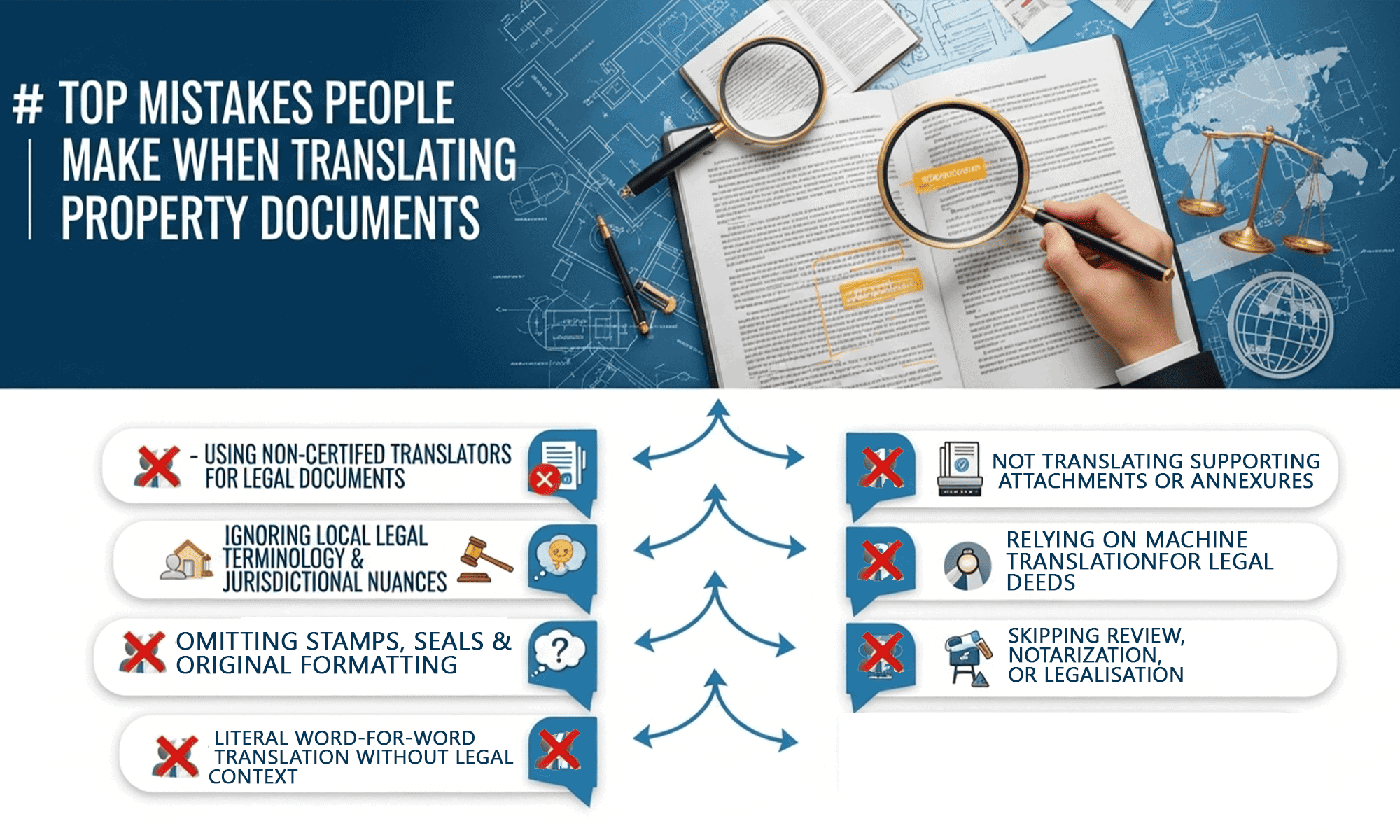
Using Non-Certified Translators for Legal Documents
Uncertified translators may produce text that reads fine but is not legally valid.
⚠️ Risk: Rejection by sub-registrar offices, courts, or banks.
✅ Solution: Always work with certified legal translators familiar with real estate terminology and formats.
For example, if you’re based in the capital, our Certified Property Document Translation Delhi team can provide translations recognized by Delhi sub-registrar offices and major banks.
Ignoring Local Legal Terminology & Jurisdictional Nuances
Each jurisdiction uses unique property law terms.
Example: German “Grundbuch” (land register) vs Indian “Sale Deed.”
⚠️ Risk: Ambiguous legal clauses that invalidate registration.
✅ Solution: Work with translators who understand local legal language and jurisdictional context.
You can also check Gujarati English Certified Property Translation or Tamil English Certified Property Translation services if your property documents are in regional languages — ensuring accuracy across linguistic and legal contexts.
Omitting Stamps, Seals & Original Formatting
Many authorities require the layout, stamps, seals, and margins to match the original.
⚠️ Risk: Registrar rejection due to layout mismatch.
✅ Solution: Professional legal translators mirror the original formatting to meet legal submission standards.
Literal Word-for-Word Translation Without Legal Context
Legal terms must be interpreted, not just translated.
Example: Translating “Power of Attorney” incorrectly can alter the scope of legal powers granted.
⚠️ Risk: Misinterpretation leads to legal disputes.
✅ Solution: Use translators with legal background who apply contextual legal meaning.
Not Translating Supporting Attachments or Annexures
Property deeds often include annexures, site plans, or schedules.
⚠️ Risk: Incomplete translations = incomplete submissions.
✅ Solution: Ensure all pages, annexures, and schedules are translated and certified.
Relying on Machine Translation for Legal Deeds
Machine translation (even AI tools) fails to understand legal nuance.
⚠️ Risk: Wrong terminology → rejected translations.
✅ Solution: Machine translation can support drafts, but final documents must be certified by professionals.
Skipping Review, Notarization, or Legalisation
⚠️ Risk: Translation may be technically correct but legally invalid.
✅ Solution:
- Have translations reviewed by legal professionals
- Notarize and apostille if required
Follow registrar or embassy submission rules
How to Avoid Common Property Translation Errors
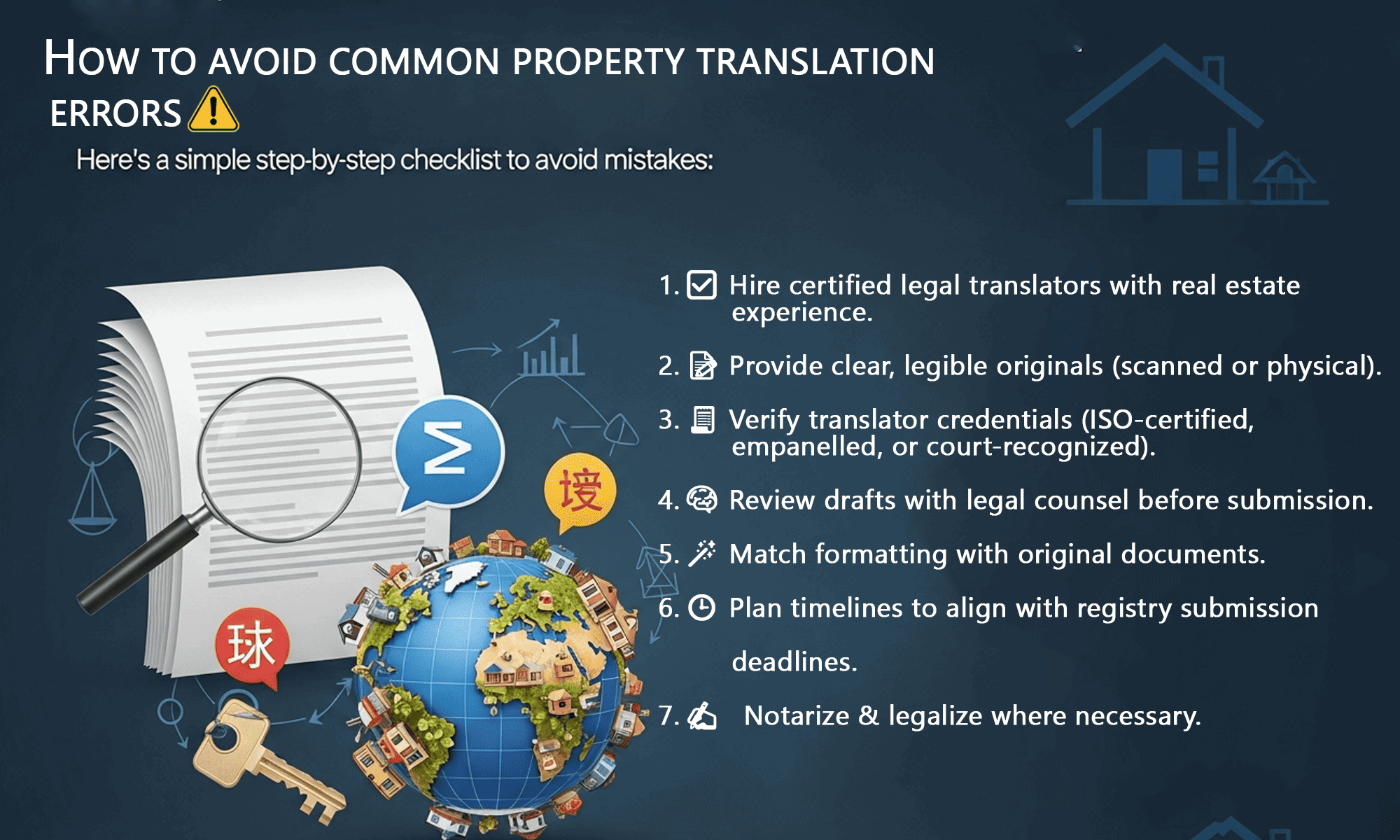
Here’s a simple step-by-step checklist to avoid mistakes:
✅ Hire certified legal translators with real estate experience.
📝 Provide clear, legible originals (scanned or physical).
🧾 Verify translator credentials (ISO-certified, empanelled, or court-recognized).
🧠 Review drafts with legal counsel before submission.
🪄 Match formatting with original documents.
🕒 Plan timelines to align with registry submission deadlines.
✍️ Notarize & legalize where necessary.
Pro Tip: Submitting a translation that’s certified, properly formatted, and notarized the first time saves weeks of delays.
Why Choose Yashvi Translation for Property Document Translation (Pan India)
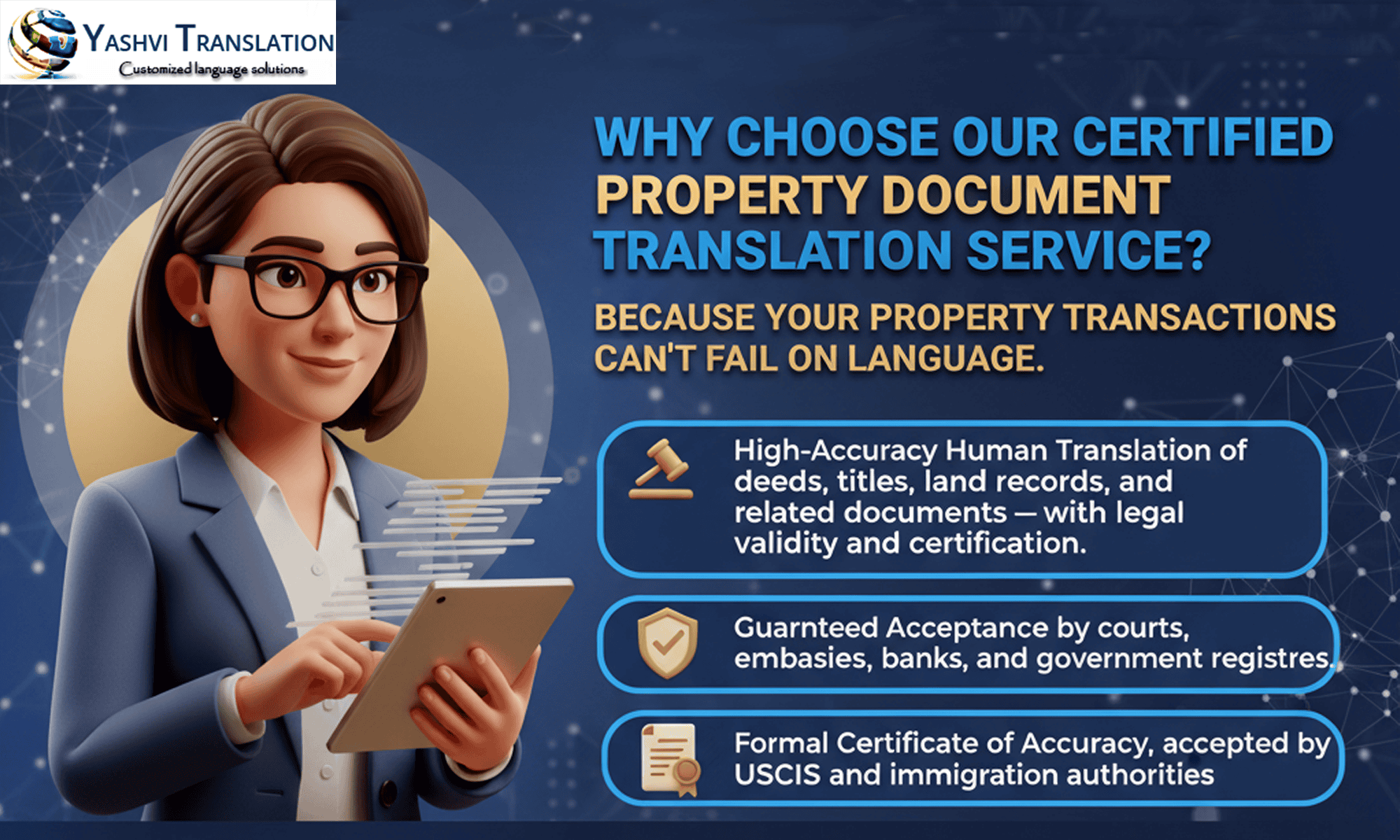
For over a decade, Yashvi Translation has helped lawyers, NRIs, real estate developers, embassies, and banks get their property documents translated accurately, securely, and legally.
🏆 What Sets Us Apart:
✔️ Certified legal translators accepted by sub-registrar offices across India
🌐 Translation for English ↔ Hindi, and all major international languages (German, French, Arabic, Spanish, and more)
🕒 24–48 hour turnaround available for urgent registrations
🔐 100% confidential & legally compliant process
📄 Support for notarization, apostille, and legalization
📝 Need error-free certified property document translation?
Upload your deed, contract, or annexure securely and get a legally valid translation within 24–48 hours.
👉 Request a Certified Translation Now
❓ Frequently Asked Questions on Property Translation Mistakes
Q1: What happens if there’s a mistake in property document translation?
A: Even a small error can lead to rejection by land registries, delays in ownership transfer, or legal disputes. Certified translations help avoid these problems.
Q2: Can I use Google Translate for property deeds?
A: No. Machine translations lack legal accuracy and are not accepted by courts or sub-registrars.
Q3: Is notarization mandatory for property translations?
A: Many sub-registrar offices and embassies require notarization or apostille. Always check the jurisdiction’s legal requirements.
Q4: Who can certify property translations in India?
A: Certified legal translators, empanelled professionals, or translators recognized by embassies and courts.
👉 Tip: Adding notarization and translator certification dramatically improves acceptance rates.
Conclusion: Precision Protects Your Property Rights
When it comes to property document translation, cutting corners is risky. Each clause, stamp, and phrase carries legal weight. By avoiding the mistakes above and partnering with certified experts, you protect your transactions, rights, and peace of mind.
👉 Ready to translate your property documents the right way?
Contact Yashvi Translation Today →
Recent Clients Review
- "I received the requested quote incredibly fast. All communication was handled with the utmost professionalism, and the document-sharing process was completely seamless. Not only is their pricing highly competitive, but... read more"I received the requested quote incredibly fast. All communication was handled with the utmost professionalism, and the document-sharing process was completely seamless. Not only is their pricing highly competitive, but their overall service delivery is exceptionally prompt. Neha truly understood my urgency and went above and beyond to accommodate my additional requests. Highly recommended! read less

 Pavan Venigella3/06/2026I contacted Yashvi Translation Services for translation of birth certificate for visa purposes about five days before my visa appointment, so it was quite urgent. I had no idea about... read moreI contacted Yashvi Translation Services for translation of birth certificate for visa purposes about five days before my visa appointment, so it was quite urgent. I had no idea about the authorized translation for visa applications, so I reached out to them a bit clueless.
From the very first call, Jyoti Verma was professional and very helpful, patiently explaining the process and guiding me on what was required. The communication was very smooth and trustworthy as everything was handled through their official email IDs.
They delivered the translated soft copy within 24 hours and also dispatched the hard copy on priority so that I could receive it before my appointment.
Special thanks to Jyoti Verma, the Project Coordinator, and her team for handling my request so efficiently.
Overall, a very professional and reliable experience. Highly recommended, especially if you have an urgent requirement. read less  Pritam Singh3/06/2026I had a superlative experience with Yashvi Translation. Since it was the first time I was getting a legal document translated or certified, I had a lot of doubts and... read moreI had a superlative experience with Yashvi Translation. Since it was the first time I was getting a legal document translated or certified, I had a lot of doubts and queries. All my doubts were patiently resolved and once I sent my documents, the process was very smooth and quick. Every thing was done on mail and WhatsApp and it saved me time and trouble of going anywhere.
I would definitely recommend Yashvi Translation for such type of service read less  Priti Barve2/27/2026
 - Service provided by Yashvi Translation was simply excellent. I hired them for translating my son’s Master’s degree certificate from Latin to English. It was delightful right from enquiry to the... read moreService provided by Yashvi Translation was simply excellent. I hired them for translating my son’s Master’s degree certificate from Latin to English. It was delightful right from enquiry to the receipt of the certified copy by courier. Fast and accurate! read less
 Kumar T2/26/2026I am writing to express my sincere thanks to Yashvi Translation and its team for their support, commitment, and on-time delivery of my document. I sought their services for translation... read moreI am writing to express my sincere thanks to Yashvi Translation and its team for their support, commitment, and on-time delivery of my document. I sought their services for translation of my marriage certificate from local language Marathi to English.
The translation is truly at the level of excellence that was desired for the certified document .
I highly appreciate efficiency, attention and professionalism of Yashvi Translation . Thanks Ms Neha for prompt and courteous support, the document received is complete with stamps and certification. read less  I K2/13/2026It was a great experience with Yashvi Translation Services. I booked for russian translation document. The service was fast, professional, and well managed. The document was given on... read moreIt was a great experience with Yashvi Translation Services. I booked for russian translation document. The service was fast, professional, and well managed. The document was given on Friday evening , and the notarized document was received on Saturday evening and hard copy on Monday as promised.
Special thanks to Neha for guiding me throughout the process. She was very helpful and responsive.
I’m very satisfied with the service and would definitely recommend them. ⭐⭐⭐⭐⭐ read less  Mrinmay Sasmal2/09/2026
 - Excellent service. Wasn't expecting such a professionalism can exist in India. Process was smooth and swift. All queries and clarifications were instantly responded by the team, especially project coordinator... read moreExcellent service. Wasn't expecting such a professionalism can exist in India. Process was smooth and swift. All queries and clarifications were instantly responded by the team, especially project coordinator Jyoti verma who was very quick in her responses, be it on mail or whatsapp. Pricing was also competitive as i had checked the prices with competitors before engaging with them. Team Yashvi, keep up the good work. You guys provide peace of mind. read less
 Ravi Verma1/17/2026Best service and professional work. I am greatful to Neha and Vikas sir for their constant guidance and support. They were always approachable, patient and willing to help whenever needed... read moreBest service and professional work. I am greatful to Neha and Vikas sir for their constant guidance and support. They were always approachable, patient and willing to help whenever needed and i truly appreciate all the effort they put in. Highly recommend!
Best wishes for 2026. read less  Aakash Srivastava1/08/2026I used Yashvi Translation for WhatsApp chat translation for my visa application, and the experience was very smooth. Neha guided me properly and ensured everything was done as per immigration... read moreI used Yashvi Translation for WhatsApp chat translation for my visa application, and the experience was very smooth. Neha guided me properly and ensured everything was done as per immigration requirements. My documents were accepted, and I am very satisfied with their service. Thanks to Neha and the entire team. read less
  Avantika1/05/2026
 - I got my documents translated from Yashvi translation service. They are very transparent about the price and commitment. They are very reliable.
 Kedim Girish12/26/2025Excellent service with great accuracy and support
Yashvi Translation provided outstanding certified translation services for my documents. The team was very professional, responsive, and ensured everything met official requirements. Delivery was... read moreExcellent service with great accuracy and support
Yashvi Translation provided outstanding certified translation services for my documents. The team was very professional, responsive, and ensured everything met official requirements. Delivery was on time, and the overall experience was smooth and stress-free. read less  Akash Captain12/17/2025it was very quick and thanks lot for… it was very quick and thanks lot for the support
 Bakki Athi11/14/2025
 - Best service. I got my birth certificate translated in just 24 hours at very reasonable price. Go for it.
 AAKAR PATEL11/06/2025I found Yashvi translation services over google and reached out to them. Their services are really great and their team did the work done in two days..I was a good... read moreI found Yashvi translation services over google and reached out to them. Their services are really great and their team did the work done in two days..I was a good experience with the team. read less
  Jogindra Korla8/05/2025Excellent service!
I had a great experience with Yashvi Translation Services. They handled my 10th marksheet translation very professionally and accurately. The process was smooth, fast, and hassle-free. I especially want... read moreExcellent service!
I had a great experience with Yashvi Translation Services. They handled my 10th marksheet translation very professionally and accurately. The process was smooth, fast, and hassle-free. I especially want to thank Neha Ma’am for her polite behavior, quick response, and helpful attitude throughout the process. She guided me at every step and made the entire process stress-free. Highly recommend their service to anyone looking for official translation work. read less  Samar7/26/2025
 - I had a wonderful experience working with Yashvi Translation. I needed several important documents to be translated quickly and accurately, and they handled the task with great efficiency and responsibility.
Vikas... read moreI had a wonderful experience working with Yashvi Translation. I needed several important documents to be translated quickly and accurately, and they handled the task with great efficiency and responsibility.
Vikas Sir's professionalism and clear guidance were truly commendable, while Neha Ma'am’s friendly, calm, and cooperative nature made the entire process smooth and stress-free.
The entire translation work was carried out in a very systematic, prompt, and error-free manner.
I sincerely thank Yashvi Translation, Vikas Sir, and Neha Ma'am for providing me with timely and high-quality service.
Thank you very much for your excellent service! 🙏 read less  Sushil Rijal6/23/2025I recently used the apostille service for my degree certificate through Yashvi Translation, and the entire process was smooth and well-handled.
Ms. Jyoti Verma coordinated with me throughout the process. She... read moreI recently used the apostille service for my degree certificate through Yashvi Translation, and the entire process was smooth and well-handled.
Ms. Jyoti Verma coordinated with me throughout the process. She was professional, responsive, and ensured that all my queries were answered promptly. The documentation and timeline were clearly communicated, and the work was completed within the expected timeframe.
I truly appreciate her support and would recommend Yashvi Translation, especially Jyoti Verma, for anyone looking for reliable and efficient apostille services. read less  Pankaj Mishra6/14/2025Outstanding Birth Certificate Translation Service!
I recently approached Yashvi Translation for the certified translation of my birth certificate, and I’m extremely happy with their service. The team was professional, quick to... read moreOutstanding Birth Certificate Translation Service!
I recently approached Yashvi Translation for the certified translation of my birth certificate, and I’m extremely happy with their service. The team was professional, quick to respond, and delivered an accurate translation well within the promised time frame.
They made the entire process stress-free, and the translated document was accepted without any issues. Their attention to detail and customer support were truly impressive. I highly recommend Yashvi Translation for anyone needing official document translations—especially for something as important as a birth certificate.
Thank you for your excellent service!
Keep it Up ! read less  Dev Parkash6/12/2025






 Yashvi Translation


From the very first call, Jyoti Verma was professional and very helpful, patiently explaining the process and guiding me on what was required. The communication was very smooth and trustworthy as everything was handled through their official email IDs.
They delivered the translated soft copy within 24 hours and also dispatched the hard copy on priority so that I could receive it before my appointment.
Special thanks to Jyoti Verma, the Project Coordinator, and her team for handling my request so efficiently.
Overall, a very professional and reliable experience. Highly recommended, especially if you have an urgent requirement. read less

I would definitely recommend Yashvi Translation for such type of service read less


The... read moreI am writing to express my sincere thanks to Yashvi Translation and its team for their support, commitment, and on-time delivery of my document. I sought their services for translation of my marriage certificate from local language Marathi to English.
The translation is truly at the level of excellence that was desired for the certified document .
I highly appreciate efficiency, attention and professionalism of Yashvi Translation . Thanks Ms Neha for prompt and courteous support, the document received is complete with stamps and certification. read less

Special thanks to Neha for guiding me throughout the process. She was very helpful and responsive.
I’m very satisfied with the service and would definitely recommend them. ⭐⭐⭐⭐⭐ read less


Best wishes for 2026. read less


Despite finalizing the work, the agency did not even provide clear payment methods initially. When I followed up, I received an email with very confusing and unclear details instead of straightforward instructions. The communication throughout the process was highly unprofessional.
Ms. Neha and Mr. Vikas were unreliable and, even without acknowledging their mistakes, they started blaming me rather than taking responsibility. The way they handled the situation showed a lack of professionalism and accountability.
Based on my experience, the service quality is far from what the reviews suggest. This was a complete waste of time and money. I would strongly advise others to be cautious before approaching this agency. Privacy is the main concern.
The decision is yours, but my experience was extremely disappointing. read less



Yashvi Translation provided outstanding certified translation services for my documents. The team was very professional, responsive, and ensured everything met official requirements. Delivery was on time, and the overall experience was smooth and stress-free.



I had a great experience with Yashvi Translation Services. They handled my 10th marksheet translation very professionally and accurately. The process was smooth, fast, and hassle-free. I especially want to thank Neha Ma’am for her polite behavior, quick response,... read moreExcellent service!
I had a great experience with Yashvi Translation Services. They handled my 10th marksheet translation very professionally and accurately. The process was smooth, fast, and hassle-free. I especially want to thank Neha Ma’am for her polite behavior, quick response, and helpful attitude throughout the process. She guided me at every step and made the entire process stress-free. Highly recommend their service to anyone looking for official translation work. read less

I recently approached Yashvi Translation for my document's translation into Spanish for visa and I’m extremely happy with their service. The team was professional, quick to respond, and delivered an accurate translation well within the promised time.
Their attention... read moreGreat Translation Service!
I recently approached Yashvi Translation for my document's translation into Spanish for visa and I’m extremely happy with their service. The team was professional, quick to respond, and delivered an accurate translation well within the promised time.
Their attention to detail and customer support were truly impressive. I highly recommend Yashvi Translation for anyone needing official document translation.
Thank you for your excellent service!
Keep it Up read less

Vikas Sir's professionalism and clear guidance were truly commendable, while Neha... read moreI had a wonderful experience working with Yashvi Translation. I needed several important documents to be translated quickly and accurately, and they handled the task with great efficiency and responsibility.
Vikas Sir's professionalism and clear guidance were truly commendable, while Neha Ma'am’s friendly, calm, and cooperative nature made the entire process smooth and stress-free.
The entire translation work was carried out in a very systematic, prompt, and error-free manner.
I sincerely thank Yashvi Translation, Vikas Sir, and Neha Ma'am for providing me with timely and high-quality service.
Thank you very much for your excellent service! 🙏 read less


Ms. Jyoti Verma coordinated with me throughout the process. She was professional, responsive, and ensured that all my queries were... read moreI recently used the apostille service for my degree certificate through Yashvi Translation, and the entire process was smooth and well-handled.
Ms. Jyoti Verma coordinated with me throughout the process. She was professional, responsive, and ensured that all my queries were answered promptly. The documentation and timeline were clearly communicated, and the work was completed within the expected timeframe.
I truly appreciate her support and would recommend Yashvi Translation, especially Jyoti Verma, for anyone looking for reliable and efficient apostille services. read less

I recently approached Yashvi Translation for the certified translation of my birth certificate, and I’m extremely happy with their service. The team was professional, quick to respond, and delivered an accurate translation well within the promised... read moreOutstanding Birth Certificate Translation Service!
I recently approached Yashvi Translation for the certified translation of my birth certificate, and I’m extremely happy with their service. The team was professional, quick to respond, and delivered an accurate translation well within the promised time frame.
They made the entire process stress-free, and the translated document was accepted without any issues. Their attention to detail and customer support were truly impressive. I highly recommend Yashvi Translation for anyone needing official document translations—especially for something as important as a birth certificate.
Thank you for your excellent service!
Keep it Up ! read less


and in understanding requirements and did a good job in reasonable charges. They were responsive to my queries/doubts and explained the process and translated... read moreI had a good experience for getting my documents translated with Yashvi. They have been extremely cooperative
and in understanding requirements and did a good job in reasonable charges. They were responsive to my queries/doubts and explained the process and translated the documents in reasonable time for US visa application. I highly recommend them. read less




and I sincerely appreciate their prompt and efficient service. Their dedication... read moreI recently used their service, I had a great experience with (Jyoti Verma)Apostille service and I must say I am highly impressed. I received my document parcel
and I sincerely appreciate their prompt and efficient service. Their dedication and professionalism in handling everything so smoothly made the entire process
I highly recommend them for their excellent service!” read less



and I sincerely appreciate their prompt and efficient service. Their dedication and professionalism in handling everything so smoothly made the entire process
I highly... read moreI recently used their service, and I must say I am highly impressed. I received my document parcel
and I sincerely appreciate their prompt and efficient service. Their dedication and professionalism in handling everything so smoothly made the entire process
I highly recommend them for their excellent service!” read less


Thank you ! read less



“I’d especially like to thank Neha Kumari and Vikas chaturvedi for going above and beyond in ensuring that my needs were met.
It’s rare to come across such a dedicated and customer-focused team, and I truly appreciate the effort you put into making your services stand out.I look forward to continuing my relationship with your company and will gladly recommend your services to others. read less



Neha Ma'am guided me. She is professional and responsible. Thanks to... read moreYashvi Translation is one of the best translation and notary services. Thank you so much, bro, for providing me with an accurate translation of my documents along with notary services.
Neha Ma'am guided me. She is professional and responsible. Thanks to her for all the help. read less




I recently used Yashvi Translation to get my documents translated and certified, and I am extremely pleased with their service. The entire process was seamless and professionally managed.
A special mention goes to Neha, who played a crucial... read moreExceptional Service and Professionalism!
I recently used Yashvi Translation to get my documents translated and certified, and I am extremely pleased with their service. The entire process was seamless and professionally managed.
A special mention goes to Neha, who played a crucial role in ensuring the translations were accurate and delivered on time. Her dedication, attention to detail, and prompt communication made the experience stress-free and efficient.
I highly recommend Yashvi Translation for anyone seeking reliable translation and certification services. Thank you, Neha, and the entire team, for your outstanding support! 👍 read less




Keep it up 👍



























I like your service is so fast
Excellent work 👍



Received my documents on time 🙂




I contacted him to get a document translated into English as he said you will get certified in 2 days I got it.
Quality work in less time, staying in that commitment, doing the work like a professional, very happy... read more"Excellent,professional service"
I contacted him to get a document translated into English as he said you will get certified in 2 days I got it.
Quality work in less time, staying in that commitment, doing the work like a professional, very happy with their service read less





Team here at Yashvi Translation did the work as per my requirement and submitted everything on time.
Fully recommend their services.
