Email Id :-
 Mobile: -



Financial Documents Translation Challenges

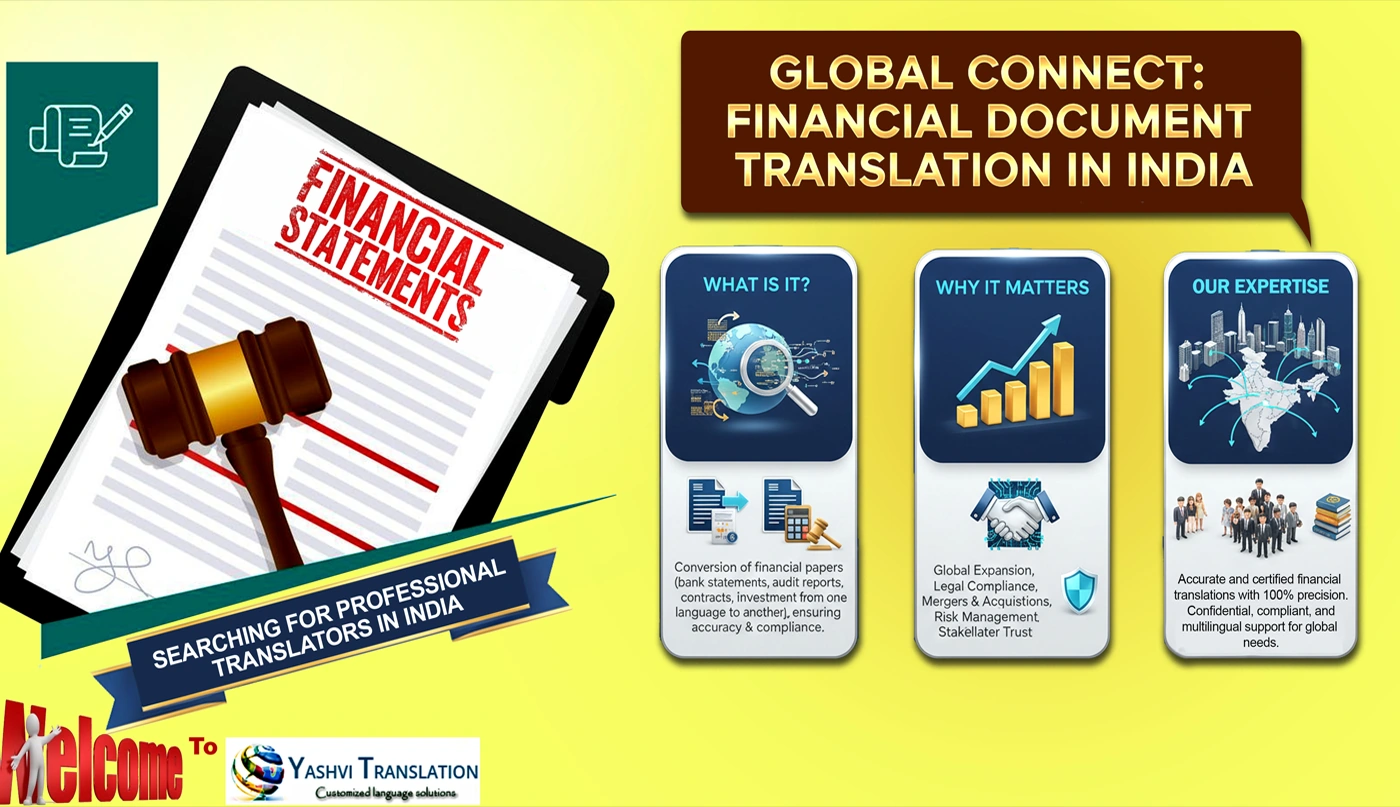
A Guide to Financial Document Translation: Accuracy, Compliance, and Key Challenges
Bank statement translation and other financial translations are not just about converting words—it requires domain expertise, consistency, compliance, and an eye for nuance. A single mistranslated figure in an annual report, a vague clause in a cross-border contract, or an inaccurate bank statement for a visa application can lead to disastrous consequences.
The types of financial documents you translate each carry unique challenges. In this guide, readers (from corporations to fintech platforms, audit firms, investors, and visa applicants) will learn:
- Which financial document types need translation
- The specific challenges for each type
- Best practices to reduce risk, cost, and delays
- How to choose a provider who can deliver accuracy, confidentiality, and compliance
- Simple invoices or receipts: 24 hours
- Contracts, bank statements: 1–2 days
- Full reports, audits, prospectuses: 3–5+ days
- Provide editable source files when possible (Excel, Word)
- Include a terminology list / glossary or previous translations
- Flag sensitive or critical sections (footnotes, risk disclosures)
- Specify formatting rules (tables, decimals, date format)
- Use domain-expert review (finance, accounting, audit)
- Final QA + layout check to ensure nothing moved or misaligned
- Translators must understand accounting standards (IFRS, GAAP) relevant to the jurisdictions.
- Provide certified translation or notarization when needed for regulators or courts.
- Use secure systems, NDAs, and encrypted file transfer to protect confidentiality.
By the end, you’ll know exactly what to ask from your translation partner and how to prepare your documents for translation.
What Factors Influence the Cost and Timeline of a Project?
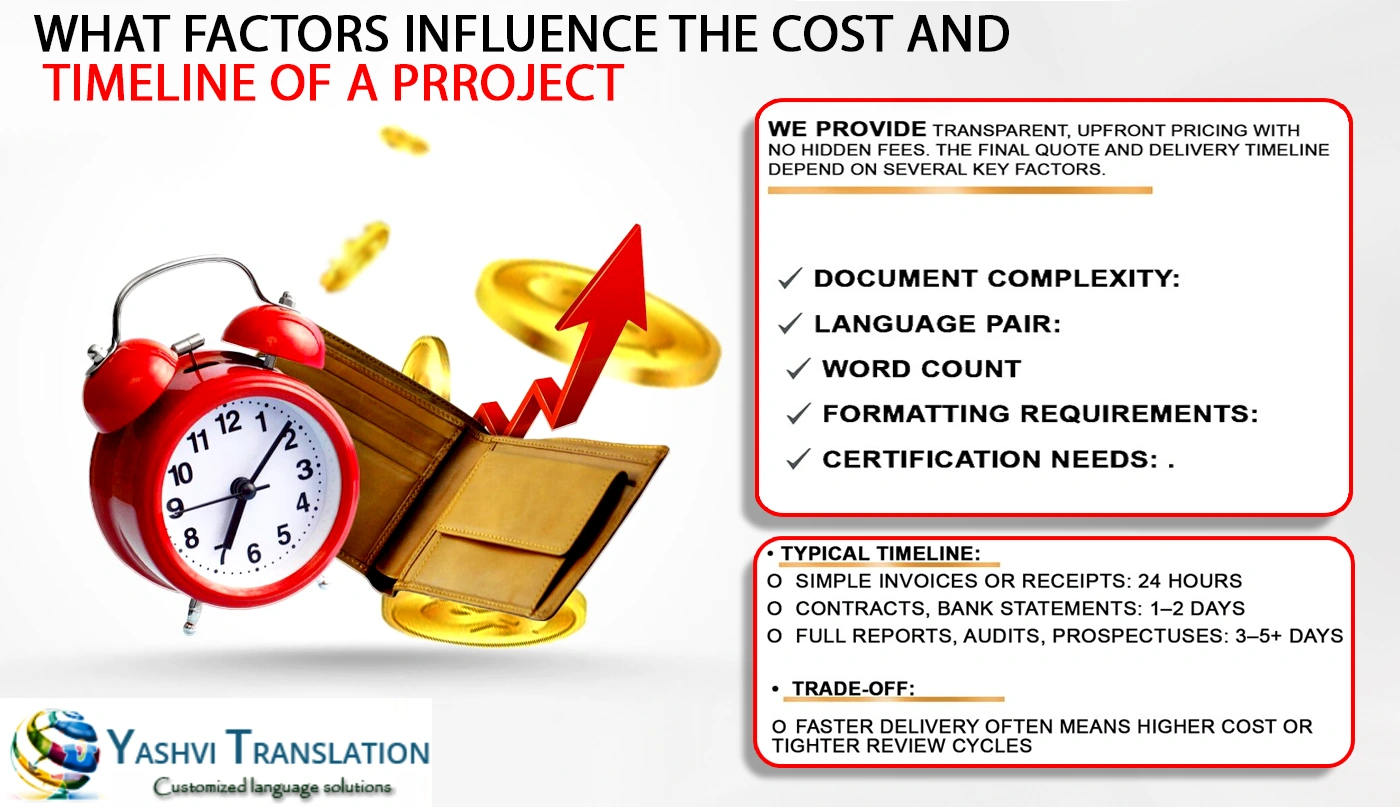
Document type, volume, certification, formatting, and expertise determine both cost and turnaround.
We provide transparent, upfront pricing with no hidden fees. The final quote and delivery timeline depend on several key factors.
✅ Document Complexity: A simple bank statement is faster and less costly to translate than a 200-page prospectus with complex charts and legal notes.
✅ Language Pair: Common language pairs (e.g., English to Spanish) are generally more cost-effective than rare language pairs.
✅ Word Count: The total number of words in the source document is the primary basis for pricing.
✅ Formatting Requirements: Documents requiring extensive desktop publishing (DTP) to replicate complex layouts will require additional time and budget.
✅ Certification Needs: The requirement for a notarized or sworn certification affects the final cost.
✅ Urgency: Standard delivery offers the best value, while express or overnight delivery is available for urgent deadlines at a premium rate.
Typical Timeline:
Trade-off: faster delivery often means higher cost or tighter review cycles
Best Practices: Translating Each Document Type Right
To minimize risk and delays, follow a structured translation process:
Compliance, Trust & Legal Validity
Errors in financial translation can lead to regulatory sanctions, financial misstatements, or reputational damage.
Sources highlight consistency and confidentiality as central challenges in financial translation.
Why the Document Type Matters: Translation Challenges Explained
Annual Reports & Audit Statements
Long, heavily cross-referenced documents with footnotes, tables, and accounting jargon are prone to structural errors.
Watch for: consistent term usage, correct footnote/appendix mapping, and preserving layout integrity.
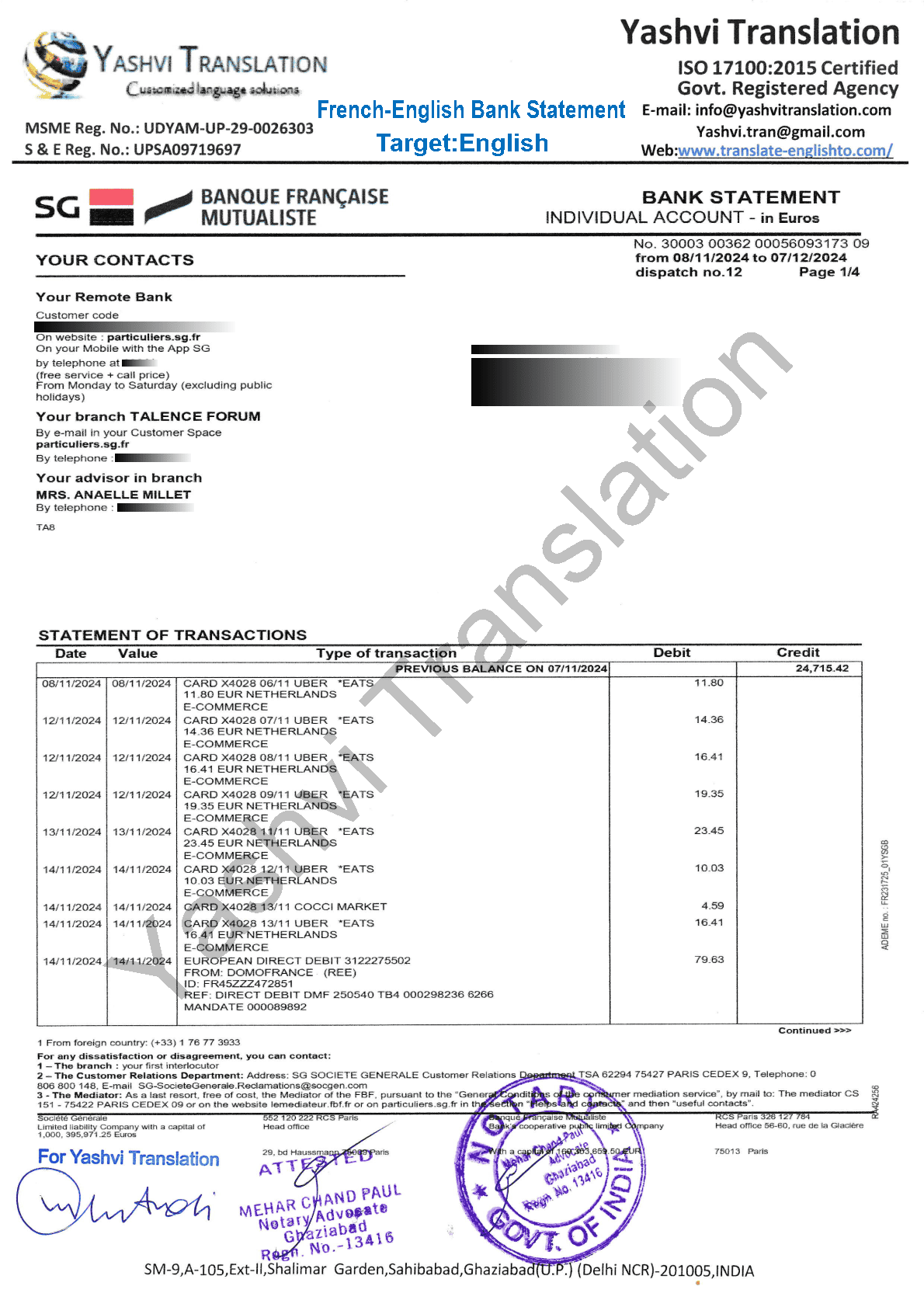
Bank Statements / Transaction & Loan Documents
These contain many small entries with dates, shorthand text, and different numeric formats.
Watch for: uniform date/number formatting, clear transaction descriptions, and currency consistency.
Prospectuses / IPO / Investor Disclosures
These use legally sensitive, heavily regulated language and technical investor terms.
Watch for: precise legal consistency, regulatory compliance in the target jurisdiction, and exact risk statement translations.
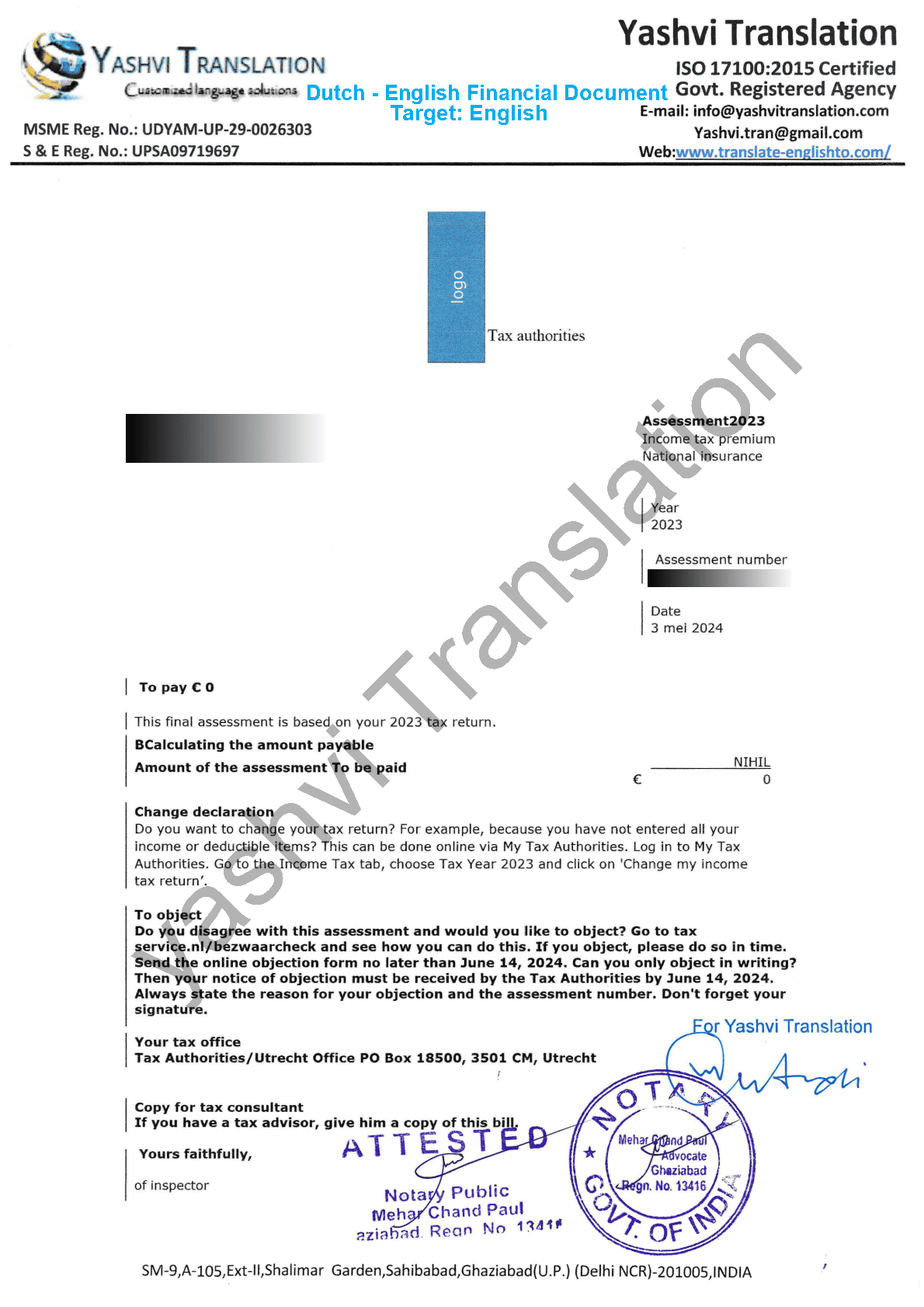
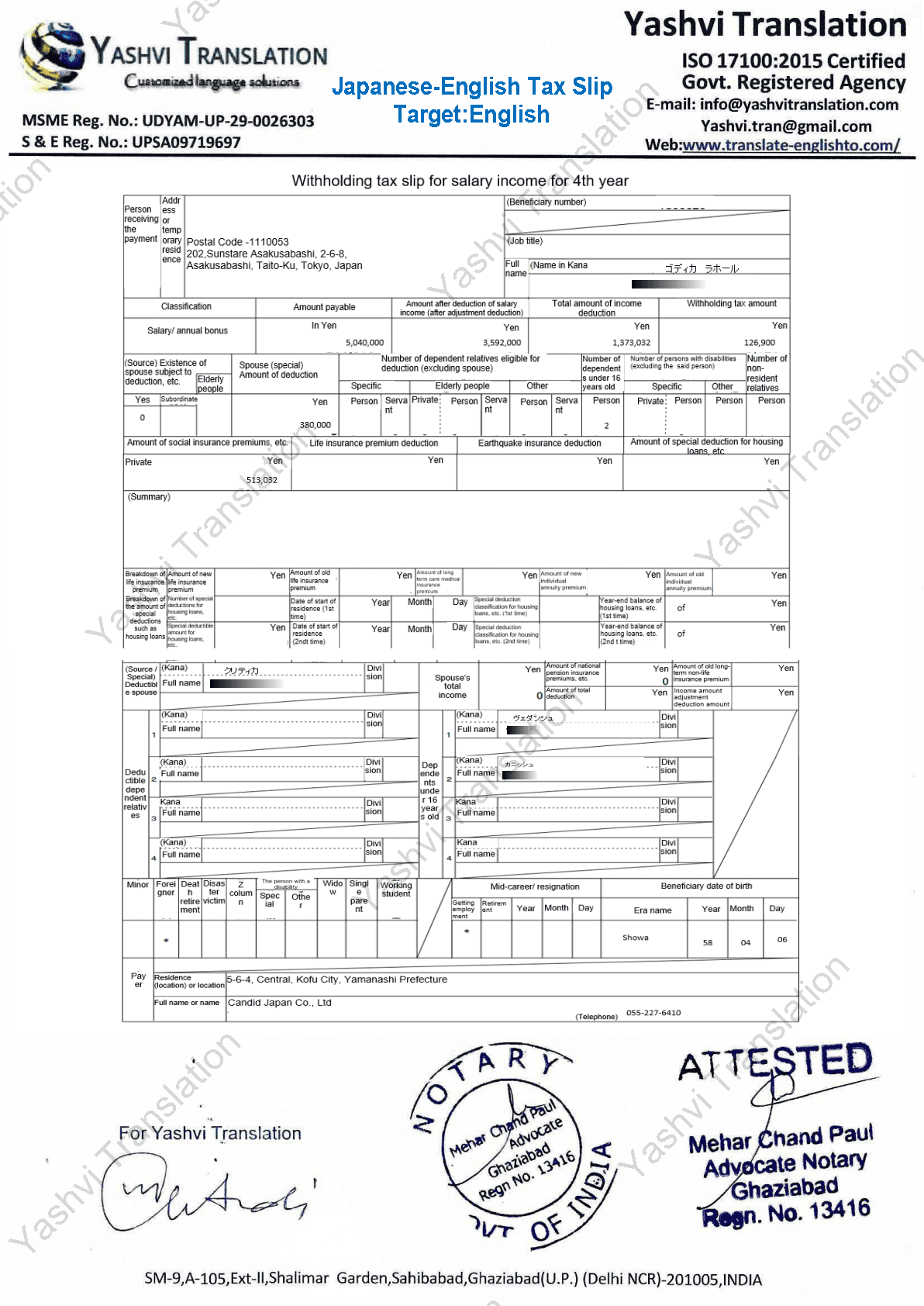
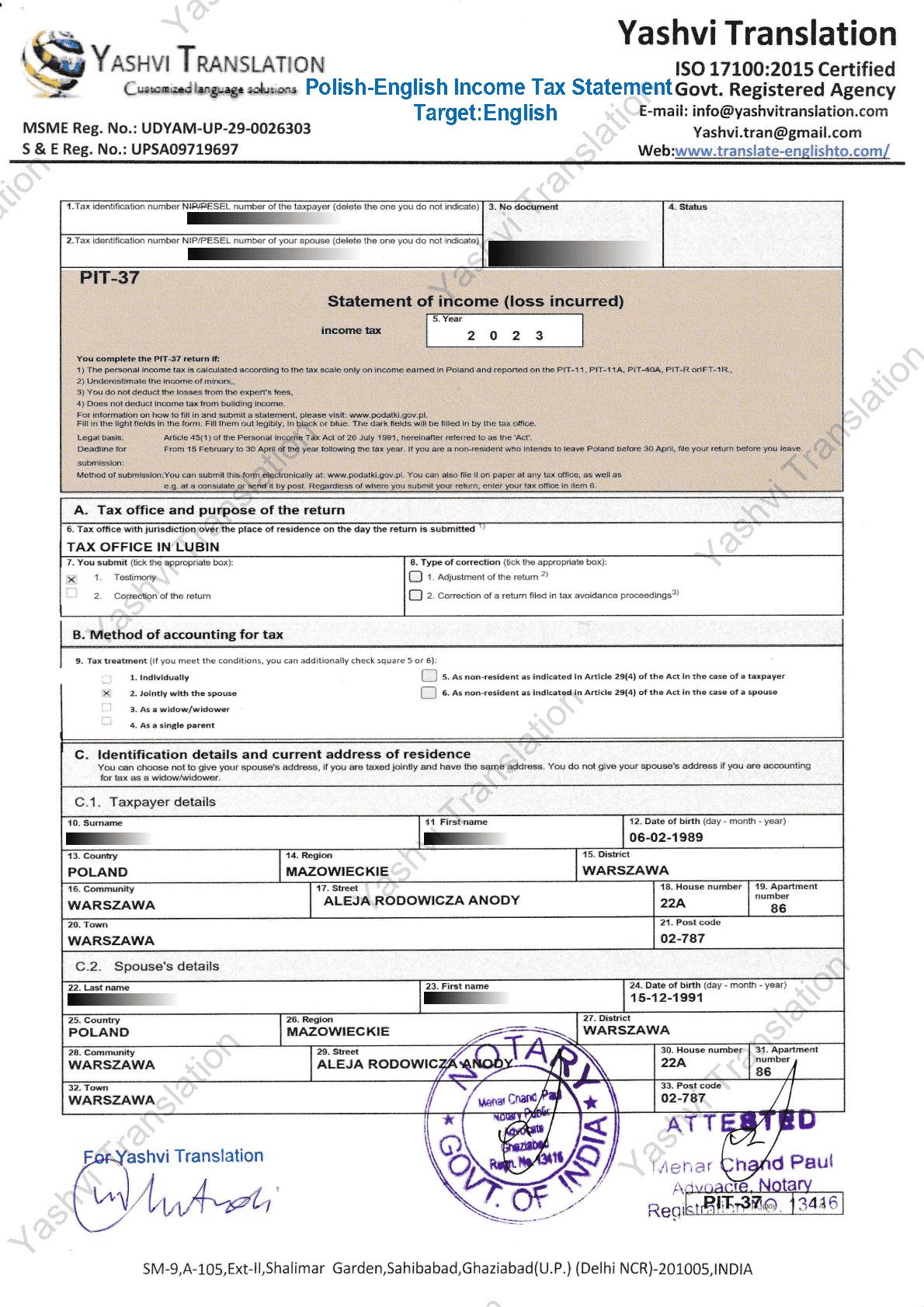
Tax Returns & Regulatory Filings
Tax codes and regulatory forms differ across countries and use structured layouts.
Watch for: faithful mapping of line-item labels, updated regulatory terminology, and matching the original form’s format.
Contracts / M&A / Financial Agreements
These include legal clauses, defined terms, conditional logic, and cross-references.
Watch for: one-to-one clause correspondence, consistency in defined terms, and correct handling of conditional statements.
Insurance / Actuarial Reports & Risk Models
These often include statistical tables, complex models, and domain-specific jargon.
Watch for: terminology consistency, alignment of tables and charts, and clarity of assumptions and risk model descriptions.
Budgets, Forecasts & Financial Models
Combining narrative explanations with numeric data and embedded assumptions is tricky.
Watch for: preserving assumption logic, consistent term usage, and clear distinction between text and numbers.
Invoices, Receipts & Billing Statements
Many line items, tax or VAT fields, abbreviations, and quantitative details are involved.
Watch for: clear itemization, consistent currency and tax formatting, and unambiguous item descriptions.
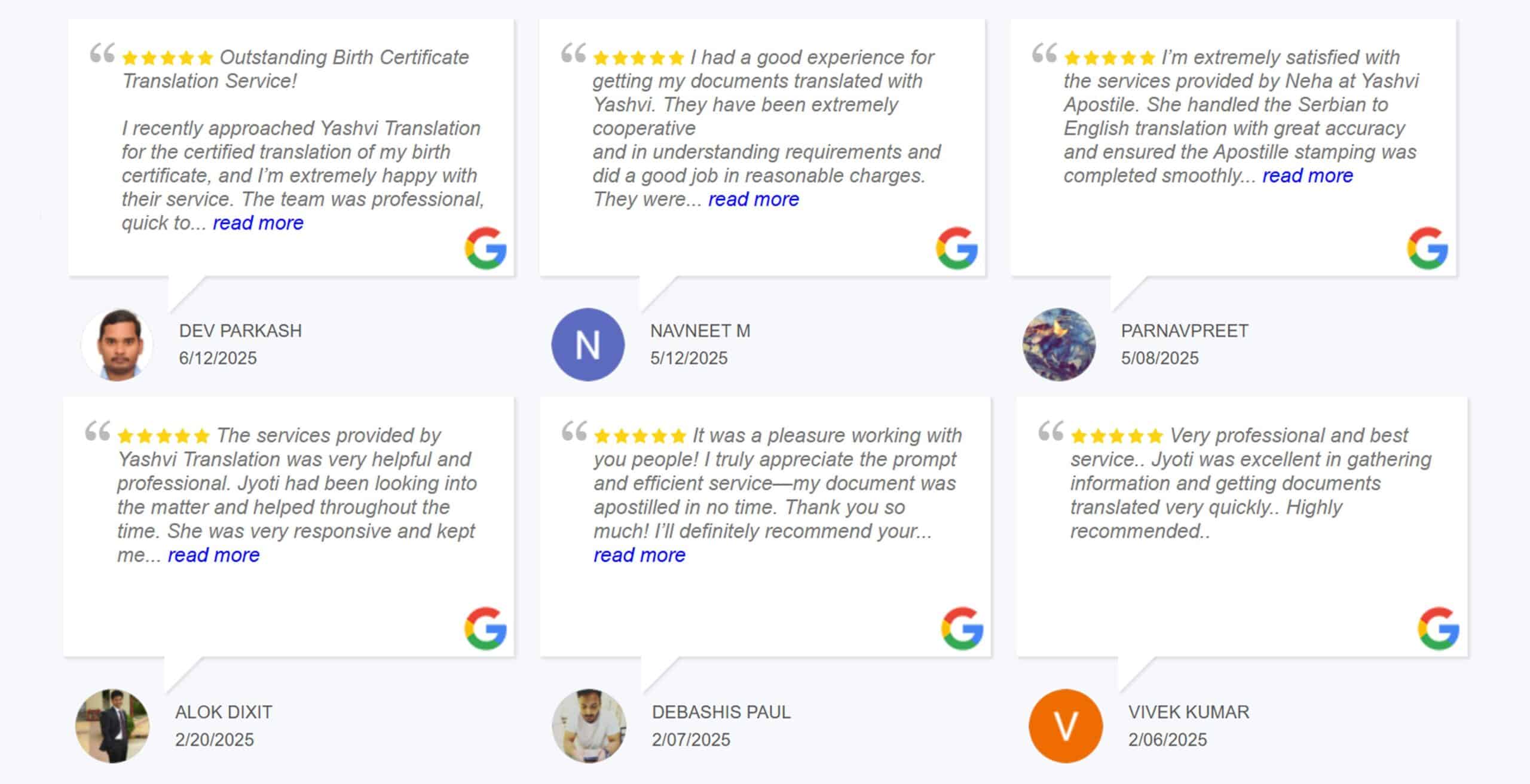
SEE OUR *5 Star CUSTOMER REVIEWS!!
What is a certified financial translation?
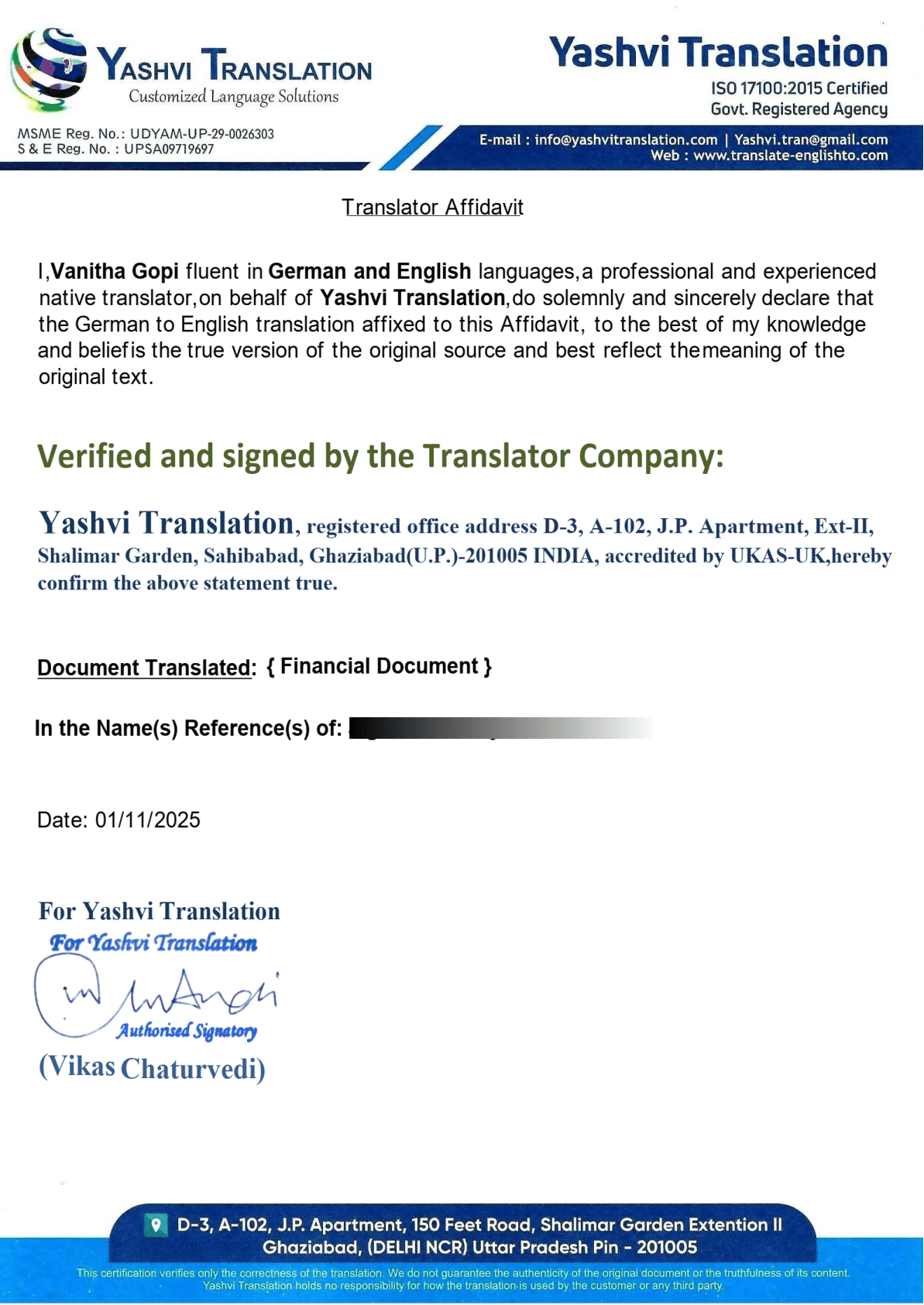
A certified financial translation is a translated document accompanied by a signed statement from the translation provider, attesting that it is a complete and accurate rendering of the original text. This “Certificate of Accuracy” is crucial for documents submitted to legal, governmental, or regulatory bodies.
Are your translations accepted by banks, courts, and embassies?
Yes. Our certified translations are prepared to meet the specific standards of institutions worldwide. We guarantee acceptance for official purposes, including immigration (USCIS, IRCC), legal proceedings, and financial compliance, because our process and certifications are designed for this purpose.
How do you ensure the confidentiality of our sensitive financial data?
We treat data security as a top priority. All our translators are bound by strict non-disclosure agreements (NDAs), and our entire workflow, from upload to delivery, is protected by end-to-end encryption. Your documents are never shared with unauthorized parties.
Can you handle complex formats like scanned PDFs or images?
Yes. Our team is equipped to work with a wide variety of file formats. We use advanced Optical Character Recognition (OCR) technology to extract text from non-editable formats like scans and images, which is then translated and reviewed by our human experts.
What is the risk of using machine translation for financial documents?
Using automated tools like Google Translate for financial documents is extremely risky. Machine translation cannot grasp context, understand specific financial terminology, or ensure regulatory compliance. It often produces literal but incorrect translations that can lead to significant legal and financial liabilities.


Why is Expert Financial Document Translation a Non-Negotiable Requirement?
Relying on non-specialist translators or machine translation for financial documents introduces unacceptable risks. The stakes are simply too high for errors. Our specialized service provides the assurance needed to meet strict legal, regulatory, and institutional standards across the globe.
✅ Mitigate Financial Risk: Inaccurate translations can lead to incorrect financial models, flawed investment decisions, and direct monetary loss.
✅ Ensure Regulatory Compliance: Global financial bodies like the SEC and ESMA, as well as national authorities, have strict language and formatting requirements. Non-compliance results in heavy fines and legal action.
✅ Secure Investor and Stakeholder Trust: Clear, professionally translated documents like annual reports and prospectuses are essential for maintaining shareholder confidence and attracting foreign investment.
✅ Support Legal Defensibility: For M&A due diligence, audits, and litigation, certified translations serve as legally sound evidence that can withstand scrutiny in court.
✅ Achieve Successful Immigration Outcomes: Embassies and immigration agencies require precisely translated financial statements to verify an applicant’s financial stability. Errors lead to delays and rejections.
What Document Types Require Financial Translation?
Financial documents are not one-size-fits-all. Each category serves a different purpose. Below is a list of key financial document categories commonly translated. Each has its own translation priorities and pitfalls:
Corporate Finance and Investor Relations Documents
- These documents communicate a company’s financial health and strategic vision to the public, investors, and regulatory bodies. The translation must be a perfect blend of financial precision and brand voice.
- Examples: Annual Reports, Quarterly Earnings Reports, Prospectuses, Shareholder Letters, Initial Public Offering (IPO) Documents.
- Primary Challenge: The primary challenge is maintaining consistency in tone, terminology, and key financial figures across hundreds of pages, often under extremely tight deadlines during earnings season. The translator must act as both a financial expert and a brand guardian.
- Target Audience: Investors, Shareholders, Financial Analysts, Regulatory Bodies, Multinational Corporations.
- These documents form the contractual basis for financial relationships, from consumer banking to large-scale corporate lending. Accuracy is paramount, as these texts are legally binding.
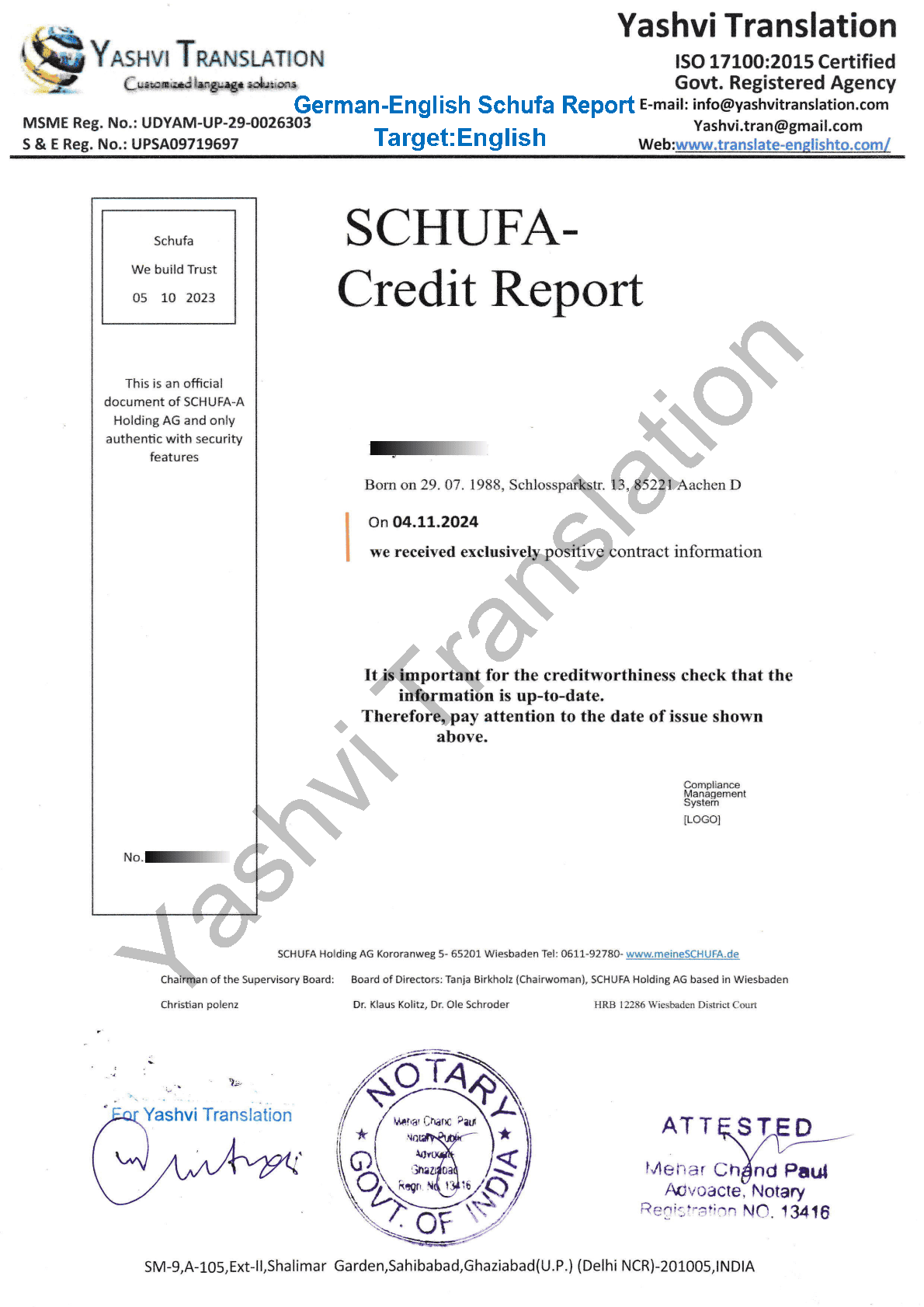
- Examples: Bank statements, loan agreements, credit reports, mortgage papers
- Example use cases include bank statement translation for visa or immigration submission and tax return translation for audits, compliance, or embassy review
- Primary Challenge: Translating legally binding clauses, interest rate calculations, and compliance statements with zero ambiguity. The translator must have deep knowledge of both source and target country banking regulations and legal terminology.
- Target Audience: Financial Institutions, Export/Import Companies, Legal Firms, Individuals applying for visas or l
- These documents provide a detailed, standardized snapshot of an entity’s financial position. They are heavily scrutinized by auditors, tax authorities, and potential buyers during due diligence.
- Examples: Balance Sheets, Income Statements, Cash Flow Statements, Audit Reports, Tax Returns, Invoices.
- Primary Challenge: Ensuring absolute numerical accuracy and the correct application of region-specific accounting standards (e.g., GAAP vs. IFRS). Even a misplaced comma or decimal point can have major consequences.
- Target Audience: Auditing Firms, Tax Consultants, M&A Advisory Firms, Corporate Accounting Departments.
- This category includes the complex policies and claims that define financial protection and liability. The language is often dense with industry-specific jargon and conditional clauses.
- Examples: Insurance Policies, Claims Documents, Actuarial Reports, Underwriting Documents.
- Primary Challenge: Accurately conveying the precise scope of coverage, exclusions, and legal conditions. A mistranslation can alter liability and lead to significant disputes during a claim.
- Target Audience: Insurance Companies, Multinational Corporations, Legal Practices.
- These documents are central to high-stakes corporate transactions and legal proceedings. They require a hybrid expertise in both financial and legal language.
- Examples: M&A Due Diligence Documents, Sales and Purchase Agreements (SPAs), Confidentiality Agreements, Litigation Support Documents.
- Primary Challenge: Maintaining the exact legal meaning and intent of every clause while accurately translating complex financial data and warranties. This requires a senior translator with proven expertise in corporate law and finance.
- Target Audience: Legal Firms, M&A Advisory Firms, Investment Firms, Corporate Legal Departments.
- For individuals, these documents are the key to proving financial standing to government bodies. They must be perfectly clear, professionally formatted, and often certified to be accepted.
- Examples: Personal Bank Statements, Salary Records (Payslips), Tax Returns, Proof of Funds Letters.
- Primary Challenge: Ensuring the translated document mirrors the format of the original and is accompanied by the correct certification required by the specific embassy or immigration agency. The translation must be clean, professional, and unambiguous.
- Target Audience: Individuals applying for visas or immigration, Spouses showing financial support, Students applying for study permits.
Banking, Lending, and Credit Documents
Accounting, Audit, and Tax Documents
Insurance and Risk Management Documents
Legal and Mergers & Acquisitions (M&A) Documents
Personal Finance Documents for Immigration and Visas
Choosing a Qualified Provider for Each Document Type
▶️ Check specialization — ensure the translator / agency has experience with your document type
▶️ Request samples / references in your domain
▶️ Certifications and credentials matter for high-stakes documents
▶️ Security & confidentiality must be guaranteed
▶️ Communication / project management — you should be able to manage complex, multi-part projects smoothly
▶️ Glossary / term base reuse — consistency across documents
For region-specific requirements, clients also rely on our financial Translation service in Delhi for corporate, legal, and visa-focused financial documentation.
Secure the Accuracy Your Financial Documents Deserve
Choosing the right partner protects your finances, reputation, and legal standing.
Whether you need bank records, audit files, contracts, or visa documents translated, we deliver compliance-ready accuracy every time.
👉 Solve financial translation challenges with Yashvi Translation
✅ Certified accuracy
✅ Regulatory compliance
✅ Confidential handling
✅ Fast, reliable delivery
Ready to eliminate risk and ensure your message is understood perfectly in any language?
Contact our team today for a confidential, no-obligation quote. Upload your documents securely and let our experts provide the certified accuracy you need to succeed
Need a quote or sample translation by document type — whether annual report, contract, bank statement, or regulatory filing?
Contact our certified financial translation team today.
We deliver precision, compliance, and speed, built for your industry’s standards and your document’s demands.
Frequently Asked Questions (FAQ)
Many organizations need translations for annual reports, bank statements, contracts, and tax filings.
Only if they have domain expertise across those types and maintain rigorous consistency.
Inconsistent terminology leads to confusion, possible financial misinterpretation, and credibility issues.
Yes—professional translators aim to preserve layout, though editable formats aid accuracy.
Absolutely—local laws, formats, and codes vary; translations must be adapted to each regulatory context.
Recent Clients Review