 Email Id :-
 Mobile: -


Translation Services / Why Human Translation Is Essential

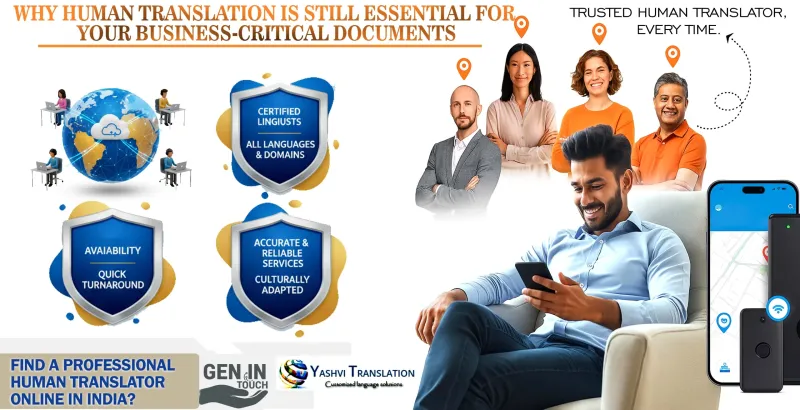
Why Human Translation Is Still Essential for Your Business-Critical Documents
In today’s fast-moving global business environment, many companies are tempted by free or low-cost AI translation tools. After all, they promise speed, ease and low cost. Yet when it comes to business-critical documents — legal contracts, regulatory filings, financial reports, cross-border agreements — the stakes are high. A translation error can cost time, reputation, money or even legal liability.
In this guide you’ll learn why human translation still matters, even in the age of AI; where machine translation falls short; how to choose the right human translation partner; and how to make the investment pay off.
Here’s what you’ll learn:
- What qualifies as a business-critical document
- What free AI/automated translation tools can and cannot do
- Why human translators provide irreplaceable advantages for high-stakes work
- When a hybrid (machine + human) might work — and when it doesn’t
- How to choose a reliable human translation service
- How investing in human translation yields value far beyond cost savings
- Legal contracts or agreements for international partners
- Regulatory filings, audit reports, annual reports destined for foreign markets
- Notarial or certified documents for cross-border corporate structures
- Intellectual-property agreements, licensing documents, financial-statement translations
- Documents submitted to courts, governmental bodies or international authorities
- Always choose certified or native linguists familiar with your industry.
- Request back-translation for legal or government documents.
- Use translation memory tools to maintain consistency across large projects.
- AI provides a fast draft
- Human linguists refine tone, terminology, and accuracy
- Clients get quicker turnarounds without sacrificing trust or quality
- Domain expertise:
Ask if they handle legal, financial or technical translations (depending on your need). - Translator credentials:
Are the translators native speakers of target language? Are they subject-matter experts? Are their credentials verifiable? - Quality assurance process:
Do they have revision, proofreading, internal QA steps? - Confidentiality and security:
Is there an NDA? How is your data stored/transmitted? - Turnaround and costs:
What are realistic timelines? Are pricing transparent? Do they handle urgent work? - Local/regional understanding (for India context):
If you’re in India (or submitting documents from India abroad), ensure the vendor understands local regulations, international submission requirements, apostille/attestation issues. - Service scope and accountability:
Do they provide a certificate of translation? If required, notarisation or sworn translator? Are guarantees given?Industry-Specific Translation Challenges
Every sector faces unique translation difficulties:
Industry Key Challenges Solution Legal Terminology precision, certification requirements Certified human translators with legal background Medical Accuracy in diagnoses and dosage details Medical linguists + peer review Academic Format consistency, plagiarism sensitivity Expert linguists familiar with academic norms Business/Marketing Cultural adaptation, brand tone Transcreation and localization specialists Voice Search Query: “How do I translate my medical report accurately in India?”
Cost vs Value: Why It’s Worth Investing
At first glance, human translation costs more than plugging your document into a free tool. But the value far outweighs the savings. Consider:
▶️ Cost of a faulty translation: revisions, legal disputes, delays, costly errors.
▶️ The benefit of correct translation: faster approval, compliance, confidence.
▶️ Human translation enhances your brand and gives you assurance.
The Cost vs Quality Dilemma
Many clients compare translation prices without realizing that low cost often compromises quality.
Machine translations may seem cheaper—but editing errors later costs more time and credibility.Tips to Choose Wisely:
▶️ Request a sample translation before committing.
▶️ Evaluate turnaround times vs. project complexity.
▶️ Choose value, not the lowest bid.
Conclusion: Building Trust Through Quality Translation
Translation isn’t just about converting text—it’s about preserving meaning, trust, and intent across languages.
Whether you’re submitting documents for a visa, court, or corporate filing, accuracy and confidentiality matter most.At Yashvi Translation, we combine certified human expertise with advanced AI tools to deliver reliable, legally accepted translations every time.
Call to Action (CTA)
Need a translation you can trust?
Get your certified, notarized, or embassy-approved document translation today.
👉 Request a Free Quote or Upload Your Document
This question reveals a bigger truth: the real challenges in translation aren’t just linguistic—they’re human, technical, and ethical.
In this post, we’ll explore the key challenges translators and clients face, how to overcome them, and why choosing the right approach—machine, human, or hybrid—can make all the difference in translation accuracy and reliability.
What “Business-Critical Documents” Means
When we say “business-critical documents,” we mean those texts whose accuracy, confidentiality and smooth processing are essential to your business outcomes. Examples include:
What is at stake? A translation mistake may mis-state an obligation, omit a clause, or shift the tone of a contract — all of which expose your business to risk. Confidentiality is also non-negotiable: business-critical documents often include sensitive data, and uncontrolled translation tools may compromise your data security.
Maintaining translation quality means avoiding the limitations of machine translation that frequently lead to costly errors and rework in official submissions.
How to Maintain Translation Quality
How to ensure translation quality for legal or certified documents
The Trust Challenge: Who Can You Rely On?
Translation involves sensitive and confidential content—financial data, legal papers, personal records.
Trust becomes a core factor when choosing a translation service.
Factors That Influence Trust
✅ Certification: Is your translation agency ISO-certified or recognized by embassies or government bodies?
✅ Confidentiality: Are NDAs and secure file transfers part of their process?
✅ Experience: Does the agency specialize in your specific domain—legal, medical, or academic?
Building client confidence starts with agencies that offer professional proofreading and certification, supported by a formal Certificate of Accuracy for official acceptance.
✅ Work with agencies offering certified translations and transparent pricing.
✅ Ask for samples or references from similar projects.
✅ Ensure they provide notarization or embassy attestation if needed.
Machine vs Human Translation: The Accuracy Debate
The Rise of AI / Machine Translation Tools
Automated translation tools — from free platforms to enterprise MT (machine translation) systems — have made major gains. They are fast, inexpensive, and sometimes acceptable for low-risk, high-volume use.
But when paired with human insight, or used alone, they still face limitations. For example:
➡️ According to research, machine translation cannot always grasp context, tone or cultural nuance.
➡️ One study found human translations scored an average of 92.2, while AI translations scored 88.2 in legal contexts — showing a measurable gap in quality.
➡️ Thus while machine translation may appear tempting, especially for volume or internal uses, relying on it alone for high-stakes documents is risky.
If your documents require regional expertise and official acceptance, working with local translation experts in Chennai through Certified translation services in Chennai ensures compliance with both Indian and international authority requirements.
For organisations operating across Tamil Nadu, many also rely on contextual support from translation services in Coimbatore for regional language accuracy and faster coordination.
Advantages:
➡️ Speed and scalability
➡️ Cost-effective for large data sets or informal use
Limitations:
➡️ Inability to capture tone, emotion, and cultural context
➡️ Potential privacy risks with sensitive data uploads
➡️ Poor performance with idioms, legal, or technical terminology
Human Translation: The Gold Standard for Precision
Professional translators bring contextual understanding, subject expertise, and cultural intelligence—things no algorithm can fully replicate.
When to Choose Human Translators:
Is human translation better than AI for legal documents?”
✅ For legal, medical, or certified translations
✅ For brand content that must connect emotionally
✅ When accuracy and confidentiality are non-negotiable
The Hybrid Approach: Human + Machine Collaboration
It’s not about rejecting AI outright. Here’s how you can think about it:
Suitable for AI or hybrid (machine + human post-editing):
▶️ Large-volume content with low risk (e.g., blog posts, product descriptions, internal memos)
▶️ When speed and cost are more important than absolute precision
▶️ Where a “good enough” translation is acceptable and you still have human review
When you should avoid relying solely on AI:
➡️ Business-critical documents (contracts, legal, regulatory)
➡️ Documents where tone, nuance, industry-specific terminology matter
➡️ Where confidentiality and accountability are key
➡️ Where rejection or regulatory non-compliance would cost you
Leading translation resources emphasise that machine translation remains unfit for high-stakes tasks because of its limitations in context and cultural understanding.
Thus, if you do choose a hybrid model (machine + human), ensure the human component is fully professional, domain-expert and responsible for final quality assurance.
The smartest agencies today leverage AI-assisted translation combined with human post-editing—striking a perfect balance between speed and quality
Benefits of Hybrid Translation
How to Choose a Reliable Human Translation Partner
Selecting the right service is as important as choosing human over machine. Here are key questions and criteria:
Sample


Frequently Asked Questions
Quality control, cultural adaptation, and maintaining confidentiality are major challenges, especially when balancing human expertise with AI tools.
No. Machine translations are not accepted for legal, immigration, or certified purposes. Only human-certified translations are valid.
Check for ISO certification, client testimonials, and whether they provide notarization or embassy attestation.
A hybrid method—AI draft + human post-editing—offers the best mix of accuracy, speed, and cost efficiency.
While you could, it’s risky. Free tools lack nuance, cannot guarantee confidentiality, and may produce errors that invalidate or delay the document. For business-critical documents, human translation is safer.
You may face delays, rework, additional costs — or worse, legal exposure. It’s better to ask up-front: what translation standard does the other party accept?
Many professional services handle urgent jobs — but turnaround will depend on language pair, volume, complexity, and whether certification/notarisation is required. Always specify “business-document translation urgent India” when requesting quotes.
Only if the human review is rigorous, domain-expert, and final responsibility rests with the human translator. Otherwise you risk missing context or nuance.
A hybrid human-machine translation with post-editing ensures both speed and contextual accuracy.
Recent Clients Review


