Email Id :-
 Mobile: -



Are Digital Sworn Translations Accepted at Spanish Consulates

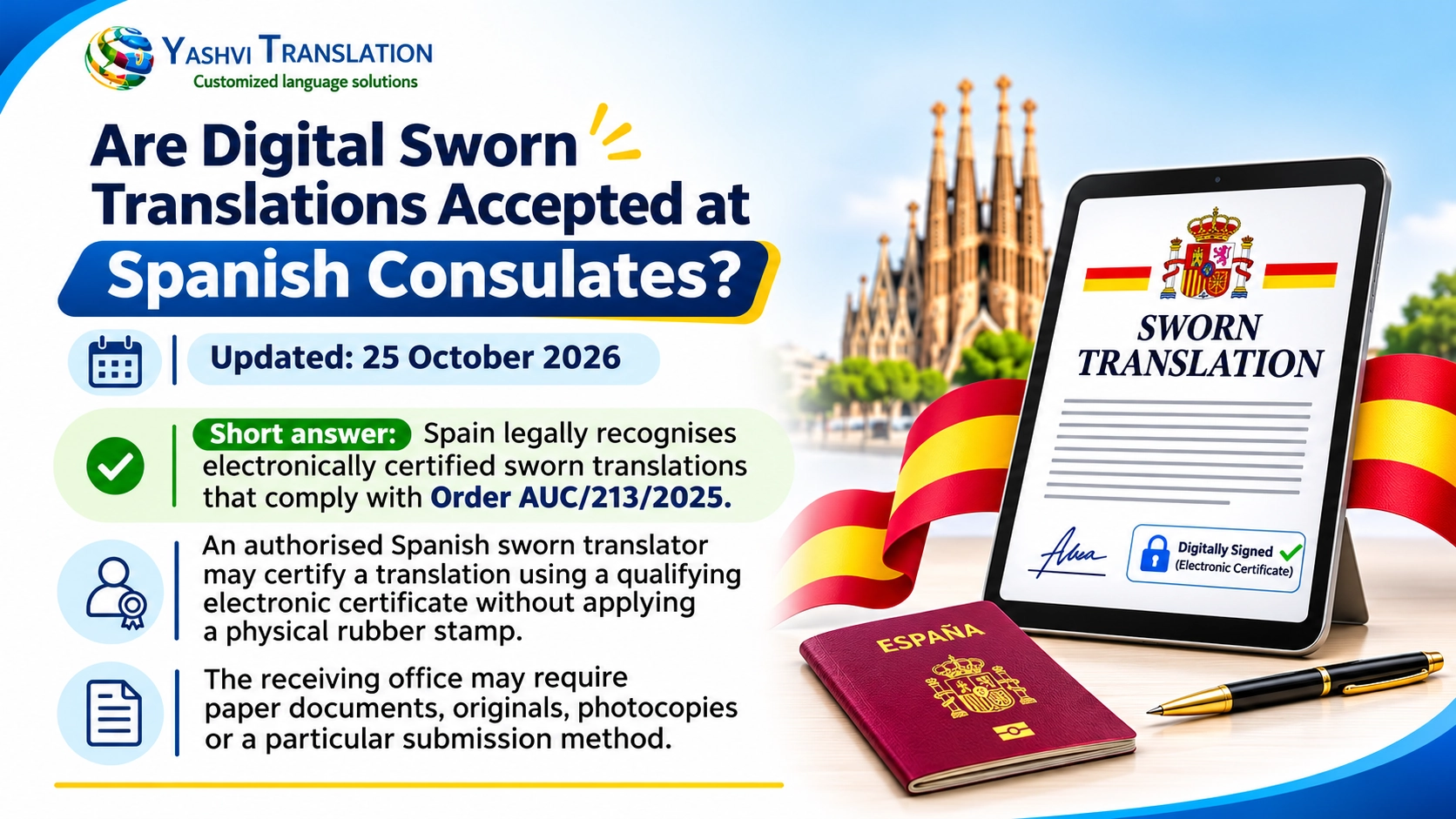
Are Digital Sworn Translations Accepted at Spanish Consulates?
Updated: 25 October 2026
Short answer: Spain legally recognises electronically certified sworn translations that comply with Order AUC/213/2025. An authorised Spanish sworn translator may certify a translation using a qualifying electronic certificate without applying a physical rubber stamp. The receiving office may require paper documents, originals, photocopies or a particular submission method.
What Does Spanish Law Say About Digital Sworn Translations?
Digital Spanish sworn translations are legally permitted under Order AUC/213/2025, which took effect on 8 March 2025. This regulation establishes how sworn translators appointed by Spain’s Ministry of Foreign Affairs, European Union and Cooperation (MAEC) may certify their work electronically.
The Legal Base
- Official Fact: On April 6, 2020, MAEC’s Oficina de Interpretación de Lenguas (OIL) issued an official statement confirming that certified Sworn Translators-Interpreters (Traductores-Intérpretes Jurados) may sign and submit official translations electronically using a Qualified Electronic Signature (Firma Electrónica Cualificada) issued by an approved certification authority (e.g., FNMT, Camerfirma), in compliance with EU Regulation 910/2014 (eIDAS) and Spanish Law 39/2015.
- Practical Explanation: Under Spanish law, a qualified electronic signature has the exact same evidentiary and legal weight as a handwritten wet-ink signature and physical rubber stamp. It does not expire when the translator’s digital certificate renews, provided it was valid at the timestamp of signing.
How Consular Verification Actually Works: The PKI & CSV Structure
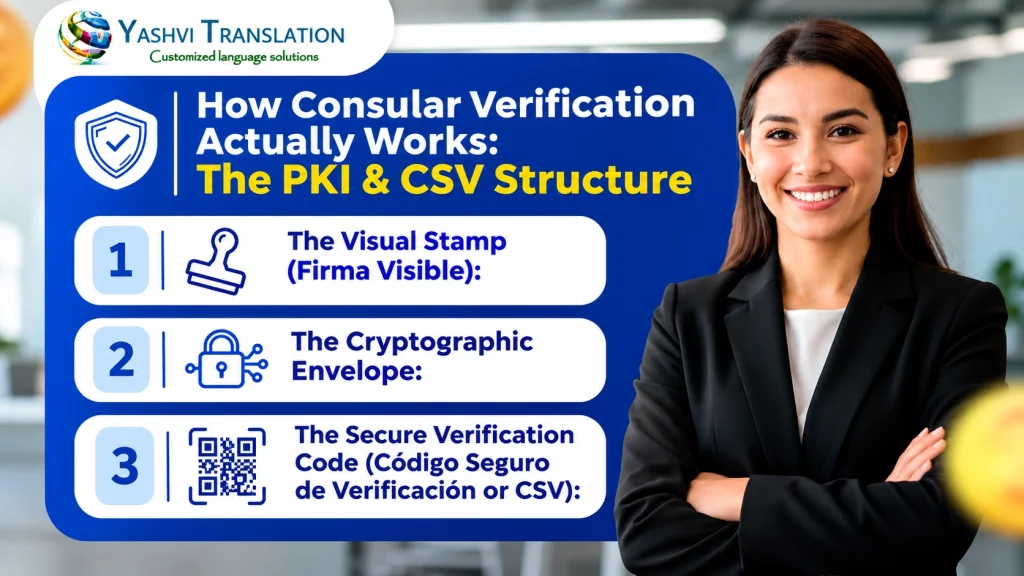
When an intake officer evaluates a digital sworn translation, they check three layers of authentication:
- The Visual Stamp (Firma Visible): The visual box showing the translator’s name, their MAEC identification number (número de TIJ), language pair, and the date.
- The Cryptographic Envelope: The underlying X.509 certificate embedded in the PDF. When opened in an approved PDF viewer (such as Adobe Acrobat Reader configured with the EU Trusted Lists), it shows a green banner confirming that the signature is valid and the document has not been altered since it was signed.
- The Secure Verification Code (Código Seguro de Verificación or CSV): A unique alphanumeric code printed along the margin or within the signature block.
Apostille Sequencing: The Common Process Breakdown
The most frequent reason Spanish Consulates reject sworn translations—whether digital or physical—is an incorrect sequence of certification.
The Rules of Consular Document Sequencing
- The Apostille Comes First: A sworn translator cannot translate an apostille that does not yet exist. If you translate your birth certificate, FBI background check, or ACRO certificate before it receives the Hague Apostille, your consular file will be rejected. You will have to pay for a supplementary translation of the Apostille.
- The Apostille Must Be Translated: Spanish consulates require the text of the Apostille itself to be translated into Spanish, even if it contains standard French or English headers.
Pre-Submission Protocol: Ensuring Your Digital Translation Is Accepted
If your translator signs your documents electronically, follow this step-by-step checklist before handing your file across the consular counter.
Step 1: Ensure Correct Configuration by the Translator
When commissioning your sworn translation, confirm that the translator will:
- Sign with an active Qualified Certificate issued by an official certifying authority (such as FNMT, Camerfirma, or ANF AC).
- Include the mandatory legal certification closing formula established by the MAEC:
“Don/Doña [Nombre del Traductor], Traductor/a-Intérprete Jurado/a de [Idioma] nombrado/a por el Ministerio de Asuntos Exteriores, Unión Europea y Cooperación, certifica que la que precede es traducción fiel y completa al [idioma de destino] de un documento redactado en [idioma de origen]. En [Lugar], a [Fecha].”
Step 2: Test the Signature on the Spanish Government’s Validator
- Visit the Spanish Ministry of Territorial Policy’s validation platform: sede.administracionespublicas.gob.es/valide/ (VALIDe).
- Select “Validar Firma” (Validate Signature).
- Upload the digitally signed PDF received from your translator.
- Input the security captcha and click “Validar”.
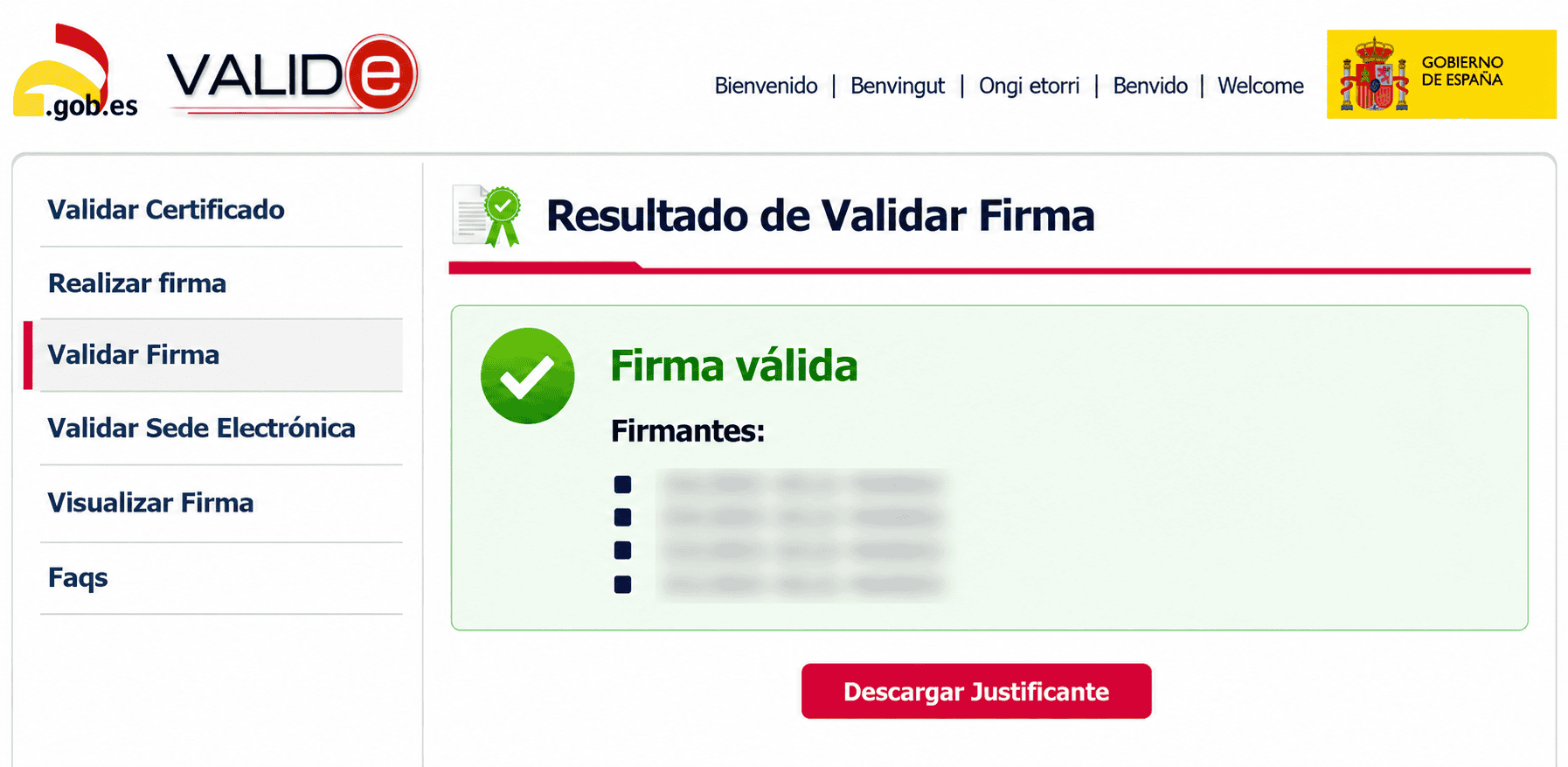
- The platform will return a confirmation stating:
-
- Estado de la firma: Válida (Signature status: Valid).
- Identidad del firmante: Name of your sworn translator.
- Tipo de certificado: Cualificado (Qualified).
Step 3: Print the Proof of Validation (Justificante de Validación)
From the VALIDe results screen, click “Descargar Justificante” (Download Validation Receipt).
Print this official receipt and clip it directly behind your printed digital translation. If an intake officer at a BLS desk or consulate challenges the legitimacy of the digital printout, this receipt provides proof from the Spanish government’s own platform that the document carries a verified legal signature.
Step 4: Correct Paper Assembly
- Print the translation in color so that the visual signature certificate, stamps, and any marginal annotations remain distinct.
- Ensure the translator’s copy of the original document (which must be appended to the translation, stamped, and dated) is printed completely, legibly, and in the exact sequence prepared by the translator.
- Do not disassemble, restaple, or trim the sheets.
What Are the Practical Advantages of a Properly Signed Digital Sworn Translation?
Digital sworn translations can reduce delivery friction and provide an additional method of checking authenticity, provided the digital workflow is compliant and the receiving office accepts it.
The most useful advantages are:
Faster electronic delivery. After certification, the signed file can be transmitted without waiting for international courier dispatch.
Verification of authenticity. Electronic signature-validation tools can help identify the signer and assess signature validity.
Greater resistance to undetected alteration. A valid cryptographic signature can reveal changes made after signing.
Better access outside major cities. Applicants in smaller towns can coordinate with an authorised translator remotely, without needing to find one locally.
See Our Real time Samples to get an Idea
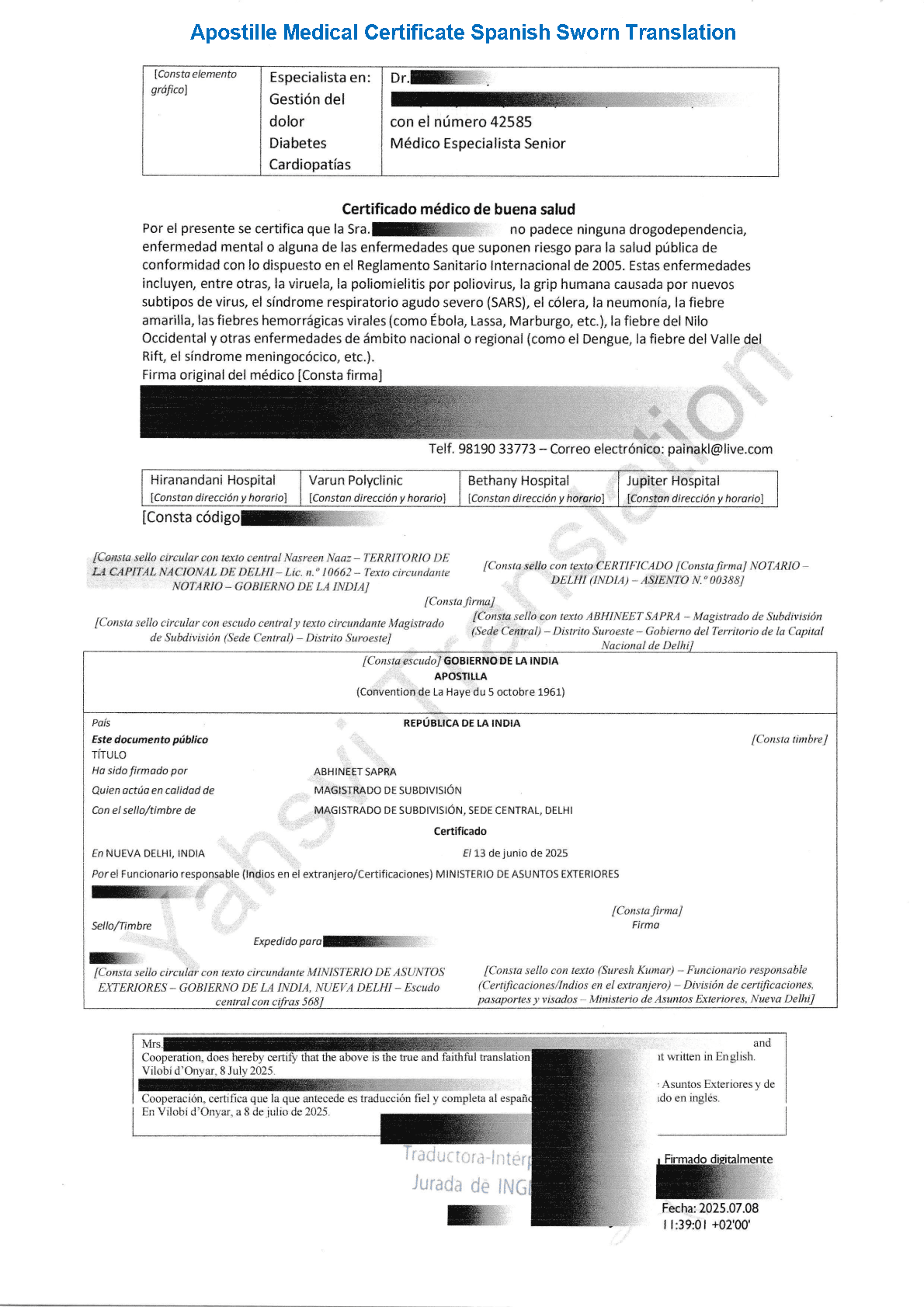
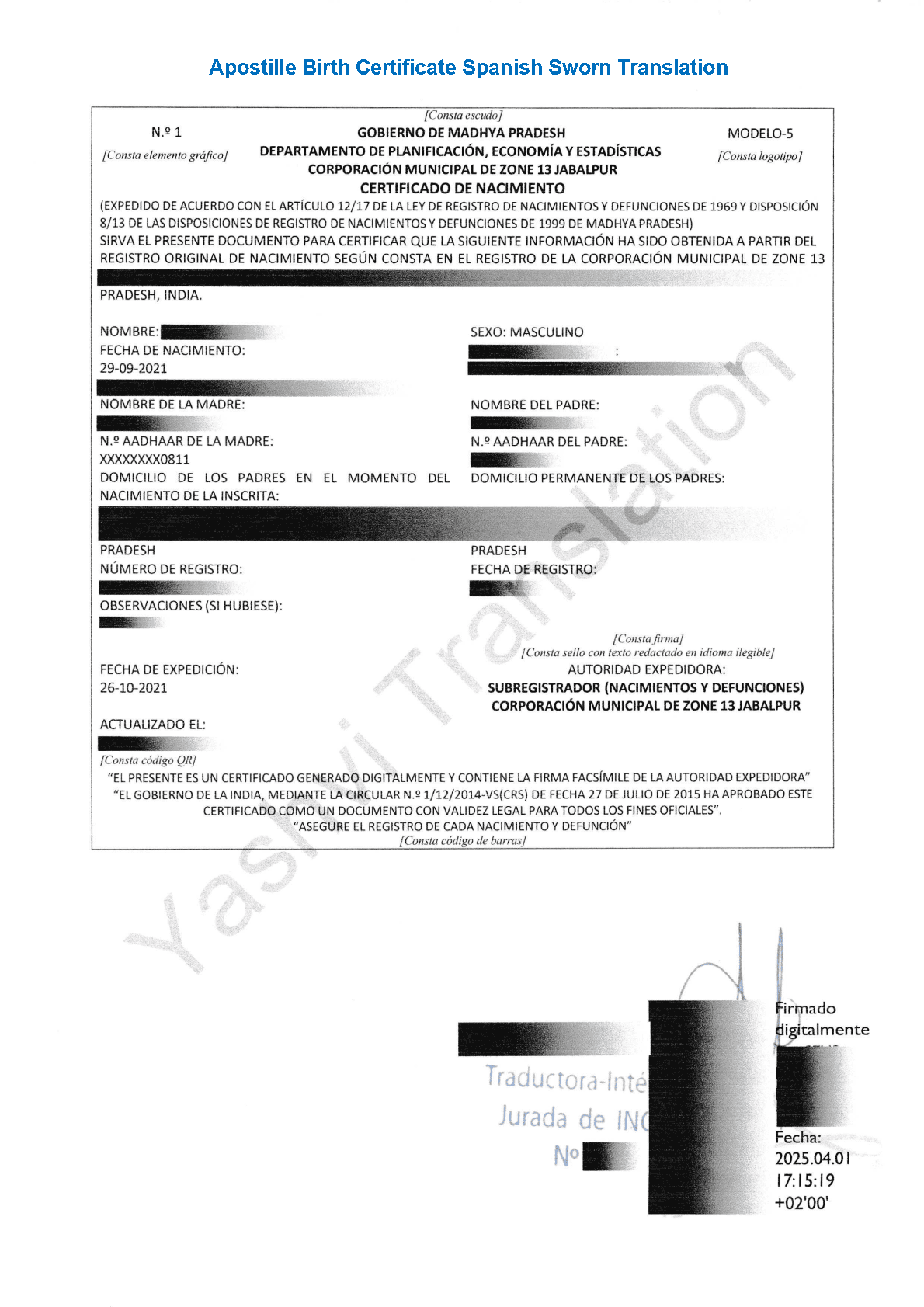
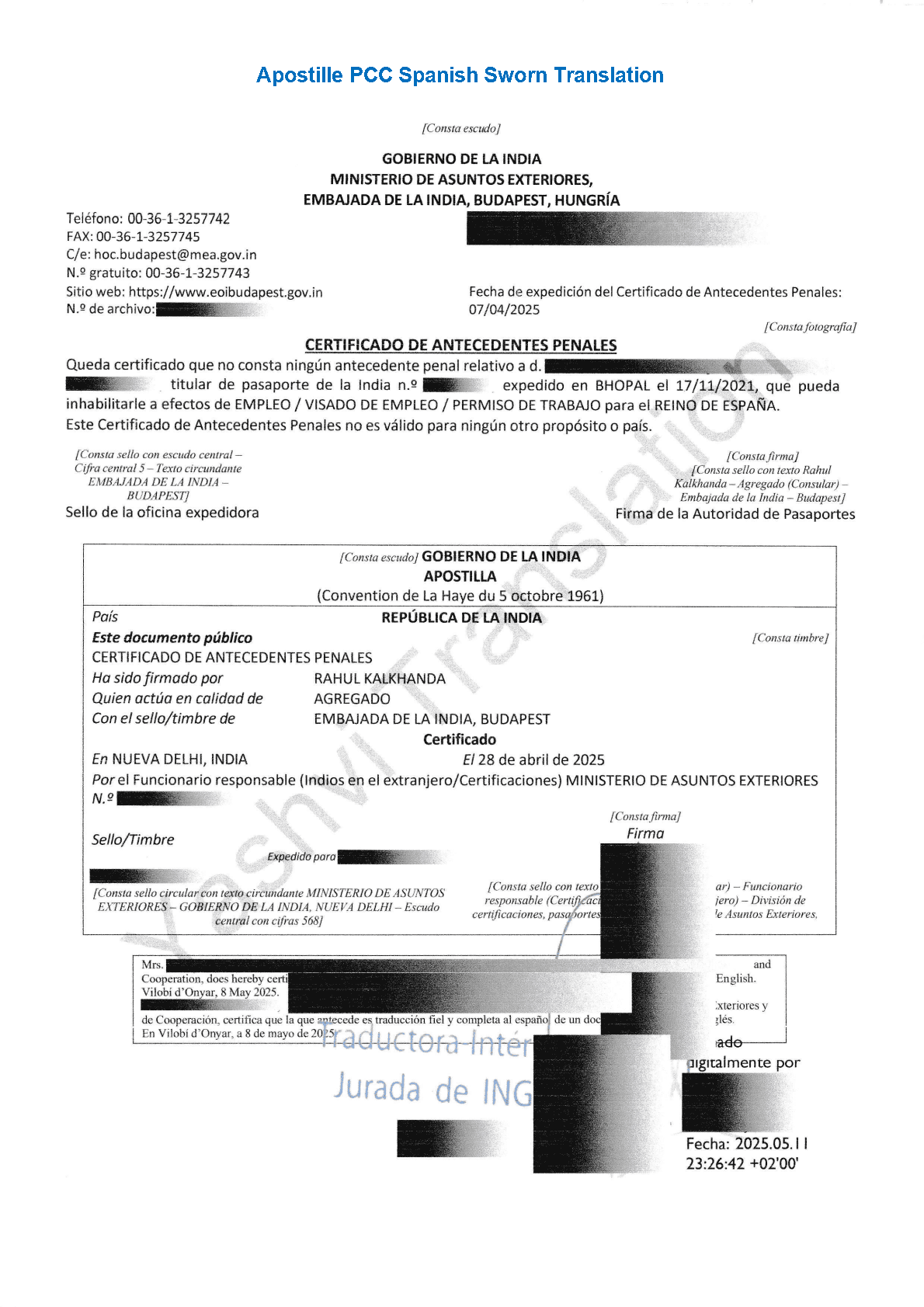


YASHVI TRANSLATION Dual-Format Approach: Traditional Sworn Stamp Plus Verifiable Digital Signature
At Yashvi Translation, we recognise that applicants may need both traditional physical certification and electronically verifiable sworn translations, depending on where and how their documents will be submitted.
Rather than treating digital and physical certification as competing methods, Yashvi coordinates with MAEC-appointed sworn translators to arrange both formats where required.
Our approach can include:
- Traditional physical certification: A paper sworn translation bearing the authorised translator’s actual ink stamp and handwritten signature.
- Digital certification: An electronically signed PDF issued by the authorised sworn translator, using a compliant electronic certificate that can be independently verified.
- Identity consistency: Checking that the sworn translator’s name, authorised language and registration information are consistent across the certification documents.
- Document completeness: Ensuring that the relevant source document, apostille where required, translation and certification are included in the appropriate signed package.
Troubleshooting Common Consular Rejections
Issue 1: “This translation is just a photocopy of a signature.”
- Cause: The intake clerk is viewing a printed PDF that lacks clear cryptographic context
- Immediate Fix: Present the printed VALIDe Validation Receipt (Justificante de Validación). Point out the Código Seguro de Verificación (CSV) and the government validation URL printed on the page margins. R
Issue 2: “The original document’s Apostille is missing from the translation.”
- Cause: The translation was completed using the baseline original document before the Apostille was issued.
- Immediate Fix: You cannot resolve this at the counter. The document must be returned to a MAEC-certified sworn translator to translate the Apostille text and re-issue the complete certified dossier.
Issue 3: “The translator’s digital certificate cannot be verified in Adobe.”
- Cause: The consular workstation’s PDF software lacks the updated Spanish national PKI trust list (Lista de Confianza de Prestadores de Servicios de Certificación).
- Immediate Fix: Direct the official to verify the document using the Spanish Government’s online validation portal (VALIDe) rather than relying on local workstation software settings.
Practical Takeaways for Your Appointment
- Spanish law allows digital sworn translations: Under Law 39/2015 and the MAEC OIL Directive of April 2020, electronic signatures hold full legal validity.
- Always demand a PDF: When hiring an official MAEC translator, confirm that the final PDF will feature a verifiable Código Seguro de Verificación Ensure the translator’s copy of the original document (which must be appended to the translation, stamped, and dated) is printed completely, legibly, and in the exact sequence prepared by the translator.
- Print and attach the VALIDe receipt: Validating your translation through Spain’s official electronic administration portal and attaching the
Need a Spanish Sworn Translation for a Visa or Official Submission?
Yashvi Translation can help assess your Indian or international documents, identify relevant authentication and sworn translation requirements, coordinate with appropriately appointed translators and arrange suitable delivery options.
Before requesting a quote, share your document type, source language, receiving authority, visa or administrative procedure, appointment date and preferred delivery forma
We at Yashvi routinely arranges both a genuine physically certified original and a properly electronically signed original, the advantage is practical:
- Two submission options: Customers can use the format required by the receiving authority.
- Independent digital verification: The original PDF can be checked using Spain’s VALIDe service.
- Physical documentation: A separately issued wet-stamped and signed original can be supplied where paper certification is required.
- Reduced rework: Applicants can potentially avoid requesting a different certification format shortly before their appointment.
- Greater transparency: Customers can inspect the translator’s credentials and the electronic signature rather than relying solely on the appearance of a stamp.
Explore Yashvi’s Spanish Sworn Translation Services
Contact us
Yashvi Translation
📞 Phone: 099111 95559, 07411866733
📱WhatsApp: 09911153839,
✉️ Email: info@translate-englishto.com | yashvi.tran@gmail.com | info@yashvitranslation.com
🌐 Website: www.translate-englishto.com
Office Hours: Monday–Saturday | 10:00 AM – 6:00 PM
Content Written by: Vikas Chaturvedi
Frequently Asked Questions
Yes, when they comply with the applicable Spanish requirements, including Order AUC/213/2025. This does not establish that every consulate accepts electronic-only filing.
Yes. Check the official MAEC sworn translator register and confirm the relevant language authorisation. Verify the electronic signature independently where a digitally certified translation is supplied.
Where the receiving authority requires a sworn translation of the apostille as well as the underlying document, complete the apostille before preparing the final translation. Check the authority’s actual requirements instead of assuming every document must be apostilled or translated.
Recent Clients Review