Email Id :-
 Mobile: -



How to Verify a Spanish Sworn Translator

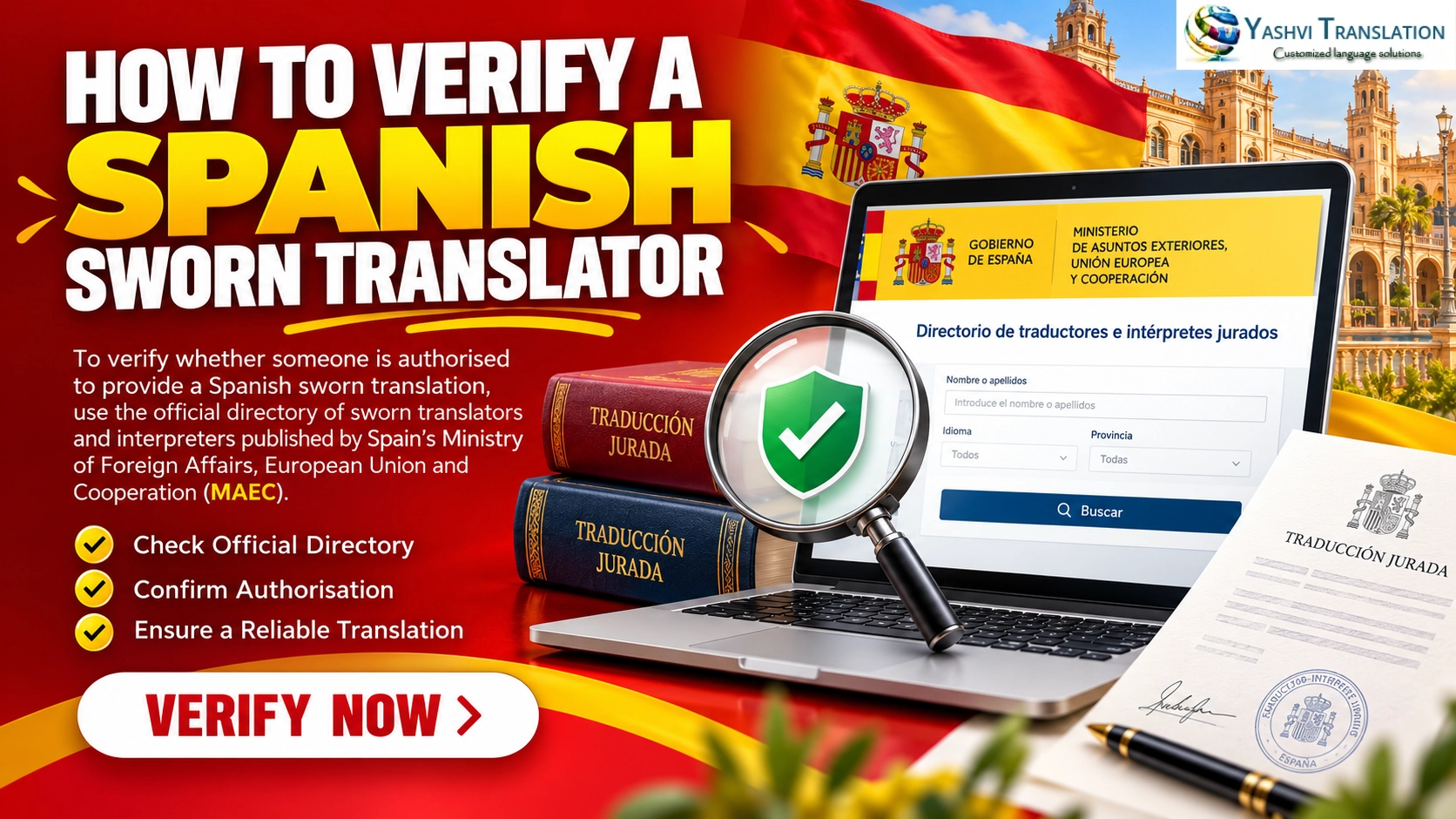
How to Verify a MAEC-Appointed Translator Using Spain’s Official Directory
A practical guide to checking translator authorisation, registration details and sworn certification before submitting documents in Spain.
Before ordering or submitting a Spanish sworn translation (traducción jurada), you can independently verify the translator through the official directory maintained by Spain’s Ministry of Foreign Affairs, European Union and Cooperation (MAEC).
The directory helps confirm the professional’s identity, authorised language and appointment category.
However, finding a translator on the official list does not automatically prove that a particular translation was issued by that person. You should also check the certification on the finished document.
This guide explains both checks and what to do if the information does not match.
1. Where to Find the Official MAEC Translator Directory
Spain’s Ministry of Foreign Affairs maintains a public register through its Office of Interpretation of Languages (Oficina de Interpretación de Lenguas).
Open the Official MAEC Sworn Translator Directory
The search allows you to filter by name, surname, country, province, language and professional title. It also includes an active-status option.
For example, if you need an English-to-Spanish sworn translation of an Indian PCC, you can search by English (Inglés) and the translator’s name.
You must enter at least one search filter to retrieve results.
2. How to Verify a MAEC-Appointed Translator
Step 1 — Obtain the Translator’s Details
Ask the translator or service provider for the name of the individual who will issue the official certification.
You should have:
- Full professional name.
- Authorised language.
- Official registration number.
- Professional title, where available.
If you are using a translation agency: Verify the individual responsible for the sworn certification, not just the agency’s business name.
Step 2 — Search the Government Directory
Open the MAEC directory and enter the translator’s name or surname.
If the result is missing, try fewer search fields or alternative spellings, especially for names containing accents or multiple surnames.
Use the language and professional-title filters to narrow the results where necessary.
Step 3 — Check the Professional Title and Language
The Ministry distinguishes between three titles:
- Traductor Jurado: Authorised for sworn written translation.
- Intérprete Jurado: Authorised for sworn oral interpretation.
- Traductor-Intérprete Jurado: Authorised for both.
For written translations, search under Traductor Jurado, Traductor-Intérprete Jurado or Todos (all).
Next, confirm the authorised language. For an English-to-Spanish translation, check the translator’s English-language authorisation.
Important: Authorisation for one language does not automatically extend to every language the professional speaks.
Step 4 — Compare the Official Record with Your Translation
Once you find the professional, compare the directory details with the certification on your actual document.
Check that:
- The translator’s name matches.
- The authorised language is appropriate.
- The official registration details are consistent.
- The translation carries the prescribed certification and signature.
The key distinction: The Ministry’s directory helps confirm professional authorization. The certification check connects that professional to the document you received.
If the identity or registration information does not match, request clarification from the named translator before submission.
3. How to Check the Official Stamp and Certification
Under Article 18 of Royal Decree 724/2020, a traditionally certified Spanish sworn translation must contain the prescribed certification, handwritten signature and official stamp.
The official stamp identifies the translator’s:
- Full name.
- Authorised language or languages.
- Official registration number.
The certification confirms the fidelity and accuracy of the translation.
A copy of the source document must also accompany the paper translation, stamped and dated on every page as required.
What this means for you: A matching name and stamp are useful checks, but a visible stamp alone cannot conclusively prove authenticity.
Where the translation’s origin is uncertain, seek confirmation directly from the named professional.
4. How to Verify a Digitally Signed Sworn Translation
Spain’s Order AUC/213/2025 permits MAEC-appointed translators to certify translations electronically using a qualified electronic certificate.
The electronic signature must cover the complete document containing both the source and its translation.
Verification Through VALIDe
- Keep the original electronically signed file.
- Visit Spain’s VALIDe signature-verification service.
- Follow the instructions to validate the signature.
- Review the result and certificate holder’s identity.
- Compare that identity with the translator’s official certification details.
Why this matters: Electronic verification can help confirm who signed the file and whether its signed contents have changed.
A scanned image of a physical stamp or signature does not provide the same electronic verification.
The signature check does not independently assess translation accuracy or guarantee acceptance by the receiving authority.
5. What If the Translator Is Not Found on the MAEC List?
An unsuccessful search does not automatically mean the translator is unauthorised.
Consider the reason:
No result for the name: Try different surname combinations or fewer filters.
Several similar names: Compare the authorised language, title and available identification details.
Wrong professional category: Confirm that the appointment covers written translation.
Different registration details: Ask the named translator for clarification.
No active-status indication: Do not treat this alone as proof that the appointment is invalid. The Ministry’s public listing includes information about active practice supplied by professionals.
Still unable to verify: Contact the translator or the Ministry’s relevant office before treating the authorisation as confirmed.
Special Note on Catalan, Basque and Galician
For certain co-official languages of Spain, separate competent regional authorities maintain professional registers.
Consult the appropriate regional authority rather than assuming every authorised professional must appear in the main MAEC directory.
6. Does MAEC Registration Guarantee Translation Acceptance?
No. Translator authorization is one requirement, but the receiving authority may also specify document validity, apostille, format or submission conditions.
For example, an Indian applicant submitting a PCC for a Spanish visa may need a properly authenticated source document in addition to a correctly certified sworn translation.
A translation may be officially certified while the underlying document still requires correction or additional authentication.
For a detailed explanation of these requirements, see our Spanish Sworn Translation Requirements for Spain.
Sample
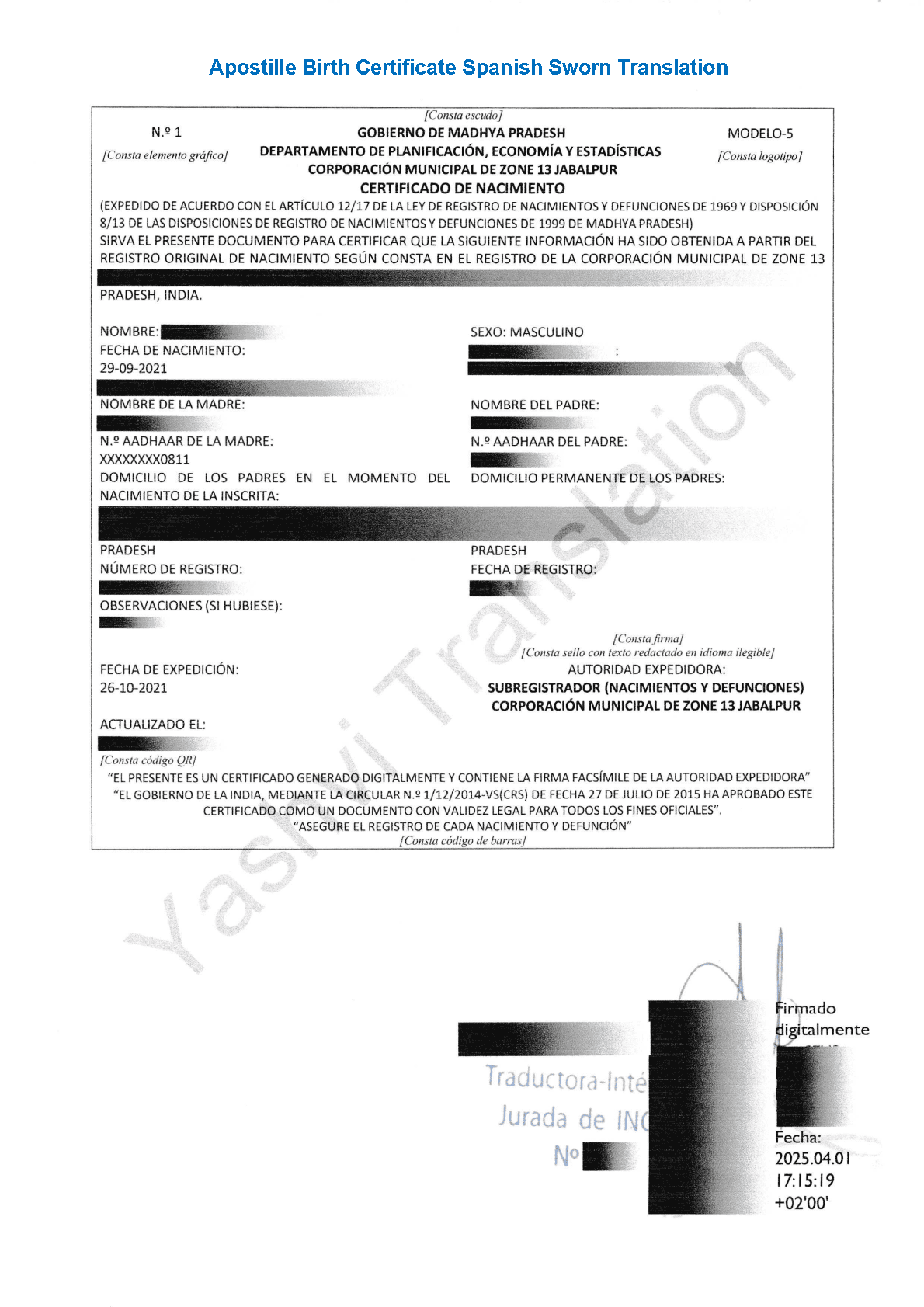
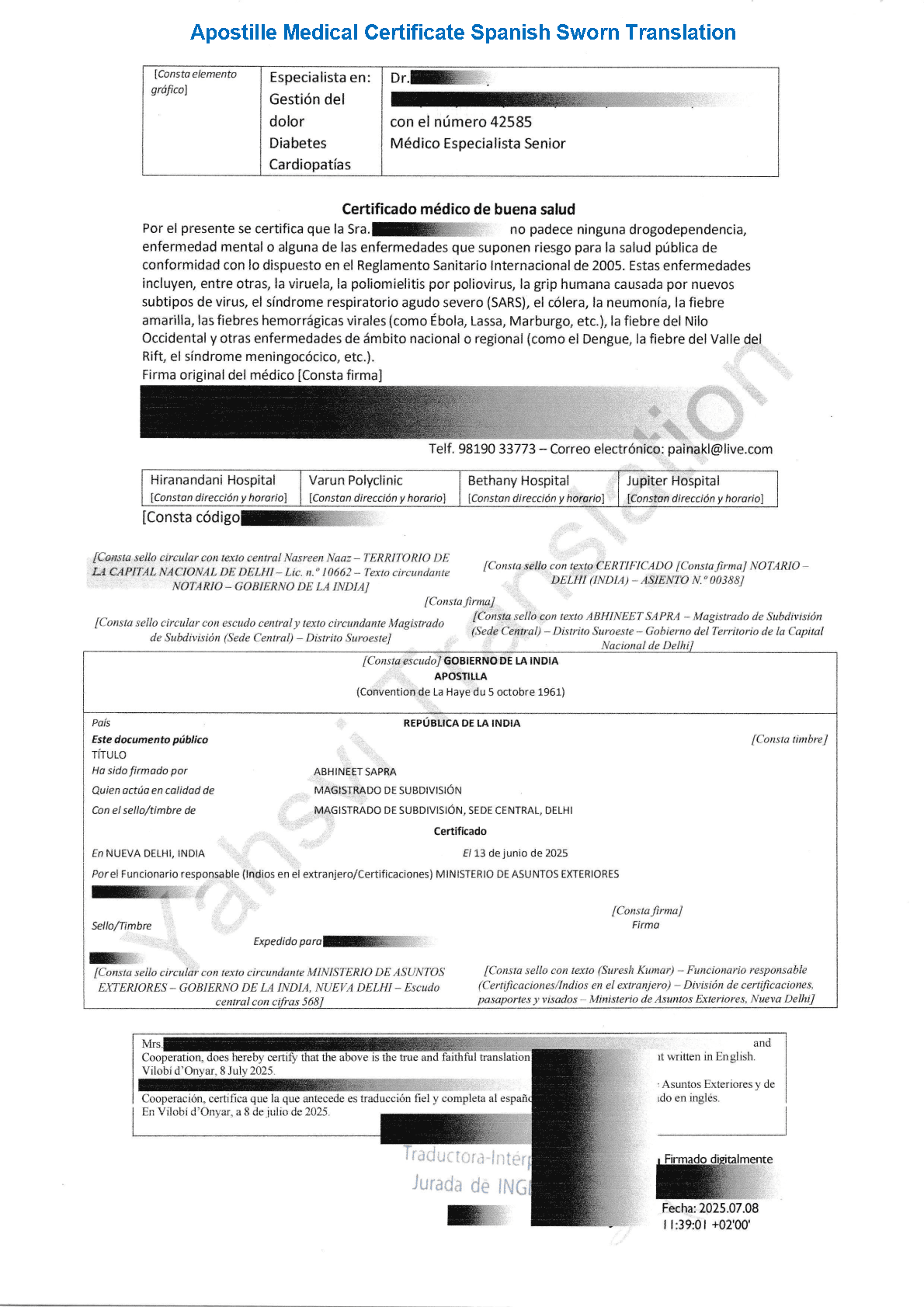
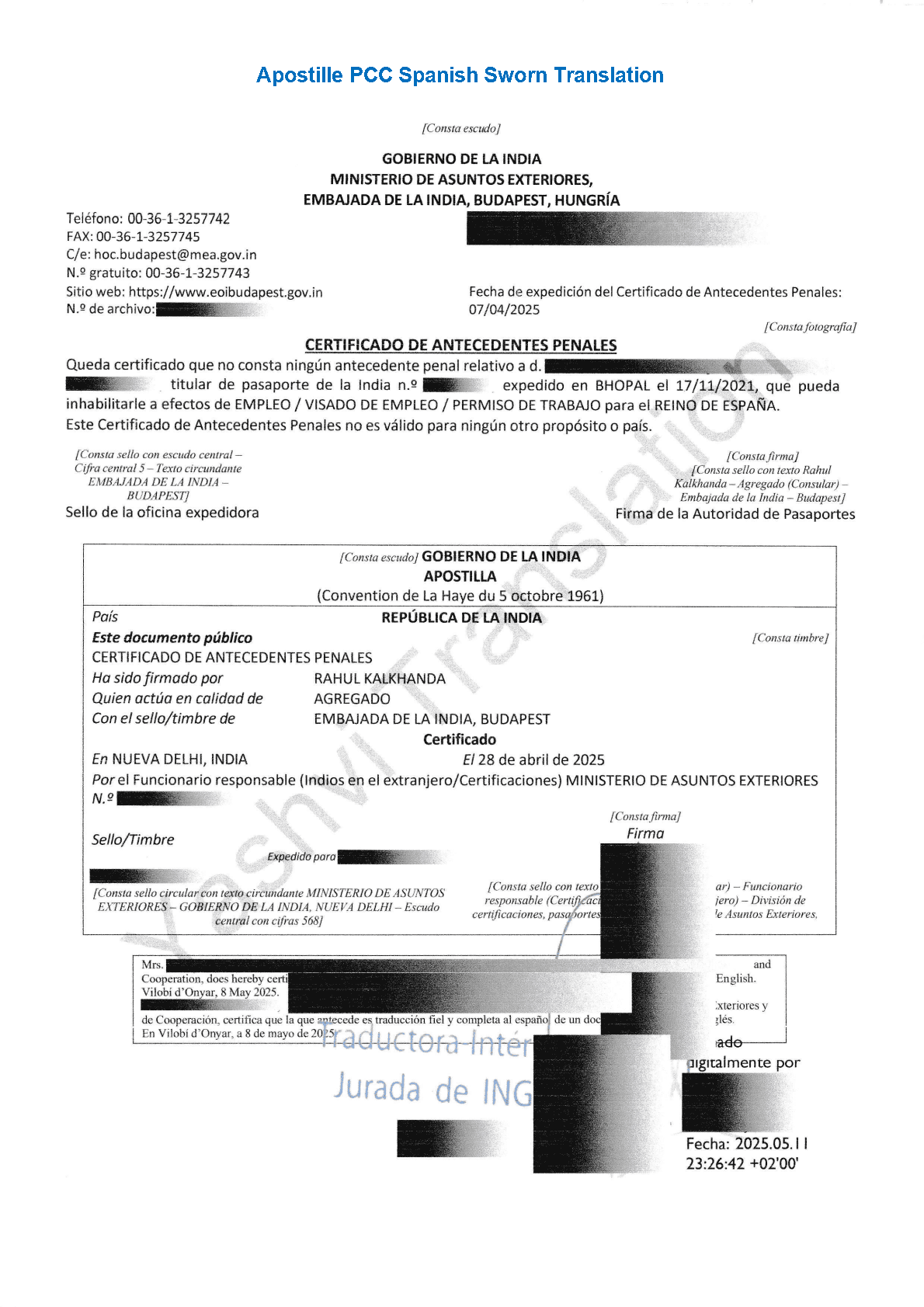


Need a Spanish Sworn Translation for Indian Documents?
Yashvi Translation coordinates Spanish sworn translations for Indian documents through appropriately authorised professionals.
We also assist with source-document checks, apostille coordination where required, and digital or physical delivery.
For an assessment, share your document scans, intended receiving authority and deadline.
Explore Spanish Sworn Translation Services in India
Yashvi coordinates translation services. The official sworn certification is issued by the authorised translator.
Official References
- MAEC — Official Sworn Translator Directory
- Royal Decree 724/2020 — Official Certification and Translator Requirements
- Order AUC/213/2025 — Electronic Certification
- Spanish Government — VALIDe
Contact us
Yashvi Translation
📞 Phone: 099111 95559, 07411866733
📱WhatsApp: 09911153839,
✉️ Email: info@translate-englishto.com | yashvi.tran@gmail.com | info@yashvitranslation.com
🌐 Website: www.translate-englishto.com
Office Hours: Monday–Saturday | 10:00 AM – 6:00 PM
Content Written by: Vikas Chaturvedi
Frequently Asked Questions
Yes. The Ministry’s official directory is publicly accessible online.
Yes. The Ministry’s directory includes geographical search options. Verify the professional’s authorisation rather than assuming their physical location determines whether the translation is official.
No. The professional title does not establish government employment.
Translations officially certified by MAEC-appointed professionals do not ordinarily require subsequent legalization by the Ministry’s Legalization Service. The underlying foreign document may still require an apostille or other authentication.
Not necessarily. A scan may show a handwritten signature, but that does not establish the presence of a qualified electronic signature.
For electronic verification, obtain the original electronically signed file.
Repeat the search with alternative name combinations, confirm the correct professional title and language, and ask the translator for their professional identification details.
Recent Clients Review