Email Id :-
 Mobile: -



Common Reasons WhatsApp Chat Translations Can Create Problems
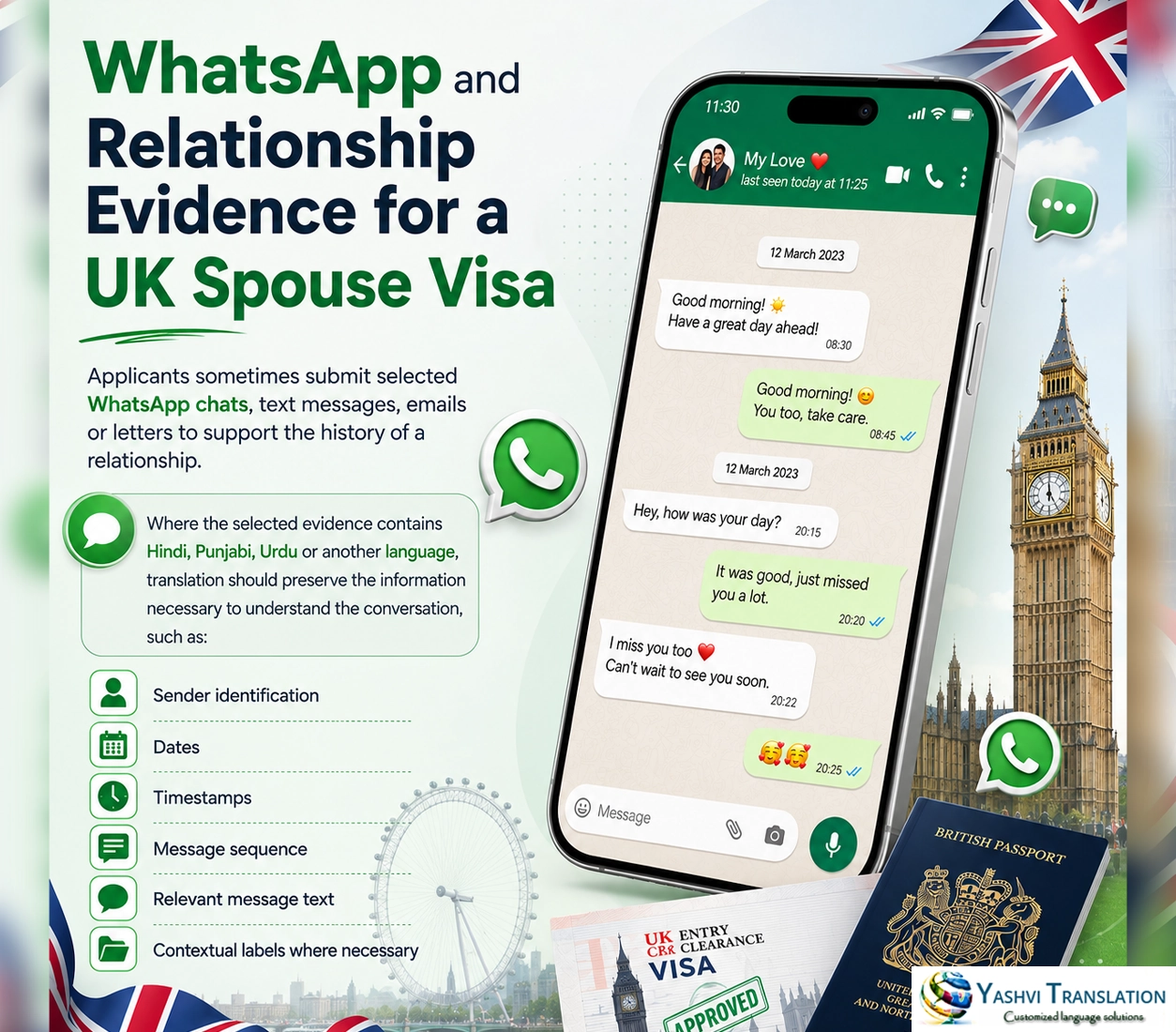
A WhatsApp translation can be linguistically accurate but still be difficult to use as immigration evidence if important context is lost. Common problems include over-cropped screenshots, isolated messages, untranslated mixed-language content, altered sender names and using the wrong translation or certification format.
A stronger approach is to preserve enough of the original conversation to show who is communicating, when messages were exchanged and how the translated text relates to the source. Translation requirements should also be checked against the immigration authority receiving the evidence.
Video Summary
This video explains five common problems that can reduce the clarity of translated WhatsApp evidence for a spouse or partner visa.
You will learn why it is important to:
- avoid excessive screenshot cropping;
- include enough conversational context;
- identify Hindi, Punjabi, Urdu, Hinglish and other mixed-language content;
- preserve sender names and source details;
- distinguish between certified translation, translator certification, affidavits and notarization; and
- identify the immigration authority before deciding how the translation should be prepared.
The goal is not to translate more material than necessary. It is to prepare the relevant chat evidence clearly, accurately and consistently with the source.
Suggested Video Chapters / Key Moments
Based on the transcript:
00:00 — Why Accurate Chat Translation Can Still Create Problems
00:20 — Mistake 1: Cropping Screenshots Too Tightly
00:35 — Mistake 2: Translating Messages Without Enough Context
00:57 — Mistake 3: Ignoring Mixed-Language Messages
01:11 — Mistake 4: Changing Names or Important Details
01:34 — Mistake 5: Assuming Every Country Has the Same Requirements
01:55 — Checklist Before Sending Chats for Translation
02:12 — Getting Your WhatsApp Chats Reviewed
These are particularly useful because they turn the video itself into several clearly defined subtopics rather than one undifferentiated 2:33 clip.
Why Random Messages Can Be Difficult to Use
A spouse-visa applicant may have thousands of WhatsApp messages.
The objective is generally not to submit or translate everything simply because it exists.
Instead, select conversations that genuinely support the evidence you intend to present and maintain enough surrounding context for those exchanges to make sense.
This is especially important where the messages form part of a broader relationship timeline, because disconnected screenshots may not clearly demonstrate how communication developed over time.
Frequently Asked Questions
Our team has been emailed the following questions on this subject:
1. Why can an accurate WhatsApp translation still create problems?
Accuracy involves more than translating individual words correctly. A translation can still become difficult to use if sender names, dates, message sequence or surrounding context are missing. The translated material should remain understandable in relation to the original WhatsApp evidence, allowing the reader to identify who said what and where the selected exchange fits into the conversation.
2. Can cropped WhatsApp screenshots cause problems with translation?
Yes. Excessive cropping can remove information needed to understand or verify the conversation, such as the sender name, date, timestamp or surrounding messages. Keep enough of the WhatsApp screen visible to preserve relevant context. The objective is not to show unnecessary private information, but to ensure that the selected evidence remains understandable and traceable to its source.
3. How much context should be included around a WhatsApp message?
Include enough surrounding conversation to make the selected message understandable. A single isolated sentence can sometimes have a different meaning when separated from the messages before and after it. This does not mean years of conversation must be translated. Select relevant sections while preserving enough context to understand the exchange and its place within the relationship evidence.
4. Do mixed Hindi-English or Hinglish chats need translation?
Relevant non-English portions of a mixed-language conversation may require translation depending on the receiving authority. A message can contain several English words while still communicating important meaning in Hindi, Punjabi, Urdu, Gujarati or Hinglish. Mixed-language chats should therefore be reviewed as complete messages rather than being treated as English simply because some English vocabulary appears.
5. Should a translator change a WhatsApp nickname to the passport name?
A translator should not silently replace a visible WhatsApp name simply because it differs from the person's passport name. The chat may contain a nickname, shortened name, maiden name or contact label. The translation should accurately represent what appears in the source, with clarification added transparently where needed rather than changing the underlying evidence.
6. What details should remain visible in translated WhatsApp chats?
Where they form part of the selected evidence, preserve details such as sender names, dates, timestamps, message order and relevant media indicators. These elements help connect the translation with the original conversation. Removing them unnecessarily can make the translated material harder to follow or compare with the source screenshots.
7. What if some WhatsApp messages are unreadable?
Unreadable text should not be guessed. If part of a screenshot is blurred, cropped or unclear, provide a clearer source image where possible. Where the content genuinely cannot be read, it should be handled transparently rather than reconstructed from assumptions. This preserves the distinction between information actually visible in the source and content that cannot reliably be determined.
8. Do I need to translate every message in my WhatsApp history?
Not necessarily. The appropriate scope depends on the conversations being submitted and the immigration authority's requirements. Select the relevant evidence rather than automatically translating an entire chat history. However, avoid selecting isolated foreign-language sentences in a way that removes important context. The submitted conversation sections should remain coherent and understandable.
9. Is certified translation the same as notarized translation?
No. Certified translation, translator certification, affidavit and notarization are different concepts. Which one is required depends on the receiving authority and application procedure. Do not automatically order notarization simply because the translation is intended for immigration. Identify the destination country and immigration authority first, then determine the appropriate translation and certification format.
10. Do IRCC, USCIS and UKVI use the same translation requirements?
No. Immigration authorities do not necessarily use identical terminology, translator requirements or certification procedures. A format suitable for one authority should not automatically be assumed to satisfy another. Before translating WhatsApp evidence, identify the exact immigration authority and application type so the translation can be prepared according to the applicable requirements.
11. What Are the Most Common WhatsApp Chat Translation Problems?
Five recurring issues can make chat evidence harder to understand: 1. Over-cropped screenshots Important sender or date information disappears. 2. Messages without enough context A single sentence may be difficult to interpret. 3. Mixed-language content is overlooked English-looking chats may still contain important Hindi, Punjabi, Urdu or Hinglish content. 4. Sender names or source details are changed The translation no longer accurately reflects what appears in WhatsApp. 5. The wrong certification approach is used Translation requirements can vary between immigration authorities.
Need Your WhatsApp Chats Translated?
Yashvi Translation provides professional translation of WhatsApp chats and other multilingual relationship evidence for immigration use.
We can review the source material, identify potential preparation issues and advise on the appropriate translation scope and format before the project begins.
To request an assessment, send:
- Relevant chat screenshots
- Source language
- Destination country
- Immigration authority
- Application type
- Required deadline
Learn More
Learn when foreign-language WhatsApp evidence may require translation and what information should be preserved.
Learn how to organize selected conversations chronologically instead of submitting unrelated screenshots.
For deeper guidance on screenshot preparation, mixed-language conversations, certification and translation workflow.
For professional translation of multilingual chats used for spouse visa, immigration and legal purposes.
About the Author
Subodh Kumar Shukla, MBA, LLB
Legal and Translation Reviewer
The page has been reviewed from a legal-document and translation perspective. Immigration requirements may change, and applicants should always follow the current instructions issued by the authority handling their application.
Recommended Page Tags
Recent Clients Review